MCQ
When an arrow is released from a bow, potential energy changes into kinetic energy.
  • True
  • B
    False
  • C
    Ambiguous
  • D
    Data insufficient

Answer

Correct option: A.
True
When an arrow is drawn back by a bow, the work done by us in stretching the bowstring gets stored at potential energy in the bow.
This potential energy of bow is transformed into kinetic energy when the bowstring is released and this gives kinetic energy to the arrow.

Need a full question paper?

Generate a complete, print-ready paper with questions like this in minutes — across 16+ boards, with answer keys.
Start Generating Free

Similar questions

As the temperature is increased, the period of a pendulum:
A uniform disc of mass $M$ and radius $R$ is suspended in vertical plane from a point on its periphery. Its time period of oscillation is ........
A tuning fork and an air column whose temperature is $51^{\circ} C$ produce $4$ beats in one second, when sounded together. When the temperature of air column decreases the number of beats per second decreases. When the temperature remains $16^{\circ} C$ only one beat per second is produced. The frequency of the tuning fork is ........... $Hz$
A ball is projected upwards. As it rises, there is increase in its:
The work of $146\,kJ$ is performed in order to compress one kilo mole of a gas adiabatically and in this process the temperature of the gas increases by $7\,^oC$ . The gas is $(R = 8.3\, J\, mol^{-1}\, K^{-1})$
When the amount of work done is $333\, cal$ and change in internal energy is $167\, cal$, then the heat supplied is ....... $cal$
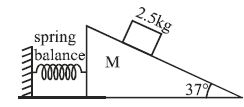
Find the reading of spring balance as shown in figure. Assume that mass $M$ is in equilibrium. All surfaces are smooth ....... $N$
If we do an experiment by swinging a small ball by a thread of length $100\ cm,$ what will be the approximate time for complete to and froperiodic motion?
A body is moving unidirectionally under the influence of a constant power source. Its displacement in time $t$ is proportional to :
Four bodies $P, Q, R$ and $S$ are projected with equal velocities having angles of projection $15^{\circ}, 30^{\circ}, 45^{\circ}$ and $60^{\circ}$ with the horizontals respectively. The body having shortest range is