Question
When an electron in hydrogen atom jumps from the third excited state to the ground state, how would the de Broglie wavelength associated with the electron change? Justify your answer.

Answer

$\lambda = \frac{\text{h}}{\text{P}} = \frac{\text{h}}{\sqrt{2\text{mK}}}$

$\frac{\lambda_{1}}{\lambda_{4}} = \sqrt{\frac{\text{K}_{4}}{\text{K}_{1}}}$

But $\text{K}_{n}( = - \text{E}_{n})\propto\frac{1}{\text{n}^{2}}$

Hence , $\frac{\lambda_{1}}{\lambda_{4}} = \sqrt{\frac{1}{16}}$

$\therefore \frac{\lambda_{1}}{\lambda_{4}} = \frac{1}{4}$

$\lambda_{4} = 4 \lambda_{1}$

i.e. $\lambda_{4} > \lambda_{1}$

Alternate Answer

$\lambda_{n} = \frac{\text{h}}{\text{P}_{n}} = \frac{\lambda}{\text{mv}_{n}}$

Velocity of electron in nth state $\upsilon_{n}\propto\frac{1}{n}$

$\lambda_{n}\propto\frac{1}{\upsilon_{n}}\therefore\lambda\propto\text{n}$

$\therefore \frac{\lambda_{4}}{\lambda_{1}} = \frac{\text{n}_{4}}{\text{n}_{1}} = \frac{4}{1}$

Need a full question paper?

Generate a complete, print-ready paper with questions like this in minutes — across 16+ boards, with answer keys.
Start Generating Free

Similar questions

A convex lens of refractive index 1.5 has a focal length of 18cm in air. Calculate the change in its focal length when it is immersed in water of refractive index $\frac{4}{3}$
Draw a diagram of magnetic field lines due to any current carrying circular loop.
A voltmeter consists of a $25\Omega$ coil connected in series with a $575\Omega$ resistor. The coil takes 10mA for full scale deflection. What maximum potential difference can be measured by this voltmeter?
The surface of water in a water tank on the top of a house is 4m above the tap level Find the pressure of water at the tap when the tap is closed Is it necessary to specify that the tap is closed? Take g = 10m/s2.
Under what condition, force on moving charged particle in a magnetic field will be (i) maximum (ii) minimum?
A point charge is placed at the centre of a closed Gaussian spherical surface of radius r. Electric flux passing through the surface is $\Phi$ How is the electric flux $\Phi$ through the surface affected when the following changes are made in turn:
  1. The spherical surface is replaced by a cylindrical surface of the same radius?
  2. The point charge is replaced by an electric dipole?
Justify your answer in each case.
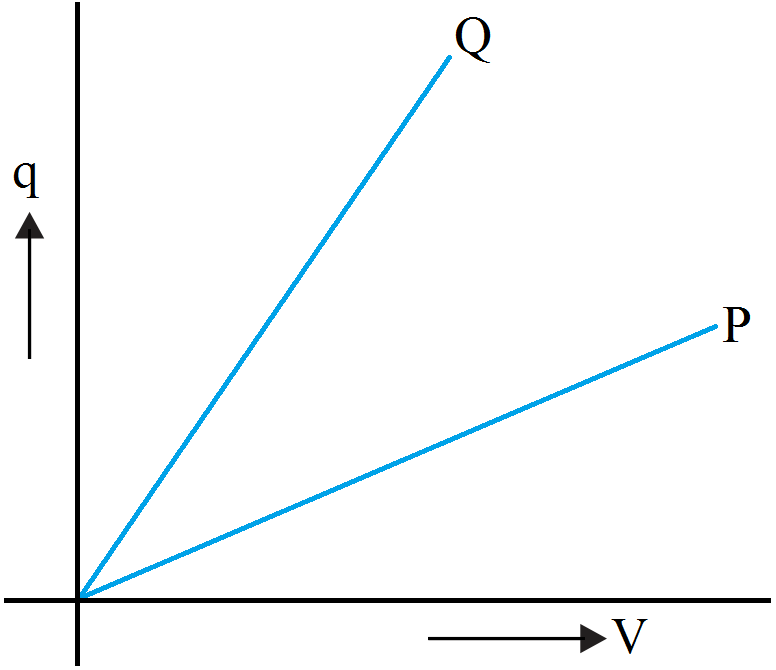
The given graph shows the variation of charge q versus potential difference V for two capacitors C1 and C2. The two capacitors have same plate separation but the plate area of C2 is double than that of C1. Which of the two graphs P and Q correspond to capacitors C1 and C2 and why?

The photoelectric cut-off voltage in a certain experiment is 1.5 V. What is the maximum kinetic energy of photoelectrons emitted?
When can the internal resistance of the cell can be neglected? Derive the formula for the current when cell is connected to the external resistance $R$.
A particle of mass 0.3kg is subjected to a force F = -kx with k = 15N/m. What will be its initial acceleration if it is released from a point x = 20cm?