MCQ
When an object is in equilibrium state, then
  • A
    It must be at rest
  • B
    No force is acting on it
  • Its net acceleration must be zero
  • D
    All of these

Answer

Correct option: C.
Its net acceleration must be zero
c
(c)

Equilibrium $\Rightarrow \vec{F}_{\text {net }}=0$

Using Newton's second law, $\vec{a}=0$

Need a full question paper?

Generate a complete, print-ready paper with questions like this in minutes — across 16+ boards, with answer keys.

Start Generating Free

Similar questions

A body will have uniform acceleration if its:
Amaterial has Poisson's ratio 0.5. If a uniform rod of it suffers a longitudinal strain of 2 × 10⁻³, then the percentage change in volume is:
A solid sphere, of radius $R$ acquires a terminal velocity $\nu_1 $ when falling (due to gravity) through a viscous fluid having a coefficient of viscosity $\eta $. The sphere is broken into $27$ identical solid spheres. If each of these spheres acquires a terminal velocity, $\nu_2$, when falling through the same fluid, the ratio $(\nu_1/\nu_2)$ equals
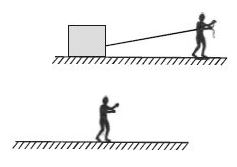
$Assertion$ : A man and a block rest on smooth horizontal surface. The man holds a rope which is connected to block. The man cannot move on the horizontal surface

$Reason$ : A man standing at rest on smooth horizontal surface cannot start walking due to absence of friction (The man is only in contact with floor as shown).
Which of the following pairs of physical quantities may be represented in the same unit?
  1. Heat and temperature.
  2. Temperature and mole.
  3. Heat and work.
  4. Specific heat and heat.
Water rises in a vertical capillary tube upto a height of $2.0\  cm$. If the tube is inclined at an angle of $60^o$ with the vertical, then upto what length the water will rise in the tube...... $cm$
A vessel at rest explodes into three pieces. Two pieces having equal masses fly off perpendicular to one another with the same velocity $30$ meter per second. The third piece has three times mass of each of other piece. The magnitude and direction of the velocity of the third piece will be
When a metal wire elongates by hanging a load on it, the gravitational potential energy is decreased.
  1. This energy completely appears as the increased kinetic energy of the block.
  2. This energy completely appears as the increased elastic potential energy of the wire.
  3. This energy completely appears as heat.
  4. None of these.
A body is rotating uniformly about a vertical axis fixed in an inertial frame. The resultant force on a particle of the body not on the axis is:
  1. Vertical.
  2. Horizontal and skew with the axis.
  3. Horizontal and intersecting the axis.
  4. None of these.
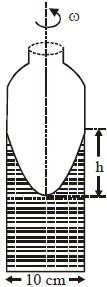
A cylindrical vessel containing a liquid is rotated about its axis so that the liquid rises at its sides as shown in the figure. The radius of vessel is $5\, cm$ and the angular speed of rotation is  $\omega\; rad \,s^{-1}$. The difference in the height, $h($ in $cm )$ of liquid at the centre of vessel and at the side will be