Question
When an object is in motion, its position changes with time. So, the quantity that describes how fast is the position changingm w.r.t. time and in what direction is given by average velocity. It is defined as the change in position or displacement $(\triangle\text{x})$ divided by the time interval $(\triangle\text{t})$ in which that displacement occur. However, the quantity used to describe the rate of motion over the actual path, is average speed. It defined as the total distance travelled by the object divided by the total time taken.

  1. A 250m long train is moving with a uniform velocity of 45kmh-1. The time taken by the train to cross a bridge of length 750m is:
  1. 56s
  2. 68s
  3. 80s
  4. 92s
  1. A truck requires 3hr to complete a journey of 150km. What is average speed?
  1. 50km/h
  2. 25km/h
  3. 15km/h
  4. 10km/h
  1. Average speed of a car between points A and B is 20m/s, between B andC is 15m/s and between C and D is 10m/s. What is the average speed between A and D, if the time taken in the mentioned sections is 20s, 10s and 5s, respectively?
  1. 17.14m/s
  2. 15m/s
  3. 10m/s
  4. 45m/s
  1. A cyclist is moving on a circular track of radius 40m completes half a revolution in 40s. Its average velocity is:
  1. $\text{Zero}$

  2. $2\text{ms}^{-1}$

  3. $4\pi\text{ms}^{-1}$

  4. $8\pi\text{ms}^{-1}$

  1. In the following graph, average velocity is geometrically represented by:
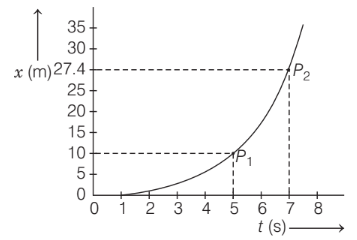
  1. Length of the line P1 P2.
  2. Slope of the straight line P1 P2.
  3. Slope of the tangent to the curve at P1.
  4. Slope of the tangent to the curve at P2.
Answer

  1. (c) 80s

Explanation:

Total time taken $=\frac{\text{Total distance}}{\text{Speed}}$

$\text{t}=\frac{250+750}{45\times\frac{5}{18}}=80\text{s}$

  1. (a) 50km/h

Explanation:

Average speed $=\frac{\text{Total distance}}{\text{Total time}}$

$=\frac{150}{3}=50\text{km}/\text{h}$

  1. (a) 17.14m/s

Explanation:

Total distance (d = tv)

= 20 × 20 + 15 × 10 + 10 × 5 = 600m

Total time = 20 + 10 + 5 = 35s

Therefore, average speed

 $=\frac{600}{35}=17.14\text{m}/\text{s}$

  1. (b) $2\text{ms}^{-1}$

Explanation:

Given, R = 40m and t = 40s

Average velocity $=\frac{\text{Total distance}}{\text{Time taken}}$

$=\frac{2\text{R}}{\text{t}}=\frac{2\times40}{40}=2\text{ms}^{-1}$

  1. (b) Slope of the straight line P1 P2.

Explanation:

From the position-time graph, average velocity is geometrically represented by the slope of curve, i.e. slope of straight line P1 P2.

Need a full question paper?

Generate a complete, print-ready paper with questions like this in minutes — across 16+ boards, with answer keys.

Start Generating Free

Similar questions

A container contains water upto a height of 20cm and there is a point source at the centre of the bottom of the container. A rubber ring of radius r floats centrally on the water. The ceiling of the room is 2.0m above the water surface.
  1. Find the radius of the shadow of the ring formed on the ceiling if r = 15cm.
  2. Find the maximum value of r for which the shadow of the ring is formed on the ceiling. Refractive index of water $\frac{4}{3}.$
The cylindrical tube of a spray pump has a cross-section of $8.0 cm^2$ one end of which has 40 fine holes each of diameter 1.0 mm . If the liquid flow inside the tube is $1.5 m min ^{-1}$, what is the speed of ejection of the liquid through the holes?
A player hits a baseball at some angle. The ball goes high up in space. The player runs and catches the ball before it hits the ground. Which of the two (the player or the ball) has greater displacement?
In tug of war, the team that exerts a larger tangential force on the ground wins. Consider the period in which a team is dragging the opposite team by applying a larger tangential force on the ground. List which of the following works are positive, which are negative and which are zero?
  1. Work by the winning team on the losing team.
  2. Work by the losing team on the winning team.
  3. Work by the ground on the winning team.
  4. Work by the ground on the losing team.
  5. Total external work on the two teams.
In a microwave oven, the food is kept in a plastic container and the microwave is directed towards the food. The food is cooked without melting or igniting the plastic container. Explain.
Read the passage given below and answer the following questions from 1 to 5. Beat The phenomenon of regular variation in intensity of sound with time at a particular position due to superposition of two sound waves of slightly different frequencies is called beats. For waves
$\therefore\text{y}=2\text{a}\cos\pi(\text{v}_1-\text{v}_2)\text{t}.\sin\pi(\text{v}_1-\text{v}_2)\text{t}$ is the required equation of beats. Beat frequency is given by $\text{v}_{\text{beat}}=\text{v}_1-\text{v}_2$ Beat period is given by
$\text{T}=\frac{1}{\text{Beat frequency}}=\frac{1}{\text{v}_1-\text{v}_2}$
  1. Which of the following phenomenon is used by the musicians to tune their musical instruments?
  1. Interference
  2. Diffraction
  3. Beats
  4. Polarisation
  1. The phenomenon of beats can take place
  1. For longitudinal waves only
  2. For transverse wave only
  3. For sound waves only
  4. For both longitudinal and transverse waves
  1. When two waves of almost equal frequencies v1 and v2 reach at a point simultaneously, the time interval between successive maxima is:
  1. $\text{v}_1+\text{v}_2$
  2. $\text{v}_1-\text{v}_2$
  3. $\frac{1}{\text{v}_1+\text{v}_2}$
  4. $\frac{1}{\text{v}_1-\text{v}_2}$
  1. Two turning forks of frequencies n1 and n2 produces n beats per second. If n2 and n are known, n1 may be given by:
  1. $\frac{\text{n}_2}{\text{n}}+\text{n}_2$
  2. $\text{n}_2\text{n}$
  3. $\text{n}_2\pm\text{n}$
  4. $\frac{\text{n}_2}{\text{n}}-\text{n}_2$
  1. P and Q are two wires whose fundamental frequencies are 256 Hz and 382 Hz respectively. How many beats in two seconds will be heard by the third harmonic of A and second harmonic of B?
  1. 4
  2. 8
  3. 16
  4. zero
A ladder is resting with one end on a vertical wall and the other end on a horizontal floor. Is it more likely to slip when a man stands near the bottom or near the top?
Mr. Verma (50kg) and Mr. Mathur (60kg) are sitting at the two extremes of a 4m long boat (40kg) standing still in water. To discuss a mechanics problem, they come to the middle of the boat. Neglecting friction with water, how far does the boat move on the water during the process?
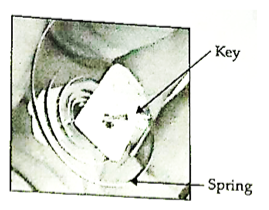
Clockwork refers to the inner workings of mechanical clock or watch (where it is known as "movement") and different types of toys which work using a series of gears driven by a spring. Clockwork device is completely mechanical and its essential parts are:
- A key (or crown) which you wind to add energy
- A spiral spring in which the energy is stored
- A set of gears through which the spring's energy is released. The gears control how quickly (or slowly) a clockwork machine can do things. Such as in mechanical clock/watch the mechanism is the set of hands that sweep around the dial to tell the time. In a clockwork car toy, the gears drive the wheels.
Winding the clockwork with the key means tightening a sturdy metal spring, called the mainspring. It is the process of storing potential energy. Clockwork springs are usually twists of thick steel, so tightening them (forcing the spring to occupy a much smaller space) is actually quite hard work. With each turn of the key, fingers do work and potential energy is stored in the spring. The amount of energy stored depends on the size and tension of the spring. Harder a spring is to turn and longer it is wound, the more energy it stores.
Image
While the spring uncoils, the potential energy is converted into kinetic energy through gears, cams, cranks and shafts which allow wheels to move faster or slower. In an ancient clock, gears transform the speed of a rotating shaft so that it drives the second hand at one speed, the minute hand at $\frac{1}{60}$ of that speed, and the hour hand at $\frac{1}{3600}$ of that speed. Clockwork toy cars often use gears to make themselves race along at surprising speed.

1. What is the meaning of movement of old age mechanical clocks?
(a) The pendulum of the clock
(b) The gears which move the hands of the clock
(c) A spring and combination of gears which move the hands of the clock
(d) The hands of the clock
2. What type of energy is stored in the spring while winding it?
(a) Potential  (b) Heat  (c) Both kinetic and potential  (d) Kinetic
3. When the spring of a clockwork uncoils
(a) Kinetic energy is converted into potential energy
(b) Potential energy is converted into kinetic
(c) Potential energy is converted into heat, light and sound energy
(d) Kinetic energy is converted into heat, light and sound energy
OR
In clockwork devices, ________ transform the speed of a rotating ________ to drive wheels slower or faster.
(a) Shaft, spring  (b) shaft, gear  (c) Gear, Shaft  (d) Spring, gear
4. More energy is stored in a spring if the
(a) Spring is larger, harder and wound fur a longer time
(b) Spring is smaller, harder and wound for a shorter time
(c) Spring is larger, harder and wound for a