Questions

4 Marks Question

🎯

Test yourself on this topic

8 questions · timed · auto-graded

Question 14 Marks
When an object is in motion, its position changes with time. So, the quantity that describes how fast is the position changingm w.r.t. time and in what direction is given by average velocity. It is defined as the change in position or displacement $(\triangle\text{x})$ divided by the time interval $(\triangle\text{t})$ in which that displacement occur. However, the quantity used to describe the rate of motion over the actual path, is average speed. It defined as the total distance travelled by the object divided by the total time taken.

  1. A 250m long train is moving with a uniform velocity of 45kmh-1. The time taken by the train to cross a bridge of length 750m is:
  1. 56s
  2. 68s
  3. 80s
  4. 92s
  1. A truck requires 3hr to complete a journey of 150km. What is average speed?
  1. 50km/h
  2. 25km/h
  3. 15km/h
  4. 10km/h
  1. Average speed of a car between points A and B is 20m/s, between B andC is 15m/s and between C and D is 10m/s. What is the average speed between A and D, if the time taken in the mentioned sections is 20s, 10s and 5s, respectively?
  1. 17.14m/s
  2. 15m/s
  3. 10m/s
  4. 45m/s
  1. A cyclist is moving on a circular track of radius 40m completes half a revolution in 40s. Its average velocity is:
  1. $\text{Zero}$

  2. $2\text{ms}^{-1}$

  3. $4\pi\text{ms}^{-1}$

  4. $8\pi\text{ms}^{-1}$

  1. In the following graph, average velocity is geometrically represented by:
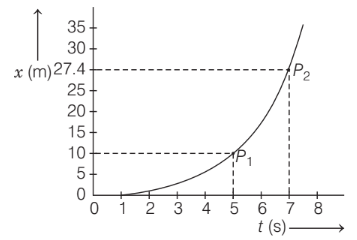
  1. Length of the line P1 P2.
  2. Slope of the straight line P1 P2.
  3. Slope of the tangent to the curve at P1.
  4. Slope of the tangent to the curve at P2.
Answer
  1. (c) 80s

Explanation:

Total time taken $=\frac{\text{Total distance}}{\text{Speed}}$

$\text{t}=\frac{250+750}{45\times\frac{5}{18}}=80\text{s}$

  1. (a) 50km/h

Explanation:

Average speed $=\frac{\text{Total distance}}{\text{Total time}}$

$=\frac{150}{3}=50\text{km}/\text{h}$

  1. (a) 17.14m/s

Explanation:

Total distance (d = tv)

= 20 × 20 + 15 × 10 + 10 × 5 = 600m

Total time = 20 + 10 + 5 = 35s

Therefore, average speed

 $=\frac{600}{35}=17.14\text{m}/\text{s}$

  1. (b) $2\text{ms}^{-1}$

Explanation:

Given, R = 40m and t = 40s

Average velocity $=\frac{\text{Total distance}}{\text{Time taken}}$

$=\frac{2\text{R}}{\text{t}}=\frac{2\times40}{40}=2\text{ms}^{-1}$

  1. (b) Slope of the straight line P1 P2.

Explanation:

From the position-time graph, average velocity is geometrically represented by the slope of curve, i.e. slope of straight line P1 P2.

View full question & answer
Question 24 Marks
Read the passage given below and answer the following questions from 1 to 5.
When an object moves along a straight line with uniform acceleration, it is possible to relate its velocity, acceleration during motion and the distance covered by it in a certain time interval by a set of equations known as the equations of motion. For convenience, a set of three such equations are given below:
v = u + at
$\text{s}=\text{ut}+\frac{1}{2}\text{at}^2$
 2a s = v2 – u2
Where u is the initial velocity of the object which moves with uniform acceleration a for Time t, v is the final velocity and s is the distance travelled by the object in time.
  1. equation of motions are applicable to motion with
  1. uniform acceleration
  2. non uniform acceleration
  3. constant velocity
  4. none of these
  1. There are 4 equation of motion. True or false?
  1. True
  2. False
  1. The brakes applied to a car produce an acceleration of 10 m/s2 in the opposite direction to the motion. If the car takes 1 s to stop after the application of brakes, calculate the distance traveled during this time by car.
  1. An object is dropped from a tower falls with a constant acceleration of 10 m/s2. Find its speed 10 s after it was dropped.
  1. A bullet hits a Sand box with a velocity of 10 m/s and penetrates it up to a distance of 5 cm. Find the deceleration of the bullet in the sand box
Answer
  1. (a) uniform acceleration
  2. (b) False
  3. Here in this problem,

v = 0

a = -10 m/s2 (as acceleration is retarding)

t = 1 sec.

To find: distance travelled

Solution: using kinematic equation

v = u + at

0=  u + -10 × 1

u = 10 m/s

Therefore distance is given by

$\text{S}=\text{ut}+\frac{1}{2}\text{at}^2$

$\text{S}=10\times1-\Big(\frac{1}{2}\Big)\times10\times1^2$

s = 5m

  1. Here in this problem,

u = 0

a = 10 m/s2(as acceleration is in the direction of gravity)

t = 10 sec.

To find: final velocity after 10 second

Solution: using kinematic equation

v = u + at

v = 0 + 10 × 10

v = 100 m/s

  1. Here in this problem,

v = 0(as bullet is going to stop)

u = 10 m/s

s = 5m.

To find: deceleration of the bullet

Solution: using kinematic equation

2a s = v2 – u2

2 × a × 5 = 0- 102

10a = -100

$\text{A}=\frac{100}{10}$

a = -10m/s2. Negative sign indicates that it is deceleration.

View full question & answer
Question 34 Marks
Read the passage given below and answer the following questions from i to v.
If an object moving along the straight line covers equal distances in equal intervals of time, it is said to be in uniform motion along a straight line. Distance and displacement are two quantities that seem to mean the same but are different with different meanings and definitions. Distance is the measure of actual path length travelled by object. It is scalar quantity having SI unit of metre while displacement refers to the shortest distance between initial and final position of object. It is vector quantity. The magnitude of the displacement for a course of motion may be zero but the corresponding path length is not zero. using this data answer following questions.
  1. Can path length be zero for motion of body from one point to other point?
  1. Yes
  2. No
  1. For any given motion from point A to B, displacement =10m and distance = 5m. Is it possible?
  1. Yes
  2. No
  1. For rectilinear motion displacement can be
  1. Positive only
  2. Negative only
  3. Can be zero
  4. All of the above
  1. Define distance and displacement of particle.
  1. Write difference between distance and displacement.
Answer
  1. (b) No
  2. (b) No
  3. (d) All of the above
  4. Distance and displacement are two quantities that seem to mean the same but are different with different meanings and definitions. Distance is the measure of “how much distance an object has covered during its motion” while displacement refers to the measure of “how far the abject actually from initial place.
  5. difference between distance and displacement is given by
No.
Distance
Displacement
1
The complete length of the path between any two points is called distance.
Displacement is the shortest length between any two points.
2
Distance is a scalar quantity
Displacement is a vector quantity
3
For any given motion distance is always greater than or equal to displacement
For any given motion displacement is always smaller than or equal to distance.
4
The distance can only have positive values.
Displacement can be positive, negative, and even zero.
 
View full question & answer
Question 44 Marks
Read the passage given below and answer the following questions from 1 to 5.
The average velocity tells us how fast an object has been moving over a given time interval but does not tell us how fast it moves at different instants of time during that interval. For this, we define instantaneous velocity or simply velocity v at an instant t. The velocity at an instant is defined as the limit of the average velocity as the time interval Dt becomes infinitesimally small. In other words.
$\text{V}=\lim_{\text{dt}-0}\frac{\text{dx}}{\text{dt}}$
$\text{v}=\frac{\text{dx}}{\text{dt}}$
The variation in velocity with time for an object moving in a straight line can be represented by a velocity-time graph. In this graph, time is represented along the x-axis and the velocity is represented along the y-axis. We know that the product of velocity and time give displacement of an object moving with uniform velocity. The area enclosed by velocity-time graph and the time axis will be equal to the magnitude of the displacement and slope of velocity time graph represents acceleration of object.
The variation in distance with time for an object moving in a straight line can be represented by a position-time graph. In this graph, time is represented along the x-axis and the displacement is represented along the y-axis. Answer the following questions based on paragraph given.
  1. The area under velocity time graph gives:
  1. Displacement over given time interval
  2. Acceleration
  3. Velocity
  4. None of these
  1. Slope of velocity time graph gives
  1. Acceleration
  2. Velocity
  3. Distance
  4. Displacement.
  1. Write note on velocity time graph.
  1. Write a note on position time graph
  1. What is instantaneous velocity ?
Answer
  1.  (a) Displacement over given time interval
  2. (a) Acceleration
  3. The change in velocity with time for an object moving in a straight line can be represented by a velocity-time graph. In this graph, time is represented along the x-axis and the velocity is represented along the y-axis. slope of velocity time graph represents acceleration of object The area enclosed by velocity-time graph and the time axis will be equal to the magnitude of the displacement and
  4. The change in distance with time for an object moving in a straight line can be given by a position-time graph. In this graph, time is represented along the x-axis and the displacement is represented along the y-axis.
  5. The velocity at an instant is defined as the limit of the average velocity as the time interval t becomes infinitesimally small. In other words

$\text{V}=\lim_{\text{dt}-0}\frac{\text{dx}}{\text{dt}}$

$\text{v}=\frac{\text{dx}}{\text{dt}}$ 

View full question & answer
Question 54 Marks
Read the passage given below and answer the following questions from 1 to 5.
When an object is in motion, its position changes with time. But how fast is the position changing with time and in what direction? To describe this, we define the quantity average velocity. Average velocity is defined as the change in position or displacement (x) divided by the time intervals (t), in which the displacement occurs:
$\text{V}=\frac{\text{x2}-\text{x1}}{\text{t2}-\text{t1}}=\frac{\triangle\text{x}}{\triangle\text{t}}$
Where x2 and x1 are the positions of the object at time t2and t1, respectively. The SI unit for velocity is m/s or m s–1, although km h–1 is used in many everyday applications. Like displacement, average velocity is also a vector quantity. Average speed is defined as the total path length travelled divided by the total time interval during which the motion has taken place:
Average speed = Total path length/ Total time interval.
Average speed has obviously the same unit (m s–1) as that of velocity. But it does not tell us in what direction an object is moving. Thus, it is always positive (in contrast to the average velocity which can be positive or negative). If the motion of an object is along a straight line and in the same direction, the magnitude of displacement is equal to the total path length.
The velocity at an instant is defined as the limit of the average velocity as the time interval Dt becomes infinitesimally small. In other words
$\text{V}=\lim_{\text{dt}-0}\frac{\text{dx}}{\text{dt}}$
$\text{V}=\frac{\text{dx}}{\text{dt}}$
Note that for uniform motion, velocity is the same as the average velocity at all instants. Instantaneous acceleration is defined in the same way as the instantaneous velocity
$\text{A}=\lim_{\text{dt}-0}\frac{\text{dv}}{\text{dt}}$
$\text{A}=\frac{\text{dv}}{\text{dt}}$
  1. For uniform motion instantaneous velocity is same as:
  1. Average velocity
  2. Average acceleration
  3. Instantaneous speed
  4. None of these
  1. If velocity is constant then
  1. Acceleration is zero
  2. Acceleration is positive
  3. Acceleration is negative
  4. None of these
  1. Define average speed
  1. Define instantaneous acceleration
  1. Define average velocity
Answer
  1. (a) Average velocity
  2. (a) Acceleration is zero
  3. Average speed is defined as the total path length travelled divided by the total time.

Average speed= Total path length/ Total time interval.

Average speed has SI unit of m/ s. it is scalar quantity it has only magnitude and doesn’t have any direction. it is always positive

  1.  Instantaneous acceleration is defined rate of change of velocity with time when time tends to zero

$\text{A}=\lim_{\text{dt}-0}\frac{\text{dv}}{\text{dt}}$

$\text{A}=\frac{\text{dv}}{\text{dt}}$

  1. Average velocity is defined as the change in position or displacement (Dx) divided by the time intervals (Dt), in which the displacement occurs:

$\text{V}=\frac{\text{x2}-\text{x1}}{\text{t2}-\text{t1}}=\frac{\triangle\text{x}}{\triangle\text{t}}$

Where x2 and x1 are the positions of the object at time t2 and t1 , respectively. The SI unit for velocity is m/ s or m s–1.


View full question & answer
Question 64 Marks
Read the passage given below and answer the following questions from (i) to (v).
Motion in a Straight Line If the position of an object is continuously changing w.r.t. its surrounding, then it is said to be in the state of motion. Thus, motion can be defined as a change in position of an object with time. It is common to everything in the universe. In the given figure, let P, Q and R represent the position of a car at different instants of time.

  1. With reference to the given figure, the position coordinates of points P and R are:
  1. P = (+ 360,0,0); R = (-120,0,0)
  2. P = (-360,0,0); R = (+120,0,0)
  3. P = (0, + 360,0); R = (-120,0,0)
  4. P = (0,0, + 360); R = (0,0 -120)
  1. Displacement of an object can be:
  1. Positive
  2. Negative
  3. Zero
  4. All of the above
  1. The displacement of a car in moving from O to P and its displacement in moving from P to Q are:
  1. + 360m and -120m
  2. -120m and + 360m
  3. + 360m and + 120m
  4. + 360m and - 600m
  1. If the car goes from O to P and returns back to O, the displacement of the journey is:
  1. zero
  2. 720m
  3. 420m
  4. 340m
  1. The path length of journey from O to P and back to O is:
  1. 0m
  2. 720m
  3. 360m
  4. 480m
Answer
  1. (a) P = (+ 360,0,0); R = (-120,0,0)

Explanation:

The position coordinates of point

P = (+ 360,0,0) and point R = (-120,0,0).

  1. (d) All of the above

Explanation:

Displacement is a vector quantity, it can be positive, negative and zero.

  1. (a) + 360m and -120m

Explanation:

Displacement, $\triangle\text{x}=\text{x}_2-\text{x}_1$

For journey of car in moving from O to P,

x2 = + 360m

x1 = 0

$\Rightarrow\triangle\text{x}=\text{x}_2-\text{x}_1=360-0=+360\text{m}$

For journey, of car in moving from P to Q

x2 = + 240m

x1 = +360m

$\Rightarrow\triangle\text{x}=\text{x}_2-\text{x}_1=240-360=-120\text{m}$

Here, -ve sign implies that the displacement is in -ve direction, i.e. towards left.

  1. (a) zero

Explanation:

Displacement, $\triangle\text{x}=\text{x}_2-\text{x}_1=0-0=0$

  1. (b) 720m

Explanation:

Path length of the journey = OP + PO = + 360m + (+360)m = 720m.

View full question & answer
Question 74 Marks
Read the passage given below and answer the following questions from 1 to 5.
Relative velocity is velocity of any object with respect to other object which may be stationary or moving. Consider two objects A and B moving uniformly with average velocities vA and vB in one dimension, say along x-axis. (Unless otherwise specified, the velocities mentioned in this chapter are measured with reference to the ground). If xA (0) and xB (0) are positions of objects A and B, respectively at time t = 0, their positions xA (t) and xB (t) at time t are given by
xA (t) = xA (0) + vA t
xB (t) = xB (0) + vB t
Then, the displacement from object A to object B is given by
xBA(t) = xB (t) – xA (t)
= [xB (0) – xA (0) ] + (vB – vA) t.
It tells us that as seen from object A, object B has a velocity vB – vA because the displacement from A to B changes steadily by the amount vB – vA in each unit of time. We say that the velocity of object B relative to object A is vB – vA
VBA = vB – vA
Similarly, velocity of object A relative to object B is:
VAB = vA – vB
This shows VBA= – VAB.
  1. Velocity of object A relative to object B is:
  1. VAB = vA – vB
  2. VBA = vB – vA
  3. None of these
  1. Velocity of object B relative to object A is:
  1. vB – vA
  2. vA – vB
  3. None of these
  1. What is relative velocity?
  1. What is relative displacement?
  1. Show that VBA = – VAB :
Answer
  1. (a) VAB = vA – vB
  2. (a) vB – vA
  3. Relative velocity is velocity of any object with respect to other object which may be stationary or moving.
  4. If xA (0) and xB (0) are positions of objects A and B, respectively at time t = 0, their positions xA (t) and xB (t) at time t are given by

xA (t) = xA (0) + vA t

xB (t) = xB (0) + vB t

Then, the displacement from object A to object B is given by

xBA(t) = xB (t) – xA (t).

  1. By definition of relative velocity We say that the velocity of object B relative to object A is vB – vA

VBA = vB – vA

Similarly, velocity of object A relative to object B is:

VAB = vA – vB

This shows VBA= – VAB.

View full question & answer
Question 84 Marks
Read the passage given below and answer the following questions from (i) to (v).
The velocity of an object, in general, changes during its course of motion. Initially, at the time of Galileo, it was thought that, this change m could be described by the rate of change of velocity with distance. But, through his studies of motion of freely falling objects and motion of objects on an inclined plane, Galileo concluded that, the rate of change of velocity with time is a constant of motion for all objects in free fall. This led to the concept of acceleration as the rate of change of velocity with time.
The motion in which the acceleration remains constant is known as to be uniformly accelerated motion. There are certain equations which are used to relate the displacement (x), time taken (t), initial velocity (u), final velocity (v) and acceleration (a) a for such a motion and are known as kinematics equations for uniformly accelerated motion.
  1. The displacement of a body in 8s starting from rest with an acceleration of 20 cms-2 is:
  1. 64m
  2. 640m
  3. 64cm
  4. 0.064m
  1. A particle starts with a velocity of 2ms-1 and moves in a straight line with a retardation of 0.1ms-2. The first time at which the particle is 15 m from the starting point is:
  1. 10s
  2. 20s
  3. 30s
  4. 40s
  1. If a body starts from rest and travels 120cm in 6th second, then what is its acceleration?
  1. 0.20 ms-2
  2. 0.027ms-2
  3. 0.218ms-2
  4. 003. ms-2
  1. An object starts from rest and moves with uniform acceleration a. The final velocity of the particle in terms of the distance x covered by it is given as:
  1. $\sqrt{2\text{ax}}$
  2. $2\text{ax}$
  3. $\sqrt{\frac{\text{ax}}{2}}$
  4. $\sqrt{\text{ax}}$
  1. A body travelling with uniform acceleration crosses two points A and B with velocities 20ms-1 and 30ms-1 , respectively. The speed of the body at mid-point of A and B is:
  1. $25\text{ms}^{-1}$
  2. $25.5\text{ms}^{-1}$
  3. $24\text{ms}^{-1}$
  4. $10\sqrt{6}\text{ms}^{-1}$
Answer
  1. (c) 64cm

Explanation:

Displacement, $\text{s}=\frac{1}{2}\times(0.2)\ (64)=64\text{cm}$

  1. (a) 10s

Explanation: 

From equation of motion, 

$\text{s}=\text{ut}-\frac{1}{2}\text{at}^2$

$15=2\text{t}-\frac{1}{2}\times(0.1)\text{t}^2$

$\Rightarrow\text{t}=10\text{s}$

  1. (c) 0.218ms-2

Explanation:

From equation of motion,

$\text{s}_{\text{n}}=\text{u}+\frac{\text{a}}{2}(2\text{n}-1 )$

$\Rightarrow1.2=0+\frac{\text{a}}{2}(2\times6-1)$

$\Rightarrow\text{a}=\frac{1.2\times2}{11}=0.218\text{ms}^{-2}$

  1. (a) $\sqrt{2\text{ax}}$

Explanation:

Given, v0 = 0

Using relation, $\text{v}^2=\text{v}_0^2+2\text{ax}$

$\text{v}^2=2\text{ax}$

$\therefore\text{v}=\sqrt{2\text{ax}}$

  1. (b) $25.5\text{ms}^{-1}$

Explanation:

Let the acceleration of the car = a and distance between A and B = d

Given, v = 30ms-1 and u = 20ms-1

2ad = (30)2 - (20)2

$\text{ad}=\frac{900-400}{2}=2.50$

When the car is at the mid-point of AB, then speed of car is v1.

$\text{v}_1^2-(20)^2=2\text{a}\big(\frac{\text{d}}{2}\big)$

$\text{v}_1^2=\text{ad}+400$

$=250+400=650$

Therefore, v1 = 25.5ms-1

View full question & answer
4 Marks Question - Physics STD 11 Science Questions - Vidyadip