Question
When an object is placed 20cm from a concave mirror, a real image magnified three times is formed. Find:
  1. The focal length of the mirror.
  2. Where must the object be placed to give a virtual image three times the height of the object?

Answer

Given:

u = -20cm, m = -3cm, for the real image

  1. We know that

$\text{m}=-\frac{\text{m}}{\text{u}}$ 

$\therefore \text{m}=-3=-\frac{\text{v}}{(-20)}$

$\Rightarrow\text{v}= -60\text{cm}$

We have

$\frac{1}{\text{v}}+\frac{1}{\text{u}}=\frac{1}{\text{f}}$ 

$\Rightarrow \frac{1}{(-60)}+\frac{1}{(-20)}=\frac{1}{\text{f}}$

$\frac{1}{\text{f}}=-\frac{1}{60}-\frac{1}{20}=\frac{-1-3}{60}=\frac{1}{15}$

$\text{f}=-15\text{cm}$

  1. For virtual image m = 3 , and f = 15cm

$\text{m}=-\frac{\text{v}}{\text{u}}$

$\therefore \text{m}=-3=-\frac{\text{v}}{(-20)}\Rightarrow \text{v}=-3\text{u}$

We have

$\frac{1}{\text{v}}+\frac{1}{\text{u}}=\frac{1}{\text{f}}$

$\Rightarrow \frac{1}{\text{(3u)}}+\frac{1}{\text{u}}=\frac{1}{(-15)}$

$\Rightarrow \frac{-1+3}{\text{3u}}=-\frac{1}{15}$

$\Rightarrow \text{u}=-\frac{2\times15}{3}=-10\text{cm}$

So object should be placed 10cm from the concave mirror.
Need a full question paper?

Generate a complete, print-ready paper with questions like this in minutes — across 16+ boards, with answer keys.

Start Generating Free

Similar questions

What is a spherical mirror? Distinguish between a concave mirror and a convex mirror.
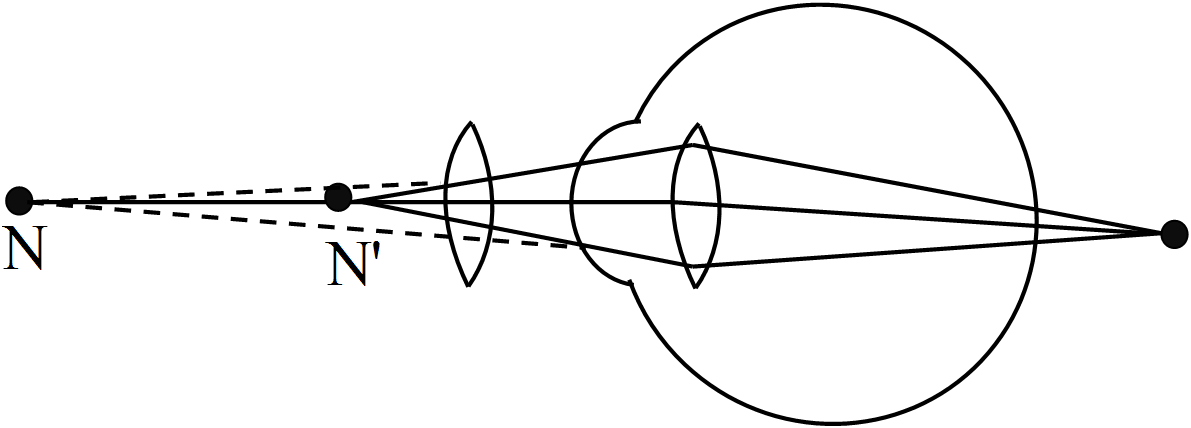
Study the diagram given below, and answer the questions that follow it.

  1. Identify the defect of vision. Give reason for your answer.
  2. State two possible causes of this defect.
  3. How can we rectify this defect? Explain with a diagram.
We wish to obtain an erect image of an object, using a concave mirror of focal length 15 cm. What should be the range of distance of the object from the mirror? What is the nature of the image? Is the image larger or smaller than the object? Draw a ray diagram to show the image formation in this case.
What would be the effect on the resistance of a metal wire of:
  1. Increasing its length?
  2. Increasing its diameter?
  3. Increasing its temperature?
A bright object 50mm high stands on the axis of a concave mirror of focal length 100mm and at a distance of 300mm from the concave mirror. How big will the image be?
In the nuclear reactor of a power plant:
  1. How do control rods control the rate of fission?
  2. How is heat removed from the reactor core, and what use is made of this heat?
An object 50cm tall is placed on the principal axis of a convex lens. Its 20cm tall image is formed on the screen placed at a distance of 10cm from the lens. Calculate the focal length of the lens.
At what distance should an object be placed from a convex lens of focal length 18cm to obtain an image at 24cm from it on the other side? What will be the magnification produced in this case?
An object 2cm tall stands on the principal axis of a converging lens of focal length 8cm. Find the position, nature and size of the image formed if the object is:
  1. 12cm from the lens.
  2. 6 cm from the lens.
A person needs a lens of power -4.5D for correction of her vision.
  1. What kind of defect in vision is she suffering from?
  2. What is the focal length of the corrective lens?
  3. What is the nature of the corrective lens?