Question
When electric current flows in a purely resistive circuit electrical energy gets fully converted into heat energy. The amount of heat produced (H) in the circuit is found to be directly proportional to (i) the square of current $\mathrm{I}^{2}$
(ii) the resistance $(R)$ of the conductor and (iii) the time $(t)$ for which current flows. In other words $H=I^{2} R t$.
Electrical devices such an electric fuse, electric heater, electric iron etc. are all based on this effect called heating effect of electric current.
a. List two properties of heating elements.
b. List two properties of electric fuse.
c. Name the principle on which an electric fuse works. Explain how a fuse wire is capable of saving electrical appliances from getting damaged due to accidently produced high currents.
OR
The power of an electric heater is 1100 W . If the potential difference between the two terminals of the heater is 220 V , find the current flowing in the circuit. What will happen to an electric fuse of rating 5 A connected in this circuit?
Answer

a. Higher resistivity than pure metals
Do not oxidise (burn) at high temperature.
b. Higher resistivity than pure metals
Low melting point.
c. Heating effect of electric current
When high current flows in the circuit accidently, the fuse wire melts and breaks the circuit.
OR
$\mathrm{P}=1100 \mathrm{~W} ; \mathrm{V}=220 \mathrm{~V}, \mathrm{I}=$ ?
$\mathrm{P}=\mathrm{VI}$
$\mathrm{I}=\frac{P}{V}=\frac{1100 \mathrm{~W}}{220 \mathrm{~V}}=5 \mathrm{~A}$
No effect on the fuse of 5A rating.

Need a full question paper?

Generate a complete, print-ready paper with questions like this in minutes — across 16+ boards, with answer keys.

Start Generating Free

Similar questions

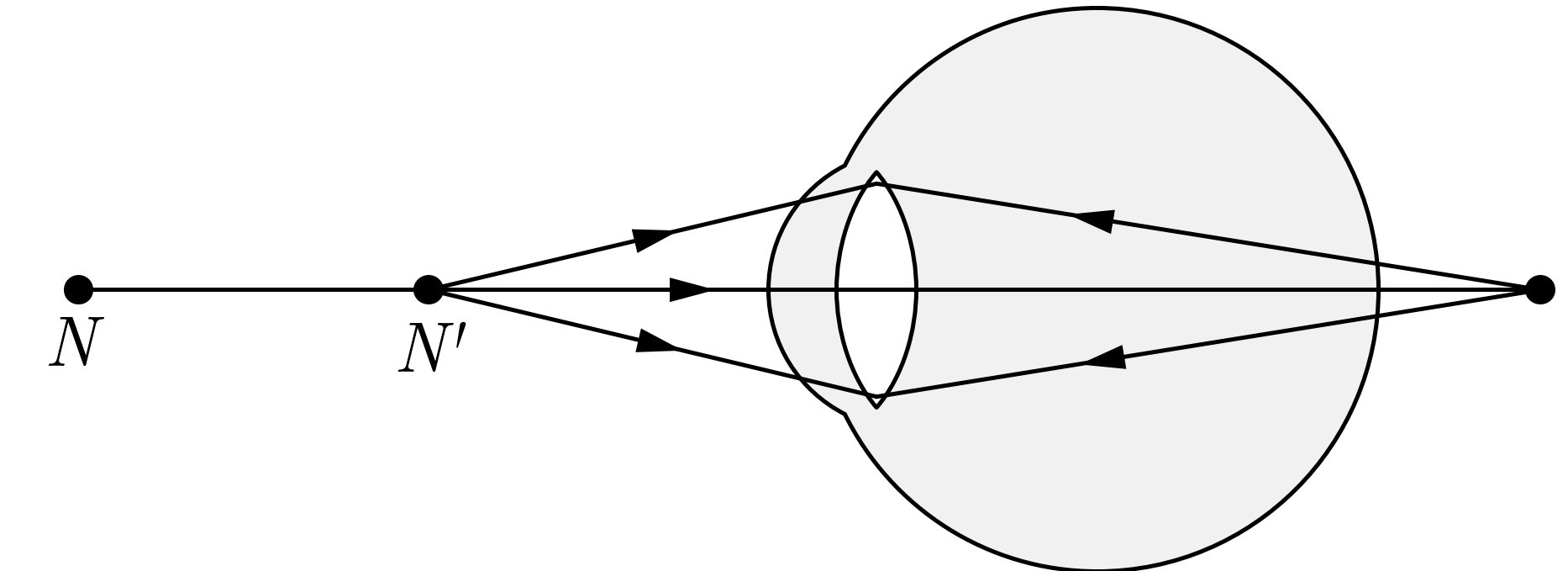
A near sighted person wears eye glass with power of $-5.0$ D for distant vision. Soon, he started having difficulties in viewing nearby objects also. His doctor prescribes a correction of $+1.5 D$ in near vision section of his bi-focal, which is measured relative to main part of the lens.

(i) Find the focal length of his distant viewing part of lens.
(ii) Find the focal length of near vision section of the lens.
(iii) What type of lens is to be used in this spectacles for near vision?
or
(iv) What is the reason of hypermetropia?
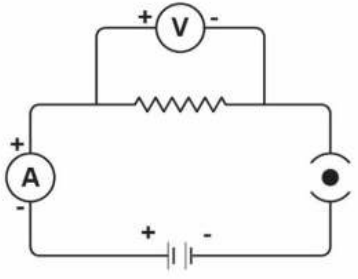
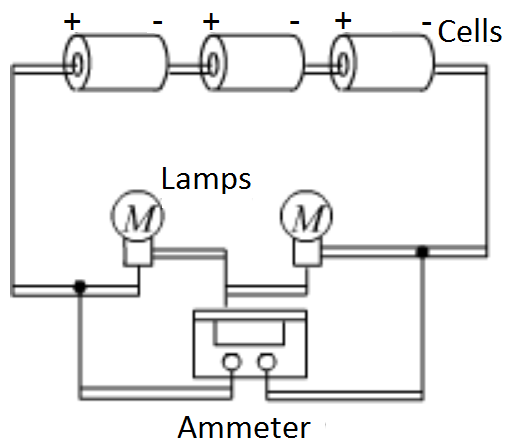
A student made an electric circuit shown here to measure the current through two lamps.
  1. Are the lamps in series or parallel?
  2. The student has made a mistake in this circuit. What is the mistake?
  3. Draw a circuit diagram to show the correct way to connect the circuit. Use the proper circuit symbols in your diagram.

A person is suffering from hypermetropia (long sightedness). It is a defect in which a human eye can see far off object clearly, but is unable to see nearby object distinctly. The near point of the person is $1.5 m$. Assume that the near point of the normal eye is $25 cm$.

(i) What type of lens should be used in his spectacles?
(ii) What should be the focal length of the lens he used?
(iii) What will be the potver of the lens?
or
(iv) Write one possible cause of this defect.
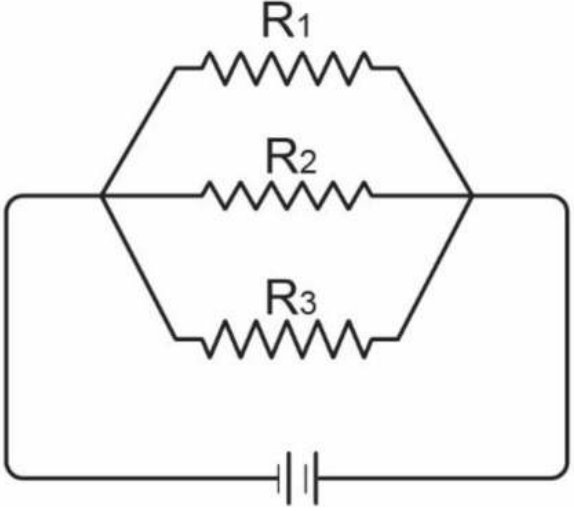
The same resistors are connected in a parallel combination in the circuit.
Image
10. What is the equivalent resistance of the circuit?
  A. Less than 1 Ω
  B. 1 Ω
  C. 2 Ω
  D. More than 2 Ω
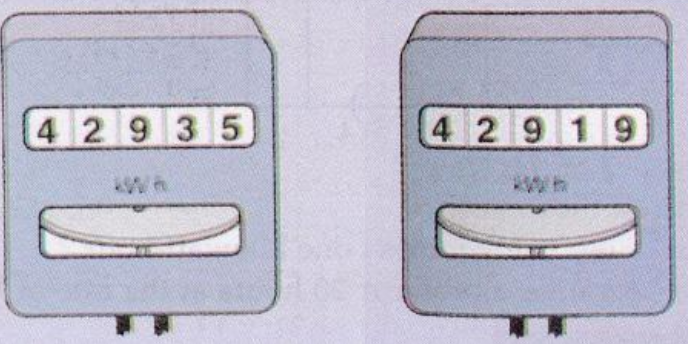
A boy noted the readings on his home’s electricity meter on Sunday at 8AM and again on Monday at 8AM (see figure below).

  1. What was the meter reading on Sunday?
  2. What was the meter reading on Monday?
  3. How many units of electricity have been used?
  4. In how much time these units have been used?
  5. If the rate is Rs. 5 per unit, what is the cost of electricity used during this time?
Mr. Rakesh was helping her daughter Aruna at home understanding about the basics of reflection of light. He found the simplest way to convey the role of curved mirrors using stainless steel teaspoon. Aruna got surprised to know that virtual image is that which can be seen but cannot be obtained on the screen. Mr. Rakesh then explained the formation of image using Ray diagrams.
(i) What do you mean by reflection of light?
(ii) The angle between incident ray and reflected ray is $60^{\circ}$. What is the value of angle of incidence?
(iii) A ray of light is incident on a plane mirror at an angle of $30^{\circ}$. what is the angle of reflection?
or
(iv) What happens to a light ray that is incident normally on a surface?
The lens of the eye does little of the bending of the light rays. Most of the refraction is done at the front surface of the cornea which also acts as a protective covering. The lens acts as a fine adjustment for focussing at different distances. This is accomplished by the ciliary muscle, which change the curvature of the lens so that its focal length is changed. To focus on a distant object, the muscles are relaxed and the lens is thin and parallel rays focus at the focal point (on the retina). To focus on a nearby object, the muscles contract, causing the centre of the lens to be thicker, thus shortening the focal length so that images of nearby objects can be focused on the retina, behind the focal point. This focusing adjustment is called accommodation.
The closest distance at which the eye can focus clearly is called the near point of the eye. A given person's far point is the farthest distance at which an object can be seen clearly. To check your own near point, place this book close to your eye and slowly move it away until the type is sharp.
A large part of the population have eyes that do not accommodate within the normal range of $25 cm$ to infinity, or have some other defect. Two common defects are near-sightedness and far-sightedness. Both can be corrected to a large extent with lenses-either eyeglasses or contact lenses.
(i) The ciliary muscle muscles of a normal eye are in their (i). most relaxed (ii). most contracted state. In which of the two cases is the focal length of the eye-lens more?
(ii) What is the least distinct of vision of young man?
(iii) What is persistence of vision?
or
(iv) What is meant by power of accommodation of the eye?