Question
In a plane electromagnetic wave, the electric field oscillates sinusoidally at a frequency of $2.0 \times 10^{10} Hz$ and amplitude $48 V m ^{-1}$.
(a) What is the wavelength of the wave?
(b) What is the amplitude of the oscillating magnetic field?
(c) Show that the average energy density of the E field equals the average energy density of the B field $\left[ c =3 \times 10^8 m s ^{-1}\right]$.
Answer

Given : $\quad v=2.0 \times 10^{10} Hz$
$E_0=48 V / m$
$\lambda=?$
$B _0=?$ and $c =3 \times 10^8 m / s$
(a) Wavelength, $\quad \lambda=\frac{c}{v}$
$=\frac{3 \times 10^8}{2 \times 10^{10}}=1.5 \times 10^{-2} m$
(b)$B_0=\frac{E_0}{c}$
On putting the values,
$B_0=\frac{48}{3 \times 10^8} T$
$B_0=16 \times 10^{-8} T=1.6 \times 10^{-7} T$
(c) Energy density in electric field $U_E=\frac{1}{2} \in_0 E^2$
Energy density in magnetic field $U_B=\frac{1}{2 \mu_0} B^2$
Energy density $\quad U _{ E }=\frac{1}{2} \in_0(c B)^2 \quad \because E =c B$
$U _{ E }=\frac{1}{2} \in_0 c^2 B^2=c^2\left(\frac{1}{2} \in_0 B^2\right)$
But $c=\frac{1}{\sqrt{\mu_0 \in_0}}$
$c^2=\frac{1}{\mu_0 \in_0}$
$\therefore \quad U _{ E }=\frac{1}{\mu_0 \in_0}\left(\frac{1}{2} \in_0 B^2\right)$
$=\frac{1}{2 \mu_0} B^2= U _{ B }$
$\therefore \quad U _{ E }= U _{ B }$
Hence the average energy density of the $\vec{E}$ field equals the averge energy density of the $\vec{B}$ field.

Need a full question paper?

Generate a complete, print-ready paper with questions like this in minutes — across 16+ boards, with answer keys.

Start Generating Free

Similar questions

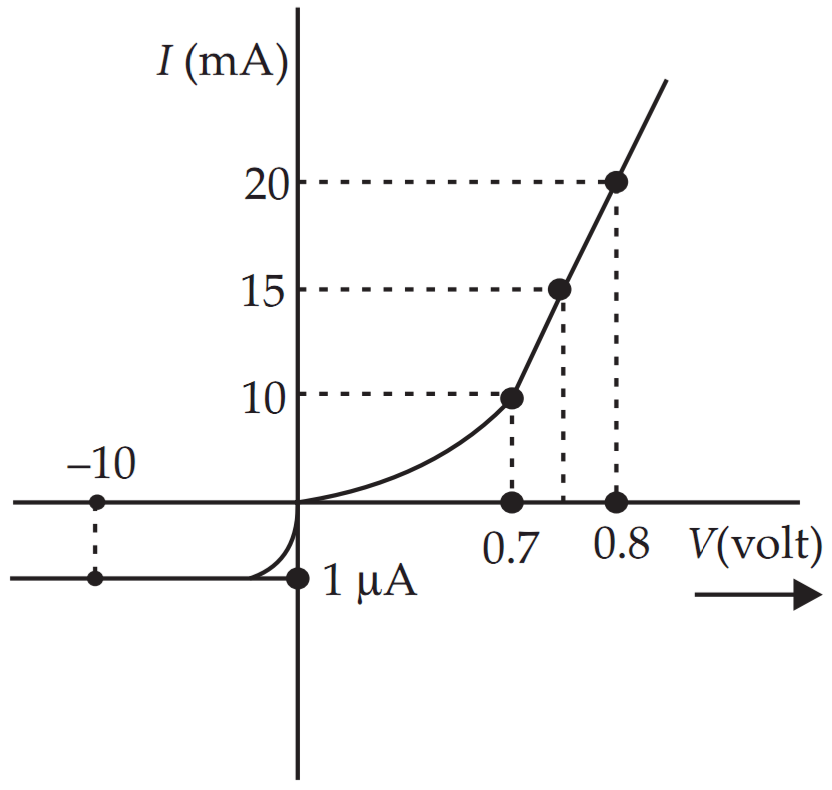
When the diode is forward biased, it is found that beyond forward voltage $V = V_k,$ called knee voltage, the conductivity is very high. At this value of battery biasing for $p-n$ junction, the potential barrier is overcome and the current increases rapidly with increase in forward voltage.
When the diode is reverse biased, the reverse bias voltage produces a very small current about a few microamperes which almost remains constant with bias. This small current is reverse saturation current.
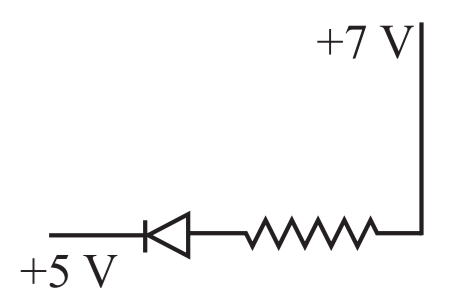
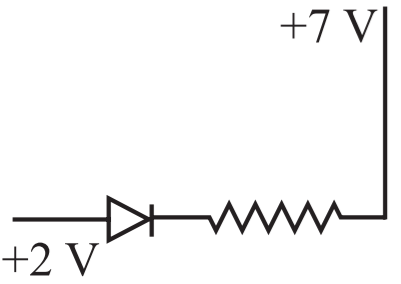
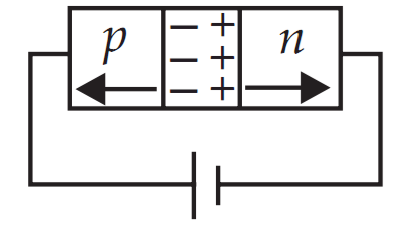
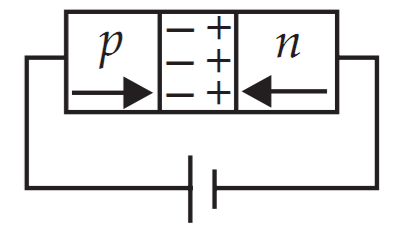
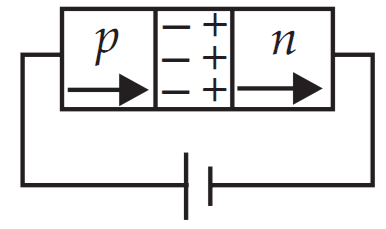
  1. In which of the following figures, the $p-n$ diode is forward biased.
  1.  
  1.  
  1.  
  1.  
  1. Based on the $V-I$ characteristics of the diode, we can classify diode as:
  1. $Bi-$ directional device.
  2. Ohmic device.
  3. Non $-$ ohmic device.
  4. Passive element.
  1. The $V-I$ characteristic of a diode is shown in the figure. The ratio of forward to reverse bi as resistance is:
  1. $100$
  2. $10^6$
  3. $10$
  4. $10^{-6}$
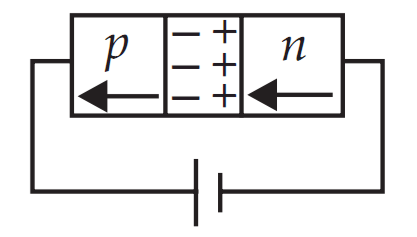
  1. In the case of forward biasing of a $p-n$ junction diode, which one of the following figures correctly depicts the direction of conventional current $($indicated by an arrow mark$)$?
  1.  
  1.  
  1.  
  1.  
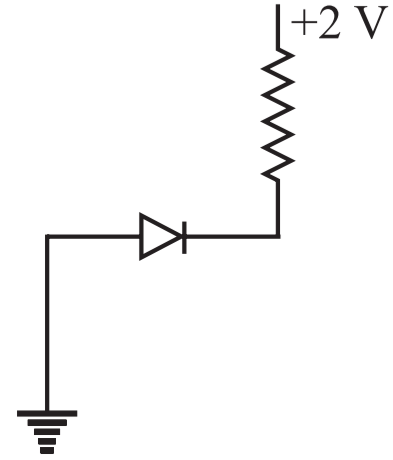
  1. If an ideal junction diode is connected as shown, then the value of the current I is:
  1. $0.013A$
  2. $0.02A$
  3. $0.01A$
  4. $0.1A$
  1. A mobile phone lies along the principal axis of a concave mirror. Show, with the help of a suitable diagram, the formation of its image. Explain why magnification is not uniform.
  2. Suppose the lower half of the concave mirror's reflecting surface is covered with an opaque material. What effect this will have on the image of the object? Explain.
A stationary charge produces only an electrostatic field while a charge in uniform motion produces a magnetic field, that does not change with time. An oscillating charge is an example of accelerating charge. It produces an oscillating magnetic field, which in turn produces an oscillating electric fields and so on. The oscillating electric and magnetic fields regenerate each other as a wave which propagates through space.

Magnetic field in a plane electromagnetic wave is given by $\vec{\text{B}}=\text{B}_0\sin(\text{kx}+\omega\text{t}) \hat{\text{j}}\text{T}.$
  1. Expression for corresponding electric field will be $($Where $c$ is speed of light$)$.
  1. $\vec{\text{E}}=-\text{B}_0\text{c}\sin(\text{kx}+\omega\text{t}) \hat{\text{k}}\frac{\text{V}}{\text{m}}$
  2. $\vec{\text{E}}=\text{B}_0\text{c}\sin(\text{kx}-\omega\text{t}) \hat{\text{k}}\frac{\text{V}}{\text{m}}$
  3. $\vec{\text{E}}=\frac{\text{B}_0}{\text{c}}\sin(\text{kx}+\omega\text{t}) \hat{\text{k}}\frac{\text{V}}{\text{m}}$
  4. $\vec{\text{E}}=\text{B}_0\text{c}\sin(\text{kx}+\omega\text{t}) \hat{\text{k}}\frac{\text{V}}{\text{m}}$
  1. The electric field component ofa monochromatic radiation is given by $\vec{\text{E}} = 2\epsilon_0\hat{\text{i}}\cos\text{kz}\cos\omega\text{t}.$ Its magnetic field $\vec{\text{B}}$ is then given by:
  1. $\frac{2\epsilon_0}{\text{c}}\hat{\text{j}}\cos\text{kz}\cos\omega\text{t}$
  2. $\frac{2\epsilon_0}{\text{c}}\hat{\text{j}}\sin\text{kz}\cos\omega\text{t}$
  3. $\frac{2\epsilon_0}{\text{c}}\hat{\text{j}}\sin\text{kz}\sin\omega\text{t}$
  4. $-\frac{2\epsilon_0}{\text{c}}\hat{\text{j}}\sin\text{kz}\sin\omega\text{t}$
  1. A plane em wave of frequency $25MHz$ travels in a free space along $x-$ direction. At a particular point in space and time, $\text{E}=(6.3\ \hat{\text{j}})\frac{\text{V}}{\text{m}}.$ What is magnetic field at that time?
  1. $0.095\mu\text{T}$
  2. $0.124\mu\text{T}$
  3. $0.089\mu\text{T}$
  4. $0.021\mu\text{T}$
  1. A plane electromagnetic wave travelling along the $x-$ direction has a wavelength of $3\ mm$. The variation in the electric field occurs in the $y-$ direction with an amplitude $66Vm^1$. The equations for the electric and magnetic fields as a function of $x$ and tare respectively.
  1. $\text{E}_\text{y}=33\cos\pi\times10^{11}\Big(\text{t}-\frac{\text{x}}{\text{c}}\Big),$
    $\text{B}_\text{z}=1.1\times10^{-7}\cos\pi\times10^{11}\Big(\text{t}-\frac{\text{x}}{\text{c}}\Big)$
  2. $\text{E}_\text{y}=11\cos2\pi\times10^{11}\Big(\text{t}-\frac{\text{x}}{\text{c}}\Big),$
    $\text{B}_\text{y}=11\times10^{-7}\cos2\pi\times10^{11}\Big(\text{t}-\frac{\text{x}}{\text{c}}\Big)$
  3. $\text{E}_\text{x}=33\cos\pi\times10^{11}\Big(\text{t}-\frac{\text{x}}{\text{c}}\Big),$
    $\text{B}_\text{x}=11\times10^{-7}\cos\pi\times10^{11}\Big(\text{t}-\frac{\text{x}}{\text{c}}\Big)$
  4. $\text{E}_\text{y}=66\cos2\pi\times10^{11}\Big(\text{t}-\frac{\text{x}}{\text{c}}\Big),$
    $\text{B}_\text{z}=2.2\times10^{-7}\cos2\pi\times10^{11}\Big(\text{t}-\frac{\text{x}}{\text{c}}\Big)$
  1. A plane electromagnetic wave travels in free space along $x-$ axis. At a particular point in space, the electric field along $y-$ axis is $9.3Vm^{-1.}$ The magnetic induction $(B)$ along $z-$ axis is:
  1. $3.1 \times 10^{-8}T$
  2. $3 \times 10^{-5}T$
  3. $3 \times 10^{-6}T$
  4. $9.3 \times 10^{-6}T$
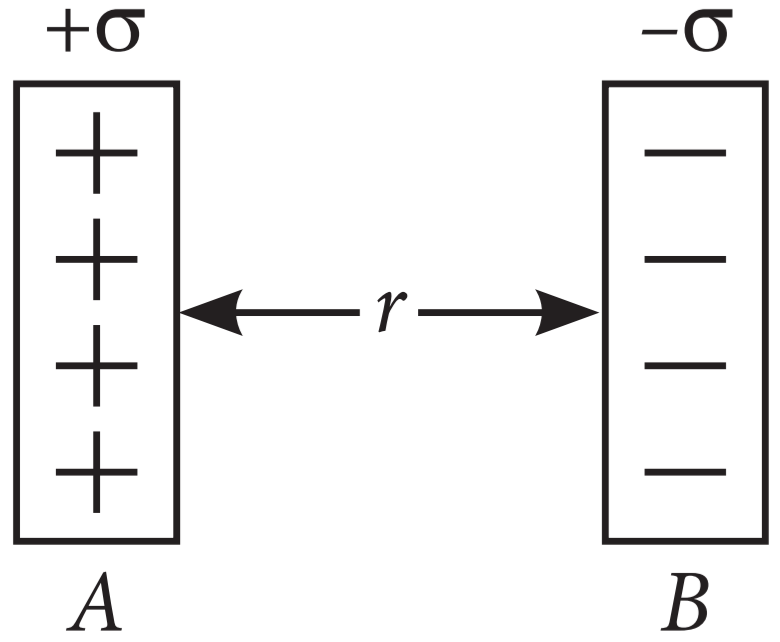
Surface charge density is defined as charge per unit surface area of surface charge distribution. i.e., $\sigma=\frac{\text{dq}}{\text{dS}}.$ Two large, thin metal plates are parallel and close to each other. On their inner faces, the plates have surface charge densities of opposite signs having magnitude of $17.0 \times 10^{-22}Cm^{-2 }$ as shown. The intensity of electric field at a point is $\text{E}=\frac{\sigma}{\epsilon_0},$ where $\epsilon_0=$ permittivity of free space.
  1. $E$ in the outer region of the first plate is:
  1. $17 \times 10^{-22} N/C$
  2. $1.5 \times 10^{-25} N/C$
  3. $1.9 \times 10^{-10} N/C$
  4. Zero.
  1. $E$ in the outer region of the second plate is:
  1. $17 \times 10^{-22} N/C$
  2. $1.5 \times 10^{-15} N/C$
  3. $1.9 \times 10^{-10} N/C$
  4. Zero.
  1. $E$ between the plates is:
  1. $17 \times 10^{-22} N/C$
  2. $1.5 \times 10^{-15} N/C$
  3. $1.9 \times 10^{-10} N/C$
  4. Zero.
  1. The ratio of $E$ from right side of $B$ at distances $2\ cm$ and $4\ cm,$ respectively is:
  1. $1 : 2$
  2. $2 : 1$
  3. $1 : 1$
  4. $1:\sqrt{2}$
  1. ln order to estimate the electric field due to a thin finite plane metal plate, the Gaussian surface considered is:
  1. Spherical.
  2. Spherical.
  3. Straight line.
  4. None of these.
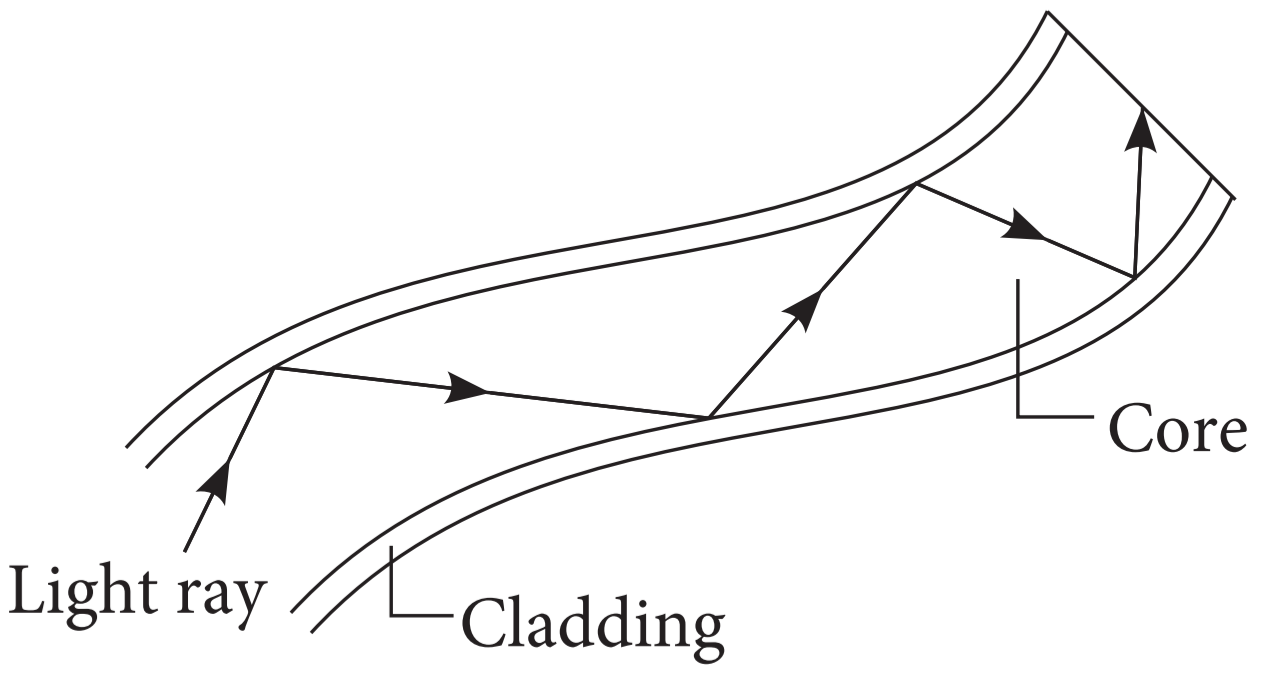
An optical fibre is a thin tube of transparent material that allows light to pass through, without being refracted into the air or another external medium. It make use of total internal reflection. These fibres are fabricated in such a way that light reflected at one side of the inner surface strikes the other at an angle larger than critical angle. Even, if fibre is bent, light can easily travel along the length.
  1. Which of the following is based on the phenomenon of total internal reflection of light?
  1. Sparkling of diamond.
  2. Optical fibre communication.
  3. Instrument used by doctors for endoscopy.
  4. All of these.
  1. A ray of light will undergo total internal reflection inside the optical fibre, if it.
  1. Goes from rarer medium to denser medium.
  2. Is incident at an angle less than the critical angle.
  3. Strikes the interface normally.
  4. Is incident at an angle greater than the critical angle.
  1. If in core, angle of incidence is equal to critical angle, then angle of refraction will be.
  1. $0^\circ$
  2. $45^\circ$
  3. $90^\circ$
  4. $180^\circ$
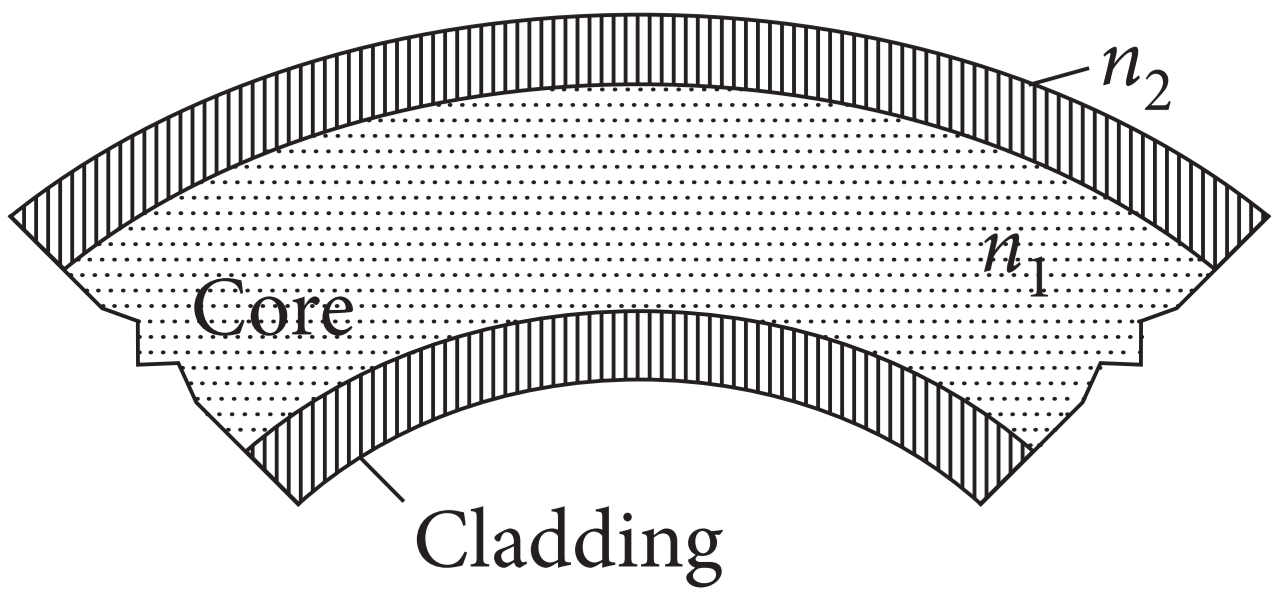
  1. In an optical fibre $($shown$),$ correct relation for refractive indices of core and cladding is:
  1. $n_1 = n_2$
  2. $n_1 > n_2$
  3. $n_1 < n_2$
  4. $n_1 + n_2 = 2$
  1. If the value of critical angle is $300$ for total internal reflection from given optical fibre, then speed of light in that fibre is:
  1. $3 \times 10^8ms^{-1}$
  2. $1.5 \times 10^8ms^{-1}$
  3. $6 \times 10^8ms^{-1}$
  4. $4.5 \times 10^8ms^{-1}$
Establish the formula : $\frac{n_{2}}{v}-\frac{n_{1}}{u}=\frac{n_{2}-n_{1}}{R}$ for refraction at single curved surface, where symbols have their usual meanings.
Coulomb's law states that the electrostatic force of attraction or repulsion acting between two stationary point charges is given by : $\text{F}=\frac{1}{4\pi\epsilon_0}\frac{\text{q}_1\text{q}_2}{\text{r}^2}$

Where $F$ denotes the force between two charges $q_1$ and $q_2$ separated by a distance $r$ in free space, $\epsilon_0$ is a constant known as permittivity of free space. Free space is vacuum and may be taken to be air practically. If free space is replaced by a medium, then $\epsilon_0$ is replaced by $(\epsilon_0\text{k})$ or $(\epsilon_0\epsilon_\text{r})$ where $k$ is known as dielectric constant or relative permittivity.
  1. In coulomb's law, $\text{F}=\text{k}\frac{\text{q}_1\text{q}_2}{\text{r}^2}$ then on which of the following factors does the proportionality constant $k$ depends?
  1. Electrostatic force acting between the two charges.
  2. Nature of the medium between the two charges.
  3. Magnitude of the two charges.
  4. Distance between the two charges.
  1. Dimensional formula for the permittivity constant $\epsilon_0$ of free space is:
  1. $[ML^{-3 }T^4 A^2]$
  2. $[M^{-1} L^3 T^2 A^2]$
  3. $[M^{-1} L^{-3} T^4 A^2]$
  4. $ML^{-3} T^4 A^{-2}]$
  1. The force of repulsion between two charges of $1C$ each, kept $1m$ apart in vaccum is:
  1. $\frac{1}{9\times10^9}\text{N}$
  2. $9 \times 10^9N$
  3. $9 \times 10^7N$
  4. $\frac{1}{9\times10^{12}}\text{N}$
  1. Two identical charges repel each other with a force equal to $10$ mgwt when they are $0.6m$ apart in air.$(g = 10m s^{-2})$. The value of each charge is:
  1. $2mC$
  2. $2 \times 10^{-7}mC$
  3. $2 nC$
  4. $2\mu\text{C}$
  1. Coulomb's law for the force between electric charges most closely resembles with:
  1. Law of conservation of energy.
  2. Newton's law of gravitation.
  3. Newton's $2^{nd}$ law of motion.
  4. Law of conservation of charge.
(a) A circular coil of 30 turns and radius 8.0 cm carrying a current of 6.0 A is suspended vertically in a uniform horizontal magnetic field of magnitude 1.0 T. The field lines make an angle of $60^{\circ}$ with the normal of the coil. Calculate the magnitude of the counter torque that must be applied to prevent the coil from turning.
(b) Would your answer change, if the circular coil in (a) were replaced by a planar coil of some irregular shape that encloses the same area? (All other particulars are also unaltered.)
Write difference between nuclear fission and radioactivity i.e. radioactive decay.
The US athlete Florence Griffith $-$ Joyner won the $100\ m$ sprint gold medal at Seol Olympic $1988$ setting a new Olympic record of $10.54s$. Assume that she achieved her maximum speed in a very short-time and then ran the race with that speed till she crossed the line. Take her mass to be $50\ kg.$
  1. Calculate the kinetic energy of Griffith $-$ Joyner at her full speed.
  2. Assuming that the track, the wind etc. offered an average resistance of one tenth of her weight, calculate the work done by the resistance during the run.
  3. What power GriffithJoyner had to exert to maintain uniform speed?