Question
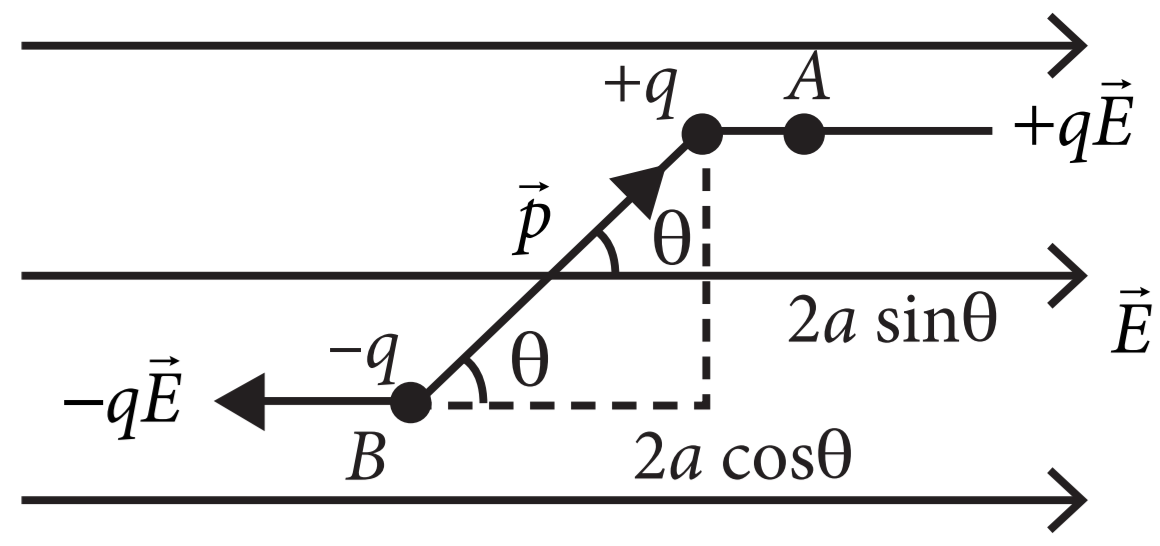
When electric dipole is placed in uniform electric field, its two charges experience equal and opposite forces, which cancel each other and hence net force on electric dipole in uniform electric field is zero. However, these forces are not collinear, so they give rise to some torque on the dipole. Since net force on electric dipole in uniform electric field is zero, so no work is done in moving the electric dipole in uniform electric field. However, some work is done in rotating the dipole against the torque acting on it.
  1. The dipole moment of a dipole in a uniform external field $\vec{\text{E}}$ is $\vec{\text{P}}.$ Then the torque 'i acting on the dipole is:
  1. $\vec{\tau}=\vec{\text{P}}\times\vec{\text{E}}$

  2. $\vec{\tau}=\vec{\text{P}}\cdot\vec{\text{E}}$

  3. $\vec{\tau}=2(\vec{\text{P}}+\vec{\text{E}})$

  4. $\vec{\tau}=(\vec{\text{P}}+\vec{\text{E}})$

  1. An electric dipole consists of two opposite charges, each of magnitude $1.0\mu\text{C}$ separated by a distance of 2.0cm. The dipole is placed in an external field of 105N C-1. The maximum torque on the dipole is:
  1. 0.2 × 10-3Nm
  2. 1 × 10⁻³Nm
  3. 2 × 10-3Nm
  4. 4 × 10⁻³Nm
  1. Torque on a dipole in uniform electric field is minimum when $\theta$ is equal to:
  1. 90º
  2. 180º
  3. Both (a) and (c)
  1. When an electric dipole is held at an angle in a uniform electric field, the net force F and torque t on the dipole are:
  1. $\text{F}=0, \tau=0$

  2. $\text{F}\not=0, \tau\not=0$

  3. $\text{F}=0, \tau\not=0$

  4. $\text{F}\not=0, \tau=0$

  1. An electric dipole of moment pis placed in an electric field of intensity E. The dipole acquires a position such that the axis of the dipole makes an angle $\theta$ with the direction of the field. Assuming that the potential energy of the dipole to be zero when $\theta=90^\circ$ the torque and the potential energy of the dipole will respectively be:
  1. $\text{pE}\sin\theta,-\text{pE}\cos\theta$

  2. $\text{pE}\sin\theta,-2\text{pE}\cos\theta$

  3. $\text{pE}\sin\theta,2\text{pE}\cos\theta$

  4. $\text{pE}\cos\theta,-2\text{pE}\sin\theta$
Answer

  1. (a) $\vec{\tau}=\vec{\text{P}}\times\vec{\text{E}}$

Explanation:

As $\tau=$ either force × perpendicular distance between the two forces.

$=\text{qaE}\sin\theta\text{ or }\tau=\text{PE}\sin\theta$

$(\because\text{qa}=\text{P})$

Or $\vec{\tau}=\vec{\text{P}}\times\vec{\text{E}}$

  1. (c) 2 × 10-3Nm

​​​​​​​​​​​​​​Explanation:

The maximum torque on the dipole in an external electric field is given by

$\tau=\text{pE}=\text{q}(\text{2a})\times\text{E}$

Here, $\text{q}=1\mu\text{C}=10^{-6}\text{C,}$

2a = 2cm = 2 × 10-2m,

E = 105N C-1,

$\tau=?$

$\therefore\tau=10^{-6}\times2\times10^{-2}\times10^5$

$=2\times10^{-3}\text{Nm}$

  1. (d) Both (a) and (c)

​​​​​​​​​​​​​​​​​​​​​​​​​​​​​​​​​​​Explanation:

When $\theta$ is 0 or 180º, the $\tau$ minimum, which means the dipole moment should be parallel to the direction of the uniform electric field.

  1. (c) $\text{F}=0, \tau\not=0$

​​​​​​​​​​​​​​​​​​​​​​​​​​​​​​​​​​​Explanation:

Net force is zero and torque acts on the dipole, trying to align p with E.

  1. (a) $\text{pE}\sin\theta,-\text{pE}\cos\theta$

​​​​​​​​​​​​​​​​​​​​​​​​​​​​​​​​​​​Explanation:

Torque, $\tau=\text{pE}\sin\theta$ and potential energy, $\text{U}=-\text{pE}\cos\theta.$​​​​​​​

Need a full question paper?

Generate a complete, print-ready paper with questions like this in minutes — across 16+ boards, with answer keys.

Start Generating Free

Similar questions

A silver ball of radius 4.8cm is suspended by a thread in a vacuum chamber. Ultraviolet light of wavelength 200 run is incident on the ball for some time during which a total light energy of 1.0 × 10⁻⁷J falls on the surface. Assuming that on the average one photon out of every ten thousand is able to eject a photoelectron, find the electric potential et the surface of the bell assuming zero potential at infinity. What is the potential at the centre of the bell?
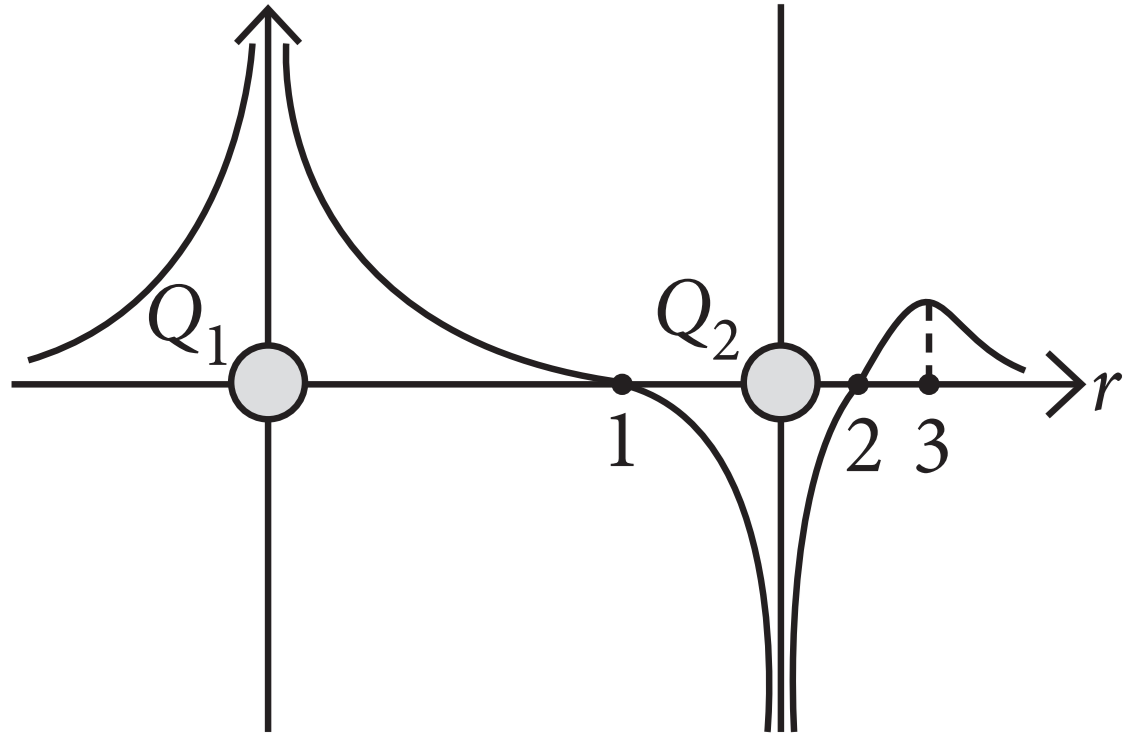
The potential at any observation point P of a static electric field is defined as the work done by the external agent (or negative of work done by electrostatic field) in slowly bringing a unit positive point charge from infinity to the observation point. Figure shows the potential variation along the line of charges. Two point charges Q1 and Q2 lie along a line at a distance from each other.

  1. At which of the points 1, 2, and 3 is the electric field is zero?
  1. 1
  2. 2
  3. 3
  4. Both (a) and (b)
  1. The signs of charges Q1 and Q2 respectively are:
  1. Positive and negative.
  2. Negative and positive.
  3. Positive and positive.
  4. Negative and negative.
  1. Which of the two charges Q1 and Q2 is greater in magnitude?
  1. Q2
  2. Q1
  3. Same.
  4. Can't determined.
  1. Which of the following statement is not true?
  1. Electrostatic force is a conservative force.
  2. Potential energy of charge q at a point is the work done per unit charge in bringing a charge from any point to infinity.
  3. When two like charges lie infinite distance apart, their potential energy is zero.
  4. Both (a) and (c).
  1. Positive and negative point charges of equal magnitude are kept at $\Big(0,0,\frac{\text{a}}{2}\Big)$ and $\Big(0,0,\frac{\text{-a}}{2}\Big)$ respectively.

The work done by the electric field when another positive point charge is moved from (-a, 0, 0) to (0, a, 0) is to:

  1. Positive.
  2. Negative.
  3. Zero.
  4. Depends on the path connecting the initial and final positions.
A player hits a baseball at some angle. The ball goes high up in space. The player runs and catches the ball before it hits the ground. Which of the two (the player or the ball) has greater displacement?
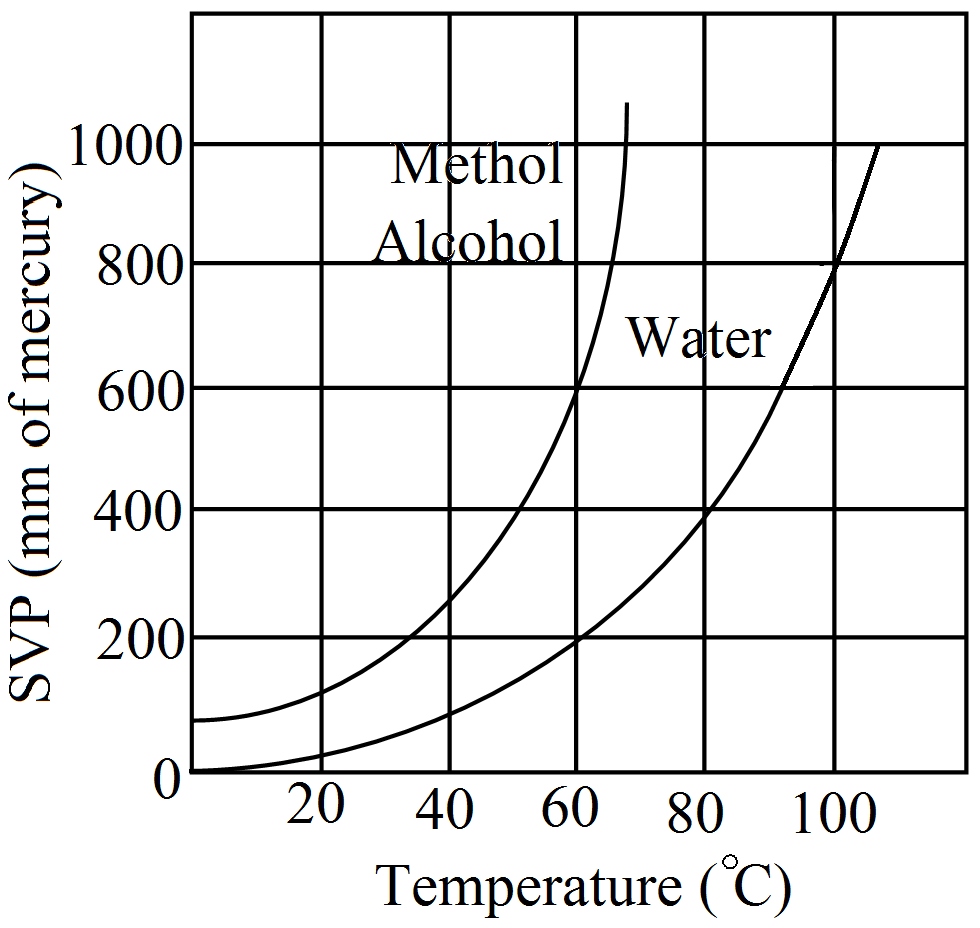
The human body has an average temperature of 98°F. Assume that the vapour pressure of the blood in the veins behaves like that of pure water. Find the minimum atmospheric pressure which is necessary to prevent the blood from boiling. Use figure. of the text for the vapour pressures.


For the $L - C - R$ series AC circuit derive the phase relationship between instantaneous current and voltage, using the phasor diagram.
A person's skin is more severely burnt when put in contact with 1g of steam at 100°C than when put in contact with 1g of water at 100°C. Explain.
In pair annihilation, an electron and a positron destroy each other to produce gamma radiation. How is the momentum conserved?
How long can an electric lamp of 100 W be kept glowing by fusion of 2.0 kg of deuterium? Take the fusion reaction as
\[{ }_1^2 H+{ }_1^2 H \longrightarrow{ }_2^3 He+n+3.27 MeV\]
A uniform magnetic field of 0.20 × 10-3 T exists in the space. Find the change in the magnetic scalar potential as one moves through 50cm along the field.