Question
A capacitor is a device to store energy. The process of charging up a capacitor involves the transferring of electric charges from its one place to another. This work done in charging the capacitor is stored as its electrical potential energy.
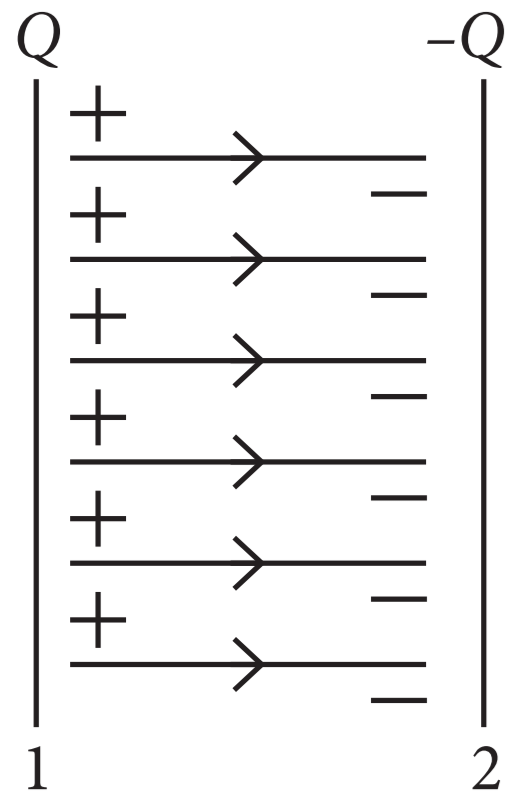
If q is the charge and V is the potential difference across a capacitor at any instant during its charging, then small work done in storing an additional small charge dq against the repulsion of charge q already stored on it is $\text{dW}=\text{V.dq}=(\frac{\text{q}}{\text{C}})\text{dq}.$
  1. A system of 2 capacitors of capacitance $2\mu\text{F}$ and $4\mu\text{F}$ is connected in series across a potential difference of 6 V. The energy stored in the system is:
  1. $3\mu\text{J}$
  2. $24\mu\text{J}$
  3. $30\mu\text{J}$
  4. $108\mu\text{J}$
  1. A capacitor of capacitance of $10\mu\text{F}$ is charged to 10V. The energy stored in it is:
  1. $100\mu\text{J}$
  2. $500\mu\text{J}$
  3. $1000\mu\text{J}$
  4. $1\mu\text{J}$
  1. A parallel plate air capacitor has capacity C farad, potential V volt and energy E joule. When the gap between the plates is completely filled with dielectric:
  1. Both V and E increase.
  2. Both V and E decrease.
  3. V decreases, E increases.
  4. V increases, E decreases.
  1. A capacitor with capacitance $5\mu\text{F}$ s charged to $5\mu\text{C}.$ If the plates are pulled apart to reduce the capacitance to $2\mu\text{F},$ how much work is done?
  1. $6.25 \times 10^{-6}J$
  2. $3.75 \times 10^{-6}J$
  3. $2.16 \times 10^{-6}J$
  4. $2.55 \times 10^{-6}J$
  1. A metallic sphere ofradius 18cm has been given a charge of $5 \times 10^{-6}C$. The energy of the charged conductor is:
  1. 0.2J
  2. 0.6J
  3. 1.2J
  4. 2.4J

Answer

  1. (b) $24\mu\text{J}$
Explanation:
As, $\text{C}_1=2\mu\text{F},\text{C}_2=4\mu\text{F}$
ln series combination, the equivalent capacitance will be,
$\text{C}=\frac{\text{C}_1\text{C}_2}{\text{C}_1+\text{C}_2}=\Big(\frac{2\times4}{2+4}\Big)\mu\text{F}$
$=\frac{4}{3}\mu\text{F}$
Potential difference applied, V = 6V
Energy stored in the system, $\text{U}=\frac{1}{2}\text{CV}^2$
$=\frac{1}{2}\times\frac{4}{3}\times10^{-6}\times(6)^2$
$\text{J}=24\mu\text{J}.$
  1. (b) $500\mu\text{J}$
​​​​​​​Explanation:
The energy stored in a capacitor is
$\text{U}=\frac{1}{2}\text{CV}^2$
$=\frac{1}{2}\times(10\times10^{-6})(10)^2=500\mu\text{J}.$
  1. (b) Both V and E decrease.
​​​​​​​​​​​​​​​​​​​​​Explanation:
When the gap between the plates is completely filled with dielectric of dielectric constant K, then potential is:
$\text{V}=\frac{\text{Qd}}{\text{A}\in_0\text{K}}$ (i)
and electric field is
$\text{E}=\frac{\text{Q}}{\text{A}\in_0\text{K}}$ (ii)
From equations (i) and (ii), both electric field and potential decrease.
  1. (b) $3.75 \times 10^{-6}J$
​​​​​​​​​​​​​​​​​​​​​​​​​​​​Explanation:
Work done $=\text{U}_\text{f}-\text{U}_\text{i}=\frac{1}{2}\frac{\text{q}^2}{\text{C}_\text{f}}-\frac{1}{2}\frac{\text{q}^2}{\text{C}_\text{i}}$
$=\frac{\text{q}^2}{2}\Big[\frac{1}{\text{C}_\text{f}}-\frac{1}{\text{C}_\text{i}}\Big]$
$=\frac{(5\times10^{-6})^2}{2}\Big[\frac{1}{2\times10^{-6}}-\frac{1}{5\times10^{-6}}\Big]$
$= 3.75 \times 10^{-6}J$​​​​​​​
  1. (b) 0.6J
​​​​​​​​​​​​​​​​​​​​​​​​​​​​​​​​​​​Explanation:
Here $r = 18cm = 18 \times 10^{-2}m, q = 5 \times 10^{-6}C$
As, $\text{C}=4\pi\in_0\text{r}=\frac{18\times10^{-2}}{9\times10^9}=2\times10^{-11}\text{F}$
Energy of charged conductor is
$\text{U}=\frac{\text{q}^2}{\text{2C}}=\frac{(5\times10^{-6})^2\text{C}}{2\times2\times10^{-11}\text{F}}=0.625\text{J}.$

Need a full question paper?

Generate a complete, print-ready paper with questions like this in minutes — across 16+ boards, with answer keys.

Start Generating Free

Similar questions

The electric field intensity at a point at a distance of 20 cm from the centre of a sphere is 10 Volt/meter. Find the intensity of the electric field at a point located at a distance 8 cm from the centre of that circle. The radius of the sphere is 5 cm.
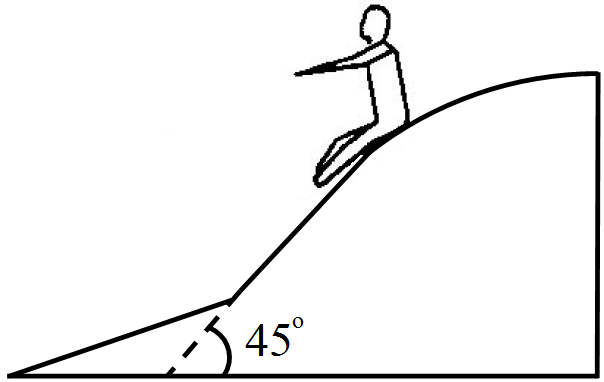
In a children-park an inclined plane is constructed with an angle of incline 45° in the middle part. Find the acceleration of a boy sliding on it if the friction coefficient between the cloth of the boy and the incline is 0.6 and $g = 10m/s^2.$
The radius of a thin hollow metal sphere (spherical shell) is 30 cm . And there is a charge of 500 $\mu C$ on that spherical shell. Find the electric field intensity at a distance.(i) 1 meter, (ii) 30 cm , (iii) 10 cm , from the centre of the cell.
Calculate the force with which you attract the earth.
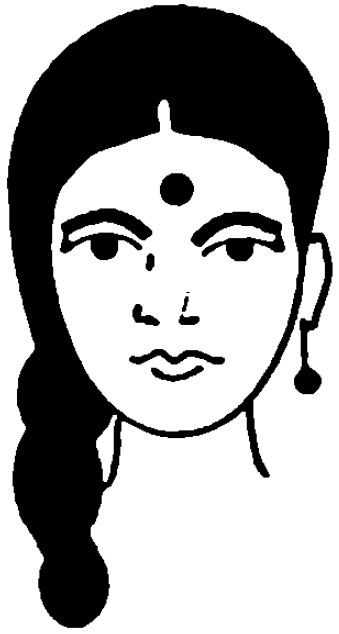
The ear-ring of a lady shown in has a 3cm long light suspension wire.
  1. Find the time period of small oscillations if the lady is standing on the ground.
  2. The lady now sits in a merry-go-round moving at 4m/s in a circle of radius 2m. Find the time period of small oscillations of the ear-ring.
Microwave oven: The spectrum of electromagnetic radiation contains a part known as microwaves. These waves have frequency and energy smaller than visible light and wavelength larger than it. What is the principle of a microwave oven and how does it work? Our objective is to cook food or warm it up. All food items such as fruit, vegetables, meat, cereals, etc., contain water as a constituent. Now, what does it mean when we say that a certain object has become warmer? When the temperature of a body rises, the energy of the random motion of atoms and molecules increases and the molecules travel or vibrate or rotate with higher energies. The frequency of rotation of water molecules is about 2.45 gigahertz (GHz). If water receives microwaves of this frequency, its molecules absorb this radiation, which is equivalent to heating up water. These molecules share this energy with neighbouring food molecules, heating up the food. One should use porcelain vessels and non-metal containers in a microwave oven because of the danger of getting a shock from accumulated electric charges. Metals may also melt from heating. The porcelain container remains unaffected and cool, because its large molecules vibrate and rotate with much smaller frequencies, and thus cannot absorb microwaves. Hence, they do not get eaten up. Thus, the basic principle of a microwave oven is to generate microwave radiation of appropriate frequency in the working space of the oven where we keep food. This way energy is not wasted in heating up the vessel. In the conventional heating method, the vessel on the burner gets heated first and then the food inside gets heated because of transfer of energy from the vessel. In the microwave oven, on the other hand, energy is directly delivered to water molecules which is shared by the entire food.

(i) As compared to visible light microwave has frequency and energy
(a) Frequency is less but energy is more
(b) less than visible light
(c) more than visible light
(d) equal to visible light

(ii) When the temperature of a body rises
(a) the energy of the random motion of atoms and molecules decreases.
(b) the energy of the random motion of atoms and molecules remains same.
(c) the energy of the random motion of atoms and molecules increases
(d) the random motion of atoms and molecules becomes streamlined.

(iii) he frequency of rotation of water molecules is about
(a) 2.45 THz
(b) 2.45 kHz
(c) 2.45 MHz
(d) 2.45 GHz

OR

In the microwave oven
(a) Energy is directly delivered to the food grains.
(b) The vessel gets heated first and then the water molecules collect heat from the body of the vessel
(c) Energy is directly delivered to water molecules which is shared by the entire food
(d) The vessel gets heated first, and then the food grains inside

(iv) Why should one use porcelain vessels and non-metal containers in a microwave oven?
(a) Because it will prevent the food items to become hot
(b) Because it will get too much hot
(c) Because of the danger of getting a shock from accumulated electric charges
(d) Because it may crack due to high frequency
A small object is embedded in a glass sphere $(\mu=1.5)$ of radius 5.0cm at a distance 1.5cm left to the centre. Locate the image of the object as seen by an observer standing.
  1. To the left of the sphere.
  2. To the right of the sphere.

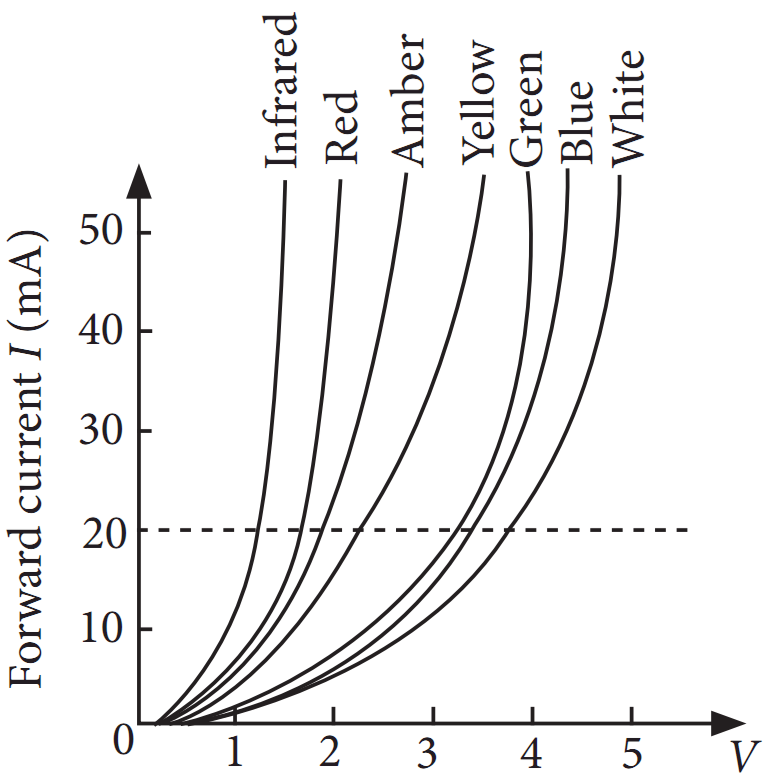
Light emitting diode is a photoelectric device which converts electrical energy into light energy. It is a heavily doped p-n junction diode which under forward biased emits spontaneous radiation. The general shape of the I-V characteristics of an LED is similar to that of a normal p-n junction diode, as shown. The barrier potentials are much higher and slightly different for each colour.
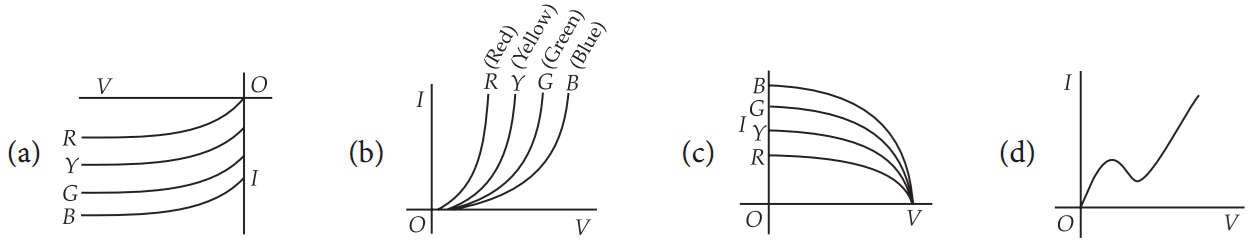
  1. The I-V characteristic of an LED is:
  1. The schematic symbol of light emitting diode is (LED).
  1. An LED is constructed from a p-n junction based on a certain Ga-As-P semiconducting material whose energy gap is 1.9eV. Identify the colour of the emitted light.
  1. Blue.
  2. Red.
  3. Violet.
  4. Green.
  1. Which one of the following statement is not correct in the case of light emitting diodes?
  1. It is a heavily doped p-n junction.
  2. It emits light only when it is forward biased.
  3. It emits light only when it is reverse biased.
  4. The energy of the tight emitted is less than the energy gap of the semiconductor used.
  1. The energy of radiation emitted by LED is:
  1. Greater than the band gap of the semiconductor used.
  2. Always less than the band gap of the semiconductor used.
  3. Always equal to the band gap of the semiconductor used.
  4. Equal to or less than the band gap of the semiconductor used.
Discuss the Einstien's explanation for the photoelectric effect.
A sample contains a mixture of $^{108}Ag$ and $^{110}Ag$ isotopes each having an activity of 8.0 \times 10^8 disintegration per second. $^{110}Ag$ is known to have larger half-life than $^{108}Ag.$ The activity A is measured as a function of time and the following data are obtained.
Time (s) Activity (A) $(10^8$ disinte- grations $s^{-1})$ Time (s) Activity (A) $(10^8$ disinte-grations $s^{-1})$
20 11.799 200 3.0828
40 9.1680 300 1.8899
60 7.4492 400 1.1671
80 6.2684 500 0.7212
100 5.4115    
  1. Plot ln $\Big(\frac{\text{A}}{\text{A}_0}\Big)$ versus time.
  2. See that for large values of time, the plot is nearly linear. Deduce the half-life of $^{110}Ag$ from this portion of the plot.
  3. Use the half-life of $^{110}Ag$ to calculate the activity corresponding to $^{108}Ag$ in the first 50s.
  4. Plot In $\Big(\frac{\text{A}}{\text{A}_0}\Big)$ versus time for $^{108}Ag$ for the first 50s.
  5. Find the half-life of $^{108}Ag.$