Question
When hydrogen is passed over copper oxide, copper and steam are formed. Write a balanced equation for this reaction and state which of the chemicals are:
  1. Elements.
  2. Compounds.
  3. Reactants.
  4. Products.
  5. Metals.
  6. Non-metals.

Answer

$\text{H}_2\ +\ \text{CuO}\xrightarrow{\ \ \ \ \ \ \ \ \ \ \ }\text{Cu}\ +\ \text{H}_2\text{O}$
1. Elements: $H _2$ and Cu
2. Compounds: CuO and $H _2 O$
3. Reactants: $H _2$ and CuO
4. Products: CU
5. Metals: Cu
6. Non-metals: $H _2$​​​​​​​

Need a full question paper?

Generate a complete, print-ready paper with questions like this in minutes — across 16+ boards, with answer keys.

Start Generating Free

Similar questions


Calculate the combined resistance in each case:
  1. Define the following terms in the context of spherical mirrors:
  1. Pole.
  2. Centre of curvature.
  3. Radius of curvature.
  4. Principal axis.
  1. Draw ray diagrams to show the principal focus of (i) a concave mirror, and (ii) a convex mirror.
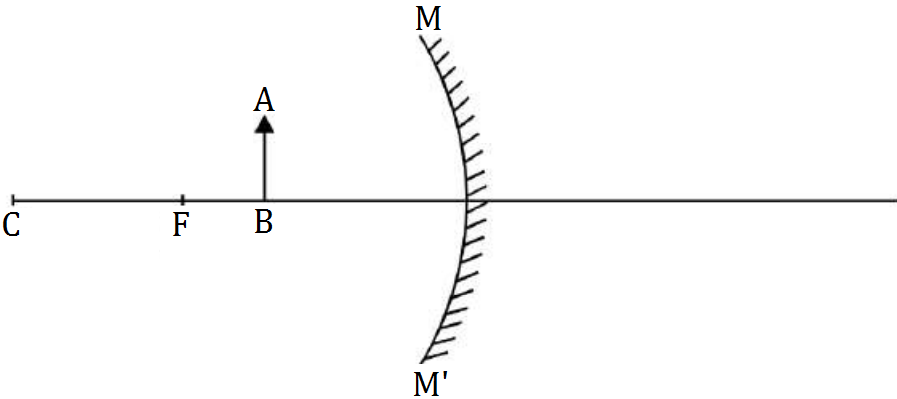
  2. In the following diagram, MM' is a concave mirror and AB is an object. Draw on your answer-sheet a ray diagram to show the formation of image of this object.
State Ohm’s law? How can it be verified experimentally? Does it hold good under all conditions? Comment.
How are the images formed when an object is moved from infinity to the convex lens?
The following diagram shows a part of the periodic table in which the elements are arranged according to their atomic numbers.
(The letters given here are not the chemical symbols of the elements):
a
3
b
4
 
c
5
d
6
e
7
f
8
g
9
h
10
i
11
j
12
 
k
13
l
14
m
15
n
16
o
17
p
18
  1. Which element has a bigger atom, a or f?
  2. Which element has a higher valency, k or o?
  3. Which element is more metallic, i or k?
  4. Which element is more non-metallic, d or g?
  5. Select a letter which represents a metal of valency 2.
  6. Select a letter which represents a non-metal of valency 2.
With the help of a circuit diagram, deduce the equivalent resistance of two resistances connected in series. Two resistances are connected in series as shown in the diagram:
  1. What is the current through the 5 ohm resistance?
  2. What is the current through R?
  3. What is the value of R?
  4. What is the value of V?
What are non-renewable sources of energy? Give two examples of such sources.
The human body contains a large number of cells A which are very long and branched, and look like electric wires. The longest branch of this cell is B whereas there are many small branches C. Any two A cells do not join to one another completely in the human body. There is a microscopic gap D between every pair of adjacent A cells through which electric impulses can pass by the release of a chemical substance.
  1. What are cells A?
  2. What is the name of (i) branch B, and (ii) branches C?
  3. What is the microscopic gap D known as?
  4. What is the function of cells like A in the human body?
  5. The cells A are of three types. name the three types.

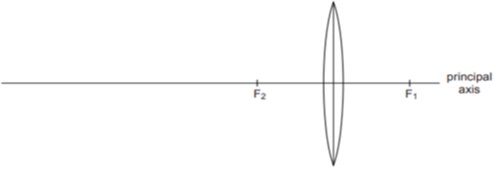
Image
The above image shows a thin lens of focal length $5 m$.
(i) What is the kind of lens shown in the above figure?
(ii) If a real inverted image is to be formed by this lens at a distance of $7 m$ from the pole, then show with calculation where should the object be placed?
(iii) Draw a neatly labelled diagram of the image formation mentioned in (ii)

Describe the working of human blood circulatory system with the help of a suitable diagram which shows all the steps involved.