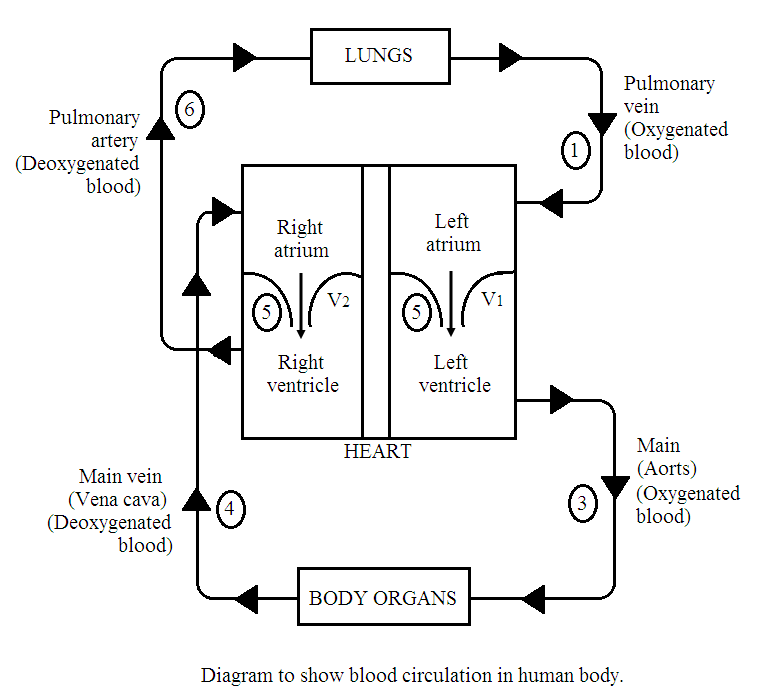
Describe the working of human blood circulatory system with the help of a suitable diagram which shows all the steps involved.
Download our app for free and get started
Working of Human blood circulatory system takes place in the steps below:
- When the muscles of all the four chambers are relaxed, the pulmonary vein brings the oxygenated blood from the lungs in the left atrium of the heart.
- When the left atrium contracts, the oxygenated blood is pushed into the left ventricle through valve V .
- When the left ventricle contracts, the oxygenated blood enters the main artery called aorta from which it goes to the different body organs through small branches called arterioles and capillaries.
- The main artery carries the blood to all the organs of the body head, arms etc except the lungs. The oxygenated blood gives off oxygen, digested food and dissolved materials to the body cells. The carbon-dioxide produced in the cells enters the blood. The deoxygenated blood enters main vein called vena cava which carried it to the right atrium of the heart.
- When the right atrium contracts, the deoxygenated blood enters right ventricle through valve V .
- When the right ventricle contracts, the deoxygenated blood enters the lungs through pulmonary artery and releases carbon-dioxide and absorbs fresh oxygen from air. The blood becomes oxygenated again and is sent to the left atrium of heart by pulmonary vein for circulation in the body. This whole process is repeated continuously.

Download our appand get started for free
Experience the future of education. Simply download our apps or reach out to us for more information. Let's shape the future of learning together!No signup needed.*
Similar Questions
- 1View SolutionDraw a labelled diagram of the human respiratory system.
- 2View SolutionThe organisms A, B and C can obtain their food in three different ways. Organism A derives its food from the body of another living organism which is called its D, without killing it. The organism B takes in the solid food by the process of ingestion, digests a part of this food and throws out undigested food in the process called E. The organism C obtains its food from dead and decaying plants.
- What is the mode of nutrition of (i) organism A (ii) organism B, and (iii) organism C?
- What is the organism like D called?
- Name the process E.
- Give one example each of organisms like A, B and C.
- What is the general name of three modes of nutrition exhibited by organisms A, B and C?
- 3View SolutionA liquid X of colour Y circulates in the human body only in one direction: from body tissues to the heart. Among other things, liquid X contains germs from cells and dead cells. The liquid X is cleaned of germs and dead cells by a special type of white blood cells called Z. This cleaned liquid is then put into blood circulatory system in subclavian veins.
- What is (i) liquid X and (ii) colour Y?
- What are Z.
- The liquid X is somewhat similar to a component of blood. Name this component.
- Why is liquid X not red?
- 4View SolutionIf the teeth are not cleaned regularly, they become covered with a sticky yellowish layer W of food particles and bacteria. Since layer W covers the teeth, the alkaline liquid X secreted by glands Y inside the mouth cannot reach the teeth surface to neutralise the acid formed by the action of organisms Z on sugary food, and hence tooth decay sets in.
- What is W known as?
- What is (i) X, and (ii) Y?
- What are organisms Z?
- State one way of removing layer W from the teeth.
- 5View SolutionDescribe double circulation in human beings. Why is it necessary?
- 6View SolutionExplain the digestion of chapati in human beings. Draw a diagram depicting human alimentary canal.
- 7View SolutionDescribe the process of urine formation in kidneys.
- 8What happens with $CO _2$ and $O _2$ in plants during daytime?View Solution
- 9View SolutionDistinguish between photosynthesis and respiration.
- 10View SolutionWith a schematic diagram, explain the overall process of respiration in animals.