MCQ
When npn transistor is used as an amplifier:
- AElectrons move from collector to base.
- BHoles move from emitter to base.
- CElectrons move from base to collector.
- DHoles move from base to emitter.
Generate a complete, print-ready paper with questions like this in minutes — across 16+ boards, with answer keys.
The voltage applied across an X-rays tube is nearly
| (a) 10 V | (b) 100 V | (c) 10000 V | (d) 106 V |
$\frac{\triangle\text{l}}{\text{l}}$
$\Big(\frac{\triangle\text{l}}{\text{l}}\Big)^2$
$\sqrt{\frac{\triangle\text{l}}{\text{l}}}$
None of these.
Binding energy per nucleon plot against the mass number for stable nuclei is shown in the figure. Which curve is correct
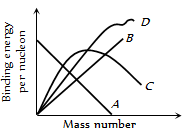
|
(a) A |
(b) B |
(c) C |
(d) D |
Which of the following is true
|
(a) Diamagnetism is temperature dependent |
|
(b) Paramagnetism is temperature dependent |
|
(c) Paramagnetism is temperature independent |
|
(d) None of these |
A network of four capacitors of capacity equal to  and
and  are conducted in a battery as shown in the figure. The ratio of the charges on
  and
and  is
is

|
(a) |
(b) |
(c) |
(d) |
If a proton and anti-proton come close to each other and annihilate, how much energy will be released
|
(a) 1.5 |
(b) 3 |
(c) 4.5 |
(d) None of these |
Find the equivalent resistance between the points a and b

|
(a) 2 W |
(b) 4 W |
(c) 8 W |
(d) 16 W |


