Question
When some wax is rubbed on a cloth, it becomes waterproof. Explain.

Answer

A liquid wets a surface when the angle of contact of the liquid with the surface is small or zero. Due to its fibrous nature, cloth produces capillary action when in contact with water. This makes clothes have very small contact angles with water. When wax is rubbed over cloth, the water does not wet the cloth because wax has a high contact angle with water.

Need a full question paper?

Generate a complete, print-ready paper with questions like this in minutes — across 16+ boards, with answer keys.
Start Generating Free

Similar questions

A short magnet produces a deflection of $37^\circ$ in a deflection magnetometer in Tan$-A$ position when placed at a separation of $10\ cm$ from the needle. Find the ratio of the magnetic moment of the magnet to the earth's horizontal magnetic field.
 For the past some time, Aarti had been observing some erratic body movement, unsteadiness and lack of coordination in the activities of her sister Radha, who also used to complain of severe headache occasionally. Aarti suggested to her parents to get a medical check-up of Radha. The doctor thoroughly examined Radha and diagnosed that she has a brain tumour.
  1. What, according to you, are the values displayed by Aarti?
  2. How can radioisotopes help a doctor to diagnose brain tumour? 
If we allow radiations of a fixed frequency to fall on plate and the accelerating potential difference between the two electrodes is kept fixed, then the photoelectric current is found to increase linearly with the intensity of incident radiation. Here, radiation pressure is $\text{P}=\Big(\frac{1+\text{e}}{\text{C}}\Big)\text{I}$. As, atmosphere pressure at sea level is $10^5Pa$. If the intensity of light of a given wavelength, is increased, there is an increase in the number of photons incident on a given area in a given time. But the energy of each photon remain the same.
  1. The number of photons hitting the cone second
  1. $\frac{\pi\text{R}^2\text{I}}{2\text{E}}$
  2. $\frac{2\pi\text{R}^2\text{I}}{\text{E}}$
  3. $\frac{\pi\text{R}^2\text{I}}{4\text{E}}$
  4. $\frac{\pi\text{R}^2\text{I}}{\text{E}}$
  1. A radiation of energy $E$ falls normally on a perfect reflecting surface. The momentum transferred to the surface is:
  1. $\frac{\text{E}}{\text{c}}$
  2. $\frac{2\text{E}}{\text{c}}$
  3. $\text{Ec}$
  4. $\frac{\text{E}}{\text{c}^2}$
  1. Which one is correct?
  1. $\text{E}^2=\text{p}^2\text{c}^2$
  2. $\text{E}^2=\text{p}^2\text{c}$
  3. $\text{E}^2=\text{p}^2$
  4. $\text{E}^2=\frac{\text{p}^2}{\text{c}^2}$
  1. The incident intensity on a horizontal surface at sea level from the Sun is about $1k Wm^{-2}.$ Assuming that $50\% $ of this intensity is reflected and $50\%$ is absorbed, determine the radiation pressure on this horizontal surface.
  1. $8.2 \times 10^{-2} Pa$
  2. $5 \times 10^{-6} Pa$
  3. $3 \times 10^{-5} Pa$
  4. $3 \times 10^{-5} Pa$
  1. Find the ratio of radiation pressure to atmospheric pressure $P_0$ about $1 \times 10^5 Pa$ at sea level.
  1. $5 \times 10^{-11}$
  2. $4 \times 10^{-8}$
  3. $6 \times 10^{-12}$
  4. $8 \times 10^{-11}$
When the atomic dipoles are aligned partially or fully, there is a net magnetic moment in the direction of the field in any small volume of the material. The actual magnetic field inside material placed in magnetic field is the sum of the applied magnetic field and the magnetic field due to magnetisation. This field is called magnetic intensity $(H)$.
$\text{H}=\frac{\text{B}}{\mu_0}-\text{M}$
where Mis the magnetisation of the material, flo is the permittivity of vacuum and $B$ is the total magnetic field. The measure that tells us how a magnetic material responds to an external field is given by a dimensionless quantity is appropriately called the magnetic susceptibility: for a certain class of magnetic materials, intensity of magnetisation is directly proportional to the magnetic intensity.
  1. Magnetization of a sample is:
  1. Volume of sample per unit magnetic moment.
  2. Net magnetic moment per unit volume.
  3. Ratio of magnetic moment and pole strength.
  4. Ratio of pole strength to magnetic moment.
  1. Identify the wrongly matched quantity and unit pair.
  1. Pole strength $- Am$
  2. Magnetic susceptibility $-$ dimensionless number
  3. Intensity of magnetisation $- Am^{-1}$
  4. Magnetic permeability $-$ Henry $m$
  1. A closed surface $S$ encloses a magnetic dipole of magnetic moment $2\ ml$. The magnetic flux emerging from the surface is:
  1. $2 \times 10^5\ A/ m$
  2. $3 \times 10^5\ A/ m$
  3. $4 \times 10^5\ A/ m$
  4. $5 \times 10^5\ A/ m$
  1. A solenoid has core of a material with relative permeability $500$ and its windings carry a current of $1A$. The number of turns of the solenoid is $500$ per metre. The magnetization of the material is nearly,
  1. $2.5 \times 10^3Am^{-1}$
  2. $2.5 \times 10^5Am^{-1}$
  3. $2.0 \times 10^3Am^{-1}$
  4. $2.0 \times 10^5Am^{-1}$
  1. The relative penneability of iron is $6000$. Its magnetic susceptibility is:
  1. $5999$
  2. $6001$
  3. $6000 \times 10^{-7}$
  4. $6000 \times 10^7$
In how many bands the full range of radiowaves can be divided ? Describe about all the bands in brief.
In an electromagnetic wave both the electric and magnetic fields are perpendicular to the direction of propagation, that is why electromagnetic waves are transverse in nature. Electromagnetic waves carry energy as they travel through space and this energy is shared equally by the electric and magnetic fields. Energy density of an electromagnetic waves is the energy in unit volume of the space through which the wave travels.
  1. The electromagnetic waves propagated perpendicular to both $\vec{\text{E}}$ and $\vec{\text{B}}.$ The electromagnetic waves travel in the direction of.
  1. $\vec{\text{E}}\times\vec{\text{B}}$
  2. $\vec{\text{E}}\times\vec{\text{B}}$
  3. $\vec{\text{B}}\times\vec{\text{E}}$
  4. $\vec{\text{B}}\times\vec{\text{E}}$
  1. Fundamental particle in an electromagnetic wave is:
  1. Photon
  2. Electron
  3. Phonon
  4. Proton
  1. Electromagnetic waves are transverse in nature is evident by:
  1. Polarisation
  2. Interference
  3. Reflection
  4. Diffraction
  1. For a wave propagating in a medium, identify the property that is independent of the others.
  1. Velocity
  2. Wavelength
  3. Frequency
  4. All these depend on each other.
  1. The electric and magnetic fields of an electromagnetic waves are:
  1. In opposite phase and perpendicular to each other.
  2. In opposite phase and parallel to each other.
  3. In phase and perpendicular to each other.
  4. In phase and parallel to each other.
A silver ball of radius $4.8\ cm$ is suspended by a thread in a vacuum chamber. Ultraviolet light of wavelength $200$ run is incident on the ball for some time during which a total light energy of $1.0 \times 10^{-7}J$ falls on the surface. Assuming that on the average one photon out of every ten thousand is able to eject a photoelectron, find the electric potential et the surface of the bell assuming zero potential at infinity. What is the potential at the centre of the bell?
A charge is a property associated with the matter due to which it experiences and produces an electric and magnetic field. Charges are scalar in nature and they add up like real numbers. Also, the total charge of an isolated system is always conserved. When the objects rub against each other charges acquired by them must be equal and opposite.
Image
(i) The cause of charging is:
(a) the actual transfer of atoms
(b) the actual transfer of protons
(c) the actual transfer of electrons
(d) the actual transfer of neutrons

(ii) Pick the correct statement.
i. The glass rod gives protons to silk when they are rubbed against each other.
ii. The glass rod gives electrons to silk when they are rubbed against each other.
iii. The glass rod gains protons from silk when they are rubbed against each other.
iv. The glass rod gains electrons when they are rubbed against each other.
(a) Option (i) (b) Option (iv) (c) Option (iii) (d) Option (ii)

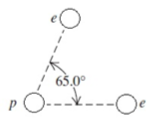
(iii) If two electrons are each $1.5 \times 10^{-10} m$ from a proton, as shown in Figure, magnitude of the net electric force they will exert on the proton is
Image

(a) $1.97 \times 10^{-8} N$
(b) $3.83 \times 10^{-8} N$
(c) $4.63 \times 10^{-8} N$
(d) $2.73 \times 10^{-8} N$

(iv) A charge is a property associated with the matter due to which it produces and experiences:
(a) electric effects only
(b) magnetic effects only
(c) both electric and magnetic effects
(d) non magnetic effects only

OR

The cause of quantization of electric charges is:
(a) transfer of an integral number of electrons
(b) transfer of an integral number of neutrons
(c) transfer of an integral number of protons
(d) transfer of an integral number of Atom
A magnetic needle is free to rotate in a vertical plane which makes an angle of 60° with the magnetic meridian. If the needle stays in a direction making an angle of $\tan^{-1}\Big(\frac{2}{\sqrt{3}}\Big)$ with the horizontal, what would be the dip at that place?
If an automobile engine is overheated, it is cooled by putting water on it. It is advised that the water should be put slowly with engine running. Explain the reason.