Question
When some wax is rubbed on a cloth, it becomes waterproof. Explain.

Answer

A liquid wets a surface when the angle of contact of the liquid with the surface is small or zero. Due to its fibrous nature, cloth produces capillary action when in contact with water. This makes clothes have very small contact angles with water. When wax is rubbed over cloth, the water does not wet the cloth because wax has a high contact angle with water.

Need a full question paper?

Generate a complete, print-ready paper with questions like this in minutes — across 16+ boards, with answer keys.
Start Generating Free

Similar questions

A woman starts from her home at 9.00 am, walks with a speed of $5$ $km h ^{-1}$ on a straight road up to her office 2.5 km away, stays at the office up to 5.00 pm , and return home by an auto with a speed of $25$ $km h ^{-1}$. Choose suitable scales and plot the $x-t$ graph of her motion.
When you push your bicycle up on an incline the potential energy of the bicyle and yourself increases. Where does this energy come from?
An air bubble, whose volume is $1.0 cm^3$ rises from the bottom of a 40 m deep lake where the temperature is $12^{\circ} C$ and comes to the surface where the temperature is $35^{\circ} C$. Now what will be its volume?
Choose the correct alternative :
(a) Acceleration due to gravity increases/ decreases with increasing altitude.
(b) Acceleration due to gravity increases/ decreases with increasing depth (assume the earth to be a sphere of uniform density).
(c) Acceleration due to gravity is independent of mass of the earth/mass of the body.
(d) The formula - GMm $\left(1 / r_2-1 / r_1\right)$ is more/ less accurate than the formula $m g\left(r_2-r_1\right)$ for the difference of potential energy between two points $r_2$ and $r_1$ distance away from the centre of the earth.
A transverse harmonic wave on a string is described by
$y(x, t)=3.0 \sin \left(36 t+0.018 x+\frac{\pi}{4}\right)$
where x and y are in cm and t in s. The positive direction of x is from left to right.
For the wave, plot the displacement ($y$) versus ($t$) versus ($t$) graphs for x = 0, 2 and 4 cm . What are the shapes of these graphs? In which aspects does the oscillatory motion in travelling wave differ from one point to another : amplitude, frequency or phase?
A fat person is standing on a light plank floating on a calm lake. The person walks from one end to the other on the plank. His friend sitting on the shore watches him and finds that the person hardly moves any distance because the plank moves backward about the same distance as the person moves on the plank. Explain.
The amplification factor of a triode operating in the linear region depends strongly on:
  1. The temperature of the cathode.
  2. The plate potential.
  3. The grid potential.
  4. The separations of the grid from the cathode and the anode.
Read the passage given below and answer the following questions from (i) to (v).

This principle is a consequence of Newton’s second and third laws of motion. In an isolated system (i.e. a system having no external force), mutual forces (called internal forces) between pairs of particles in the system causes momentum change in individual particles. Let a bomb be at rest, then its momentum will be zero. If the bomb explodes into two equal parts, then the parts fly off in exactly opposite directions with same speed, so that the total momentum is still zero. Here, no external force is applied on the system of particles (bomb).

  1. A bullet of mass 10g is fired from a gun of mass 1kg with recoil velocity of gun 5m/ s. The muzzle velocity will be:
  1. 30km/ min
  2. 60km/ min
  3. 30m/ s
  4. 500m/ s
  1. A shell of mass 10 kg is moving with a velocity of 10 ms" 1 when it blasts and forms two parts of mass 9 kg and 1 kg respectively. If the first mass is stationary, the velocity of the second is:
  1. 1ms-1
  2. 10ms-1
  3. 100ms-1
  4. 1000ms-1
  1. A bullet of mass 0.1kg is fired with a speed of 100ms’ 1 . The mass of gun being 50kg, then the velocity of recoil becomes:
  1. 0.05ms-1
  2. 0.5ms-1
  3. 0.lms-1
  4. 0.2ms-1
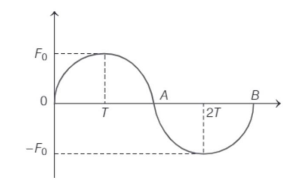
  1. A unidirectional force F varying with time Tas shown in the figure acts on a body initially at rest for a short duration:

2.T. Then, the velocity acquired by the body is

  1. $\frac{\pi\text{F}_\text{o}\text{T}}{4\text{m}}$

  2. $\frac{\pi\text{F}_\text{o}\text{T}}{2\text{m}}$

  3. $\frac{\text{F}_\text{o}\text{T}}{4\text{m}}$

  4. $\text{zero}$

  1. Two masses ofM and 4Af are moving with equal kinetic energy. The ratio of their linear momenta is
  1. 1 : 8
  2. 1 : 4
  3. 1 : 2
  4. 4 : 1
Read the passage given below and answer the following questions from i to v.
When an object follows a circular path at a constant speed, the motion of the object is called uniform circular motion. The word “uniform” refers to the speed, which is uniform (constant) throughout the motion. Suppose an object is moving with uniform speed v in a circle of radius R Since the velocity of the object is changing continuously in direction, the object undergoes acceleration. Let us find the magnitude and the direction of this acceleration. Thus, the acceleration of an object moving with speed v in a circle of radius R has a magnitude V2/R and is always directed towards the centre. This is why this acceleration is called centripetal acceleration (a term proposed by Newton). A thorough analysis of centripetal acceleration was first published in 1673 by the Dutch scientist Christiaan Huygens (1629-1695) but it was probably known to Newton also some years earlier. “Centripetal” comes from a Greek term which means ‘centre-seeking’. Since v and R are constant, the magnitude of the centripetal acceleration is also constant. However, the direction changes pointing always towards the centre. Therefore, a centripetal acceleration is not a constant vector. We can express centripetal acceleration ac in terms of angular speed as
$\text{a}_\text{c}=\omega^2\text{R}$
The time taken by an object to make one revolution is known as its time period T and the number of revolution made in one second is called its frequency v (=1/T). However, during this time the distance moved by the object is $\text{s}=2\pi\text{R}.$ Therefore, $\text{v}=2\pi\frac{\text{R}}{\text{T}}=2\pi\text{ Rv}$ In terms of frequency n, we have
$\omega=2\pi\text{v}$
$\text{V}=2\pi\text{ RV}$
$\text{ac}=4\pi^2\text{v}^2\text{R}$
  1. SI unit of angular velocity is
  1. Rev/ sec
  2. m/ s
  3. m/ s2
  4. None of these
  1. A centripetal acceleration is not a constant vector. True or false?
  1. True
  2. False
  1. Define Uniform circular motion
  2. What is meaning of word centripetal?
  3. What is centripetal acceleration? Give its relation with angular velocity
Why do marine animals live deep inside a lake when the surface of the lake freezes?