Question
When subatomic particles undergo reactions, energy is conserved, but mass is not necessarily conserved. However, a particle's mass “contributes” to its total energy, in accordance with Einstein's famous equation, E = mc2 In this equation, E denotes the energy carried by a particle because of its mass. The particle can also have additional energy due to its motion and its interactions with other particles. Consider a neutron at rest and well separated from other particles. It decays into a proton, an electron and an undetected third particle as given here: Neutron → proton + electron + ???

The given table summarizes some data from a single neutron decay. Electron volt is a unit of energy. Column 2 shows the rest mass of the particle times the speed of light squared.

Particle
Mass × c2 (MeV)
Kinetic energy (MeV)
Neutron
940.97
0.00
Proton
939.67
0.01
Electron
0.51
0.39
  1. From the given table, which properties of the undetected third particle can be calculate?
  1. Total energy, but not kinetic energy.
  2. Kinetic energy, but not total energy.
  3. Both total energy and kinetic energy.
  4. Neither total energy nor kinetic energy.
  1. Assuming the table contains no major errors, what can we conclude about the (mass × c2) of the undetected third particle?
  1. It is 0. 79 MeV
  2. It is 0.39 MeV
  3. It is less than or equal to 0.79 MeV; but we cannot be more precise.
  4. It is less than or equal to 0.40 MeV; but we cannot be more precise.
  1. Could this reaction occur?

Proton → neutron + other particles

  1. Yes, if the other particles have much more kinetic energy than mass energy.
  2. Yes, but only if the proton has potential energy (due to interactions with other particles). 
  3. No, because a neutron is more massive than a proton.
  4. No, because a proton is positively charged while a neutron is electrically neutral.
  1. How much mass has to be converted into energy to produce electric power of 500MW for one hour?
  1. 2 × 10-5kg
  2. 1 × 10⁻⁵kg
  3. 3 × 10⁻⁵kg
  4. 4 × 10⁻⁵kg
  1. The equivalent energy of 1g of substance is.
  1. 9 × 10¹³J
  2. 6 × 10¹²J
  3. 3 × 10¹³J
  4. 6 × 10¹³J

Answer

  1. (a) Total energy, but not kinetic energy.

Explanation:

As just shown, energy conservation allows us to calculate the third particle's total energy. But we do not know what percentage of that total is mass energy. 

  1. (d) It is less than or equal to 0.40 MeV, but we cannot be more precise.

Explanation:

According to the passage, subatomic reactions do not conserve mass. So, we cannot find the third particle's mass by setting $\text{m}_\text{neutron}$equal to $\text{m}_\text{proton}+\text{m}_\text{electron}+\text{E}_\text{thrid particle}$

The neutron has energy 940.97 MeV. The proton has energy 939.67 MeV + 0.01 MeV = 939.69 MeV. The electron has energy 0.51 MeV + 0.39 MeV = 0.90 MeV. Therefore, the third particle has energy.

$\text{E}_\text{third particle}=\text{E}_\text{neutron}-\text{E}_\text{proton}-\text{E}_\text{electron}$

= 940.97 - 939.67 - 0.90 = 0.40 MeV 

We just found the third particle's total energy, the sum of its mass energy and kinetic energy. Without more information, we cannot figure out how much of that energy is mass energy.

  1. (b) Yes, but only if the proton has potential energy (due to interactions with other particles). 
  2. (a) 2 × 10-5kg

Explanation:

Here, P = 500MW = 5 × 10⁸W,

t = 1h = 3600s

Energy produced, E = P × t = 5 × 108 × 3600 = 18 × 1011J

$\text{As}\ \text{E}=\Delta\text{mc}^2$

$\therefore\Delta\text{m}=\frac{\text{E}}{\text{c}^2}=\frac{18\times10^{11}}{(3\times10^8)^2}$

$=\frac{18\times10^{11}}{(3\times10^8)^{16}}=2\times10^{-5}\text{kg}$

  1. (a) 9 × 10¹³J

Explanation:

Using, E = mc2

Here, m = 1g = 1 × 10⁻³kg, c = 3 × 10⁸m s-1

$\therefore$ E = 10-3 × 9 × 1016 = 9 × 1013J

Need a full question paper?

Generate a complete, print-ready paper with questions like this in minutes — across 16+ boards, with answer keys.

Start Generating Free

Similar questions

If the radius of a circular current carrying coil is doubled and the current flowing through it is reduced to half, then what will be effect on magnetic moment?
A bar magnet has a length of 8cm. The magnetic field at a point at a distance 3cm from the centre in the broadside-on position is found to be 4 × 10⁻⁶ T. Find the pole strength of the magnet.
The magnetic field due to the earth has a horizontal component of $26\mu\text{T}$ at a place where the dip is 60°. Find the vertical component and the magnitude of the field.
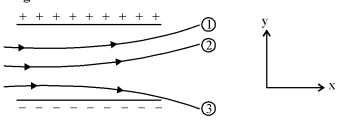
Figure shows track of three charged particles in a uniform elecrostatic field. Give the signs of the three charges. Which particle has the highest charge to mass ratio?
Image
In tug of war, the team that exerts a larger tangential force on the ground wins. Consider the period in which a team is dragging the opposite team by applying a larger tangential force on the ground. List which of the following works are positive, which are negative and which are zero?
  1. Work by the winning team on the losing team.
  2. Work by the losing team on the winning team.
  3. Work by the ground on the winning team.
  4. Work by the ground on the losing team.
  5. Total external work on the two teams.
A steel blade placed gently on the surface of water floats on it. If the same blade is kept well inside the water, it sinks. Explain.
Draw a block diagram of a generalized communication system. Write the functions of each of the following:
(a) Transmitter, (b) Channel, (c) Receiver.
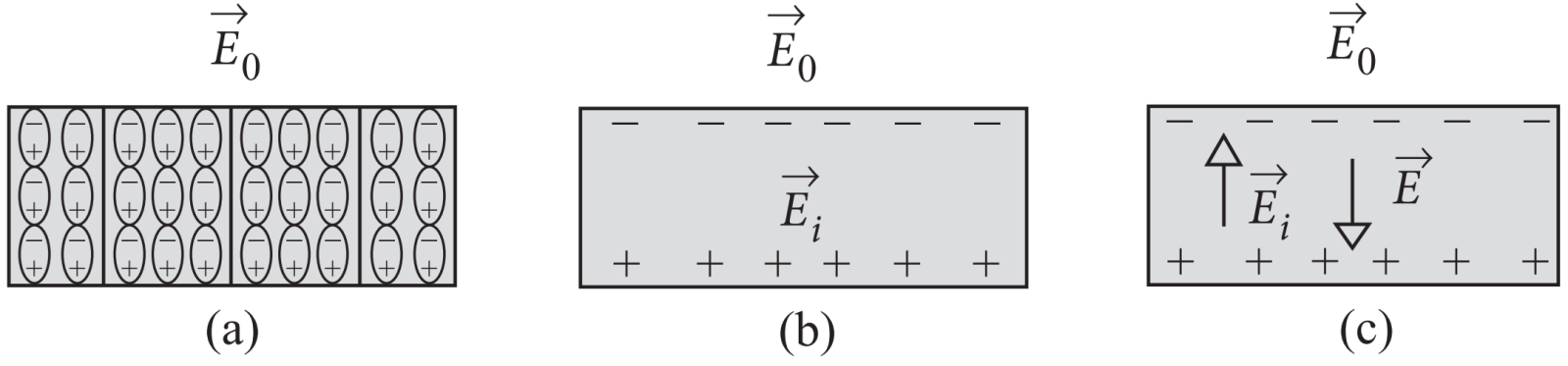
When an insulator is placed in an external field, the dipoles become aligned. Induced surface charges on the insulator establish a polarization field $\vec{\text{E}}_\text{i}$ in its interior. The net field $\vec{\text{E}}$ in the insulator is the vector sum of $\vec{\text{E}}_0$ and $\vec{\text{E}}_\text{i}$ as shown in the figure.

On the application of external electric field, the effect of aligning the electric dipoles in the insulator is called polarisation, and the field $\vec{\text{E}}_\text{i}$ is known as the polarisation field.

The dipole moment per unit volume of the dielectric is known as polarisation $(\vec{\text{P}}).$ For linear isotropic dielectrics, $\vec{\text{P}}=\chi\vec{\text{E}},$ where $\chi=$ electrical susceptibility of the dielectric medium.

  1. Which among the following is an example of polar molecule?
  1. O2
  2. H2
  3. N2
  4. HCI
  1. When air is replaced by a dielectric medium of constant K, the maximum force of attraction between two charges separated by a distance:
  1. Increases K times.
  2. Remains unchanged.
  3. Decreases K times.
  4. Increases 2K times.
  1. Which of the following is a dielectric?
  1. Copper.
  2. Glass.
  3. Antimony (Sb).
  4. None of these.
  1. For a polar molecule, which of the following statements is true?
  1. The centre of gravity of electrons and protons coincide.
  2. The centre of gravity of electrons and protons do not coincide.
  3. The charge distribution is always symmetrical.
  4. The dipole moment is always zero.
  1. When a comb rubbed with dry hair attracts pieces of paper. This is because the?
  1. Comb polarizes the piece of paper.
  2. Comb induces a net dipole moment opposite to the direction of field.
  3. Electric field due to the comb is uniform.
  4. Comb induces a net dipole moment perpendicular to the direction of field.
Write difference between nuclear fission and radioactivity i.e. radioactive decay.