Question
Write difference between nuclear fission and radioactivity i.e. radioactive decay.

Answer

Difference between Nuclear fission and Radioactive decay : Although these two processes are nuclear phenomenon, yet they are quite different from each other in following respects :
(i) Radioactive decay is a spontaneous phenomenon whereas fission is not. In fission, heavy nuclei are bombarded by neutrons.
(ii) In radioactive decay, $\alpha$ - and $\beta$ - particles are emitted from the nucleus and energy is obtained in the form of $\gamma$ - rays which is not very large. In nuclear fission, a heavy nucleus is broken into two nearly equal lighter nuclei and very huge energy is liberated.
(iii) In radioactive decay, the atomic number can change by 1 or 2 and the mass number can change by 0 or 1. In nuclear fission, both atomic number and mass number are almost equally distributed.
(iv) The rate of radioactive decay cannot by controlled in any way, but the rate of nuclear fission can be controlled.

Need a full question paper?

Generate a complete, print-ready paper with questions like this in minutes — across 16+ boards, with answer keys.
Start Generating Free

Similar questions

A slide projector has to project a 35mm slide (35mm × 23mm) on a 2m × 2m screen at a distance of 10m from the lens. What should be the focal length of the lens in the projector?
In a chamber, a uniform magnetic field of 6.5 G (1 G = 10-4T ) is maintained. An electron is shot into the field with a speed of 4.8 X 10⁶ m s-1normal to the field. Explain why the path of the electron is a circle. Determine the radius of the circular orbit.
$\left( e =1.6 \times 10^{-19} C , m_e=9.1 \times 10^{-31} kg\right)$
$q, 2 q, 3 q$ and $4 q$ Coulomb charges are located at the four corners of a square of side a meter each. Prove that the electric field at its centre will be $4 \sqrt{2} \frac{k q}{a^2} N / C$
Two fat astronauts each of mass 120kg are travelling in a closed spaceship moving at a speed of 15km/s in the outer space far removed from all other material objects. The total mass of the spaceship and its contents including the astronauts is 660kg. If the astronauts do slimming exercise and thereby reduce their masses to 90kg each, with what velocity will the spaceship move?
A uniform magnetic field of 0.20 × 10-3 T exists in the space. Find the change in the magnetic scalar potential as one moves through 50cm along the field.
What do you mean by nuclear fission ?
On disintegration of one atom of ${}^{235}U$ the amount of energy obtained is 200 MeV. The power obtained in a reactor is 1000 kilowatt. How many atoms are disintegrated per second in the reactor? What is the decay in mass per hour?
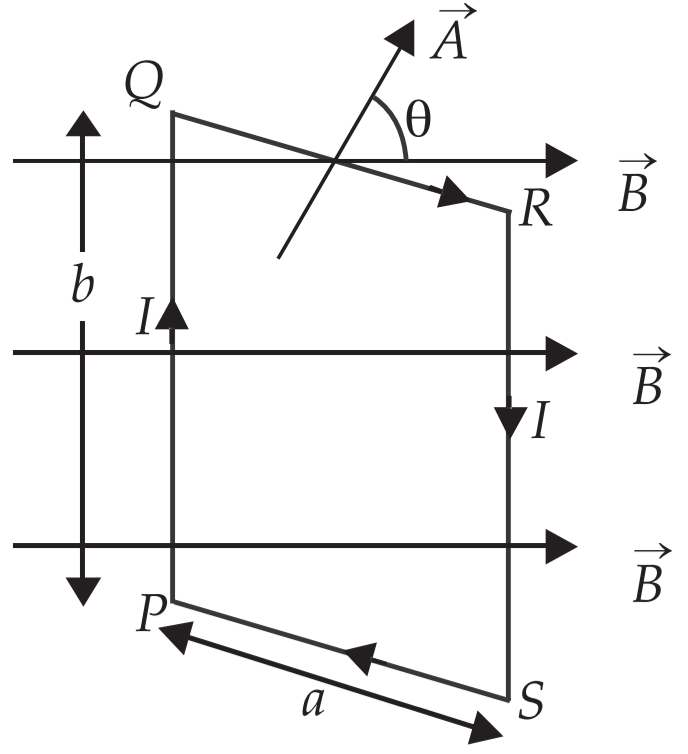
When a rectangular loop PQRS of sides' a' and' b' carrying current I is placed in uniform magnetic field B, such that area vector ii makes an angle 8 with direction of magnetic field, then forces on the arms QR and SP of loop are equal, opposite and collinear, thereby perfectly cancel each other, whereas forces on the arms PQ and RS of loop are equal and opposite but not collinear, so they give rise to torque on the loop.

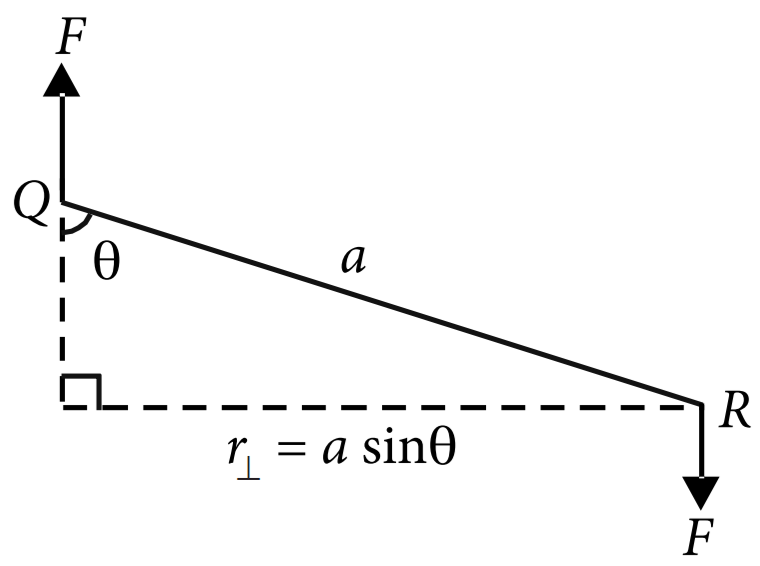
Force on side PQ or RS of loop is F = JbB sin 90º = lb B and perpendicular distance between two non-collinear forces is $\text{r}_\bot=\text{a}\sin\theta$

So, torque on the loop. $\tau=\text{IAB}\sin\theta$

In vector form torque, $\vec{\tau}=\vec{\text{M}}\times\vec{\text{B}}$

Where $\vec{\text{M}}=\text{NI}\vec{\text{A}}$ is called magnetic dipole moment of current loop and is directed in direction of area vector $\vec{\text{A}}$ i.e., normal to the plane ofloop.

  1. A circular loop of area 1cm2, carrying a current of 10A is placed in a magnetic field of 0.1T perpendicular to the plane of the loop. The torque on the loop due to the magnetic field is:
  1. Zero
  2. 10-4Nm
  3. 10-2Nm
  4. 1Nm
  1. Relation between magnetic moment and angular velocity is:
  1. $\text{m}\propto\omega$

  2. $\text{m}\propto\omega^2$

  3. $\text{m}\propto\sqrt{\omega}$

  4. None of these.
  1. A current loop in a magnetic field:
  1. Can be in equilibrium in two orientations, both the equilibrium states are unstable.
  2. Can be in equilibrium in two orientations, one stable while the other is unstable.
  3. Experiences a torque whether the field is uniform or non uniform in all orientations.
  4. Can be in equilibrium in one orientation.
  1. The magnetic moment of a current I carrying circular coil of radius rand number of turns N varies as:
  1. $\frac{1}{\text{r}^2}$
  2. $\frac{1}{\text{r}}$

  3. $\text{r}$

  4. $\text{r}^2$
  1. A rectangular coil carrying current is placed in a non-uniform magnetic field. On that coil the total:
  1. Force is non-zero.
  2. Force is zero.
  3. Torque is zero.
  4. ZNone of these.  
The needle of a dip circle shows an apparent dip of 45° in a particular position and 53° when the circle is rotated through 90°. Find the true dip.
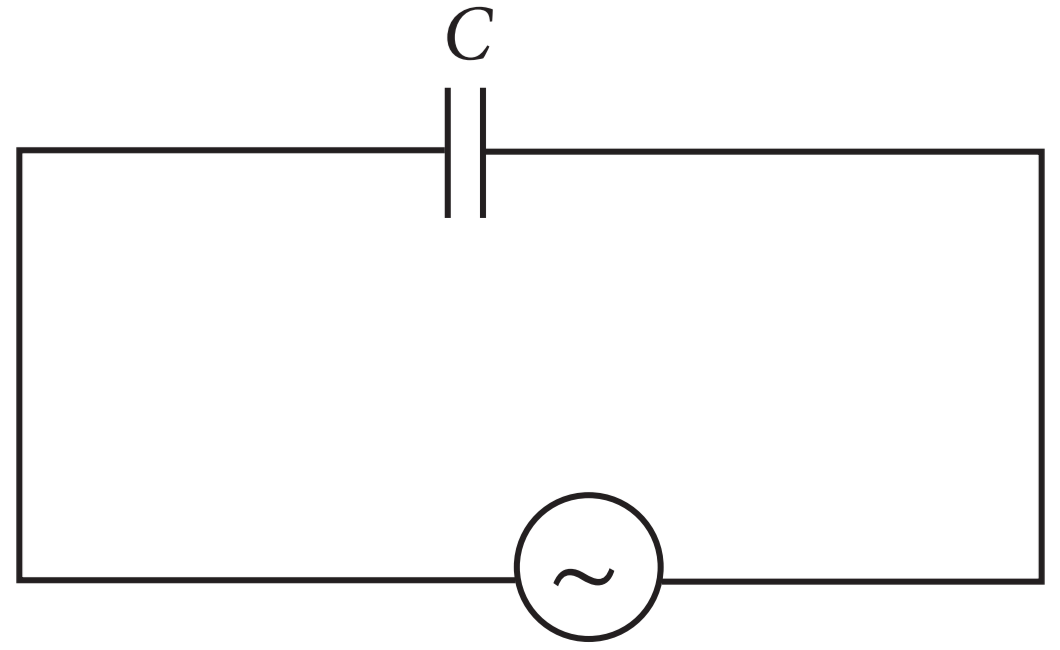
Let a source of alternating e.m.f. $\text{E} = \text{E}_\circ\sin\omega\text{t}$ be connected to a capacitor of capacitance C. If 'I' is the instantaneous value of current in the circuit at instant t, then $\text{I}=\frac{\text{E}_0}{\frac{1}{\omega\text{C}}}\sin\Big(\omega\text{t}+\frac{\pi}{2}\Big).$ The capacitive reactance limits the amplitude of current in a purely capacitive circuit and it is given by $\text{X}_\text{C}=\frac{1}{\omega\text{C}}.$

  1. What is the unit of capacitive reactance?
  1. Farad
  2. Ampere
  3. Ohm
  4. Ohm-1
  1. The capacitive reactance of a $5\mu\text{F}$ capacitor for a frequency of 106Hz is:
  1. $0.032\Omega$
  2. $2.52\Omega$
  3. $1.25\Omega$
  4. $4.51\Omega$
  1. In a capacitive circuit, resistance to the flow of current is offered by:
  1. Resistor
  2. Capacitor
  3. Inducto
  4. Frequency
  1. In a capacitive circuit, by what value of phase angle does alternating current leads the e.m.f?
  1. 45º
  2. 90º
  3. 75º
  4. 60º
  1. One microfarad capacitor is joined to a 200V, 50Hz alternator. The rrns current through capacitor is:
  1. 6.28 × 10⁻²A
  2. 7.5 × 10⁻⁴A
  3. 10.52 × 10⁻²A
  4. 15.25 × 10⁻²A
In an electromagnetic wave both the electric and magnetic fields are perpendicular to the direction of propagation, that is why electromagnetic waves are transverse in nature. Electromagnetic waves carry energy as they travel through space and this energy is shared equally by the electric and magnetic fields. Energy density of an electromagnetic waves is the energy in unit volume of the space through which the wave travels.
  1. The electromagnetic waves propagated perpendicular to both $\vec{\text{E}}$ and $\vec{\text{B}}.$ The electromagnetic waves travel in the direction of.
  1. $\vec{\text{E}}\times\vec{\text{B}}$
  2. $\vec{\text{E}}\times\vec{\text{B}}$
  3. $\vec{\text{B}}\times\vec{\text{E}}$
  4. $\vec{\text{B}}\times\vec{\text{E}}$
  1. Fundamental particle in an electromagnetic wave is:
  1. Photon
  2. Electron
  3. Phonon
  4. Proton
  1. Electromagnetic waves are transverse in nature is evident by:
  1. Polarisation
  2. Interference
  3. Reflection
  4. Diffraction
  1. For a wave propagating in a medium, identify the property that is independent of the others.
  1. Velocity
  2. Wavelength
  3. Frequency
  4. All these depend on each other.
  1. The electric and magnetic fields of an electromagnetic waves are:
  1. In opposite phase and perpendicular to each other.
  2. In opposite phase and parallel to each other.
  3. In phase and perpendicular to each other.
  4. In phase and parallel to each other.