Question
When the modulating frequency is doubled, the modulation index is halved and the modulating voltage remains constant, the modulation system is
Generate a complete, print-ready paper with questions like this in minutes — across 16+ boards, with answer keys.
$1.$ For two structures namely $S_1$ with $n_1=\sqrt{45} / 4$ and $n_2=3 / 2$, and $S_2$ with $n_1=8 / 5$ and $n_2=7 / 5$ and taking the refractive index of water to be $4 / 3$ and that of air to be 1 , the correct option$(s)$ is(are)
$(A)$ $NA$ of $S_1$ immersed in water is the same as that of $S_2$ immersed in a liquid of refractive index $\frac{16}{3 \sqrt{15}}$
$(B)$ $NA$ of $S _1$ immersed in liquid of refractive index $\frac{6}{\sqrt{15}}$ is the same as that of $S _2$ immersed in water
$(C)$ $NA$ of $S_1$ placed in air is the same as that of $S_2$ immersed in liquid of refractive index $\frac{4}{\sqrt{15}}$.
$(D)$ $NA$ of $S_1$ placed in air is the same as that of $S_2$ placed in water
$2.$ If two structures of same cross-sectional area, but different numerical apertures $N A_1$ and $NA _2\left( NA _2< NA _1\right)$ are joined longitudinally, the numerical aperture of the combined structure is
$(A)$ $\frac{ NA _1 NA _2}{ NA _1+ NA _2}$ $(B)$ $NA _1+ NA _2$ $(C)$ $NA _1$ $(D)$ $NA _2$
Give the answer question $1$ and $2.$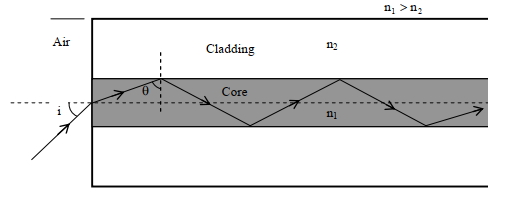
${}_Z{X^A} \to {}_{Z + 1}{Y^A} + {}_{ - 1}{e^0} + \bar v$ , represents