When the temperature of a gas is $20^{\circ} C$ and pressure is changed from $P_1=1.01 \times 10^5 \,Pa$ to $P_2=1.165 \times$ $10^5 \,Pa$, then the volume changes by $10 \%$. The Bulk modulus is $........\times 10^5 \,Pa$
Medium
Download our app for free and get started
$\frac{\Delta V}{V}=\frac{-\Delta P}{B}$ $\left\{\begin{array}{l}\Delta V=10 \% \text { of } V \text { ( } \because \text { Pressure increases volume must } \\ \text { If } \begin{array}{l}\text { decreases by } 10 \% \text { so we will use a +ve sign) }\end{array} \\ \begin{array}{rl}\Rightarrow \Delta V & =100 cc \\ \Delta P & =P_2-P_1 \\ & =1.165 \times 10^5-1.01 \times 10^5\end{array}\end{array}\right.$
Substituting the values
$\frac{-10}{100}=\frac{-\left(1.165 \times 10^6-1.01 \times 10^6\right)}{B}$
$\frac{1}{10}=\frac{.155 \times 10^5}{B}$
$B=1.55 \times 10^5 \,Pa$
Substituting the values
$\frac{-10}{100}=\frac{-\left(1.165 \times 10^6-1.01 \times 10^6\right)}{B}$
$\frac{1}{10}=\frac{.155 \times 10^5}{B}$
$B=1.55 \times 10^5 \,Pa$

Download our appand get started for free
Experience the future of education. Simply download our apps or reach out to us for more information. Let's shape the future of learning together!No signup needed.*
Similar Questions
- 1View SolutionShearing stress causes change in
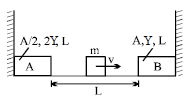
- 2In the given figure, two elastic rods $A$ & $B$ are rigidly joined to end supports. $A$ small mass $‘m’$ is moving with velocity $v$ between the rods. All collisions are assumed to be elastic & the surface is given to be frictionless. The time period of small mass $‘m’$ will be : [$A=$ area of cross section, $Y =$ Young’s modulus, $L=$ length of each rod ; here, an elastic rod may be treated as a spring of spring constant $\frac{{YA}}{L}$ ]View Solution
- 3View SolutionThe Bulk modulus for an incompressible liquid is
- 4A wire of cross section $4 \;mm^2$ is stretched by $0.1\, mm$ by a certain weight. How far (length) will be wire of same material and length but of area $8 \;mm^2$ stretch under the action of same force......... $mm$View Solution
- 5The elastic limit of brass is $3.5 \times 10^{10}\,N / m ^2$. Find the maximum load that can be applied to a brass wire of $0.75\,mm$ diameter without exceeding the elastic limit$.......\times 10^4\,N$View Solution
- 6When the temperature of a gas is $20^{\circ} C$ and pressure is changed from $P_1=1.01 \times 10^5 \,Pa$ to $P_2=1.165 \times$ $10^5 \,Pa$, then the volume changes by $10 \%$. The Bulk modulus is .........$\times 10^5 \,Pa$View Solution
- 7View SolutionShear modulus is zero for
- 8The length of an iron wire is $L$ and area of cross-section is $A$. The increase in length is $l$ on applying the force $F$ on its two ends. Which of the statement is correctView Solution
- 9A steel rod of length $\ell$, cross sectional area $A$, young's modulus of elasticity $Y$, and thermal coefficient of linear expansion $'a'$ is heated so that its temperature increases by $t\,^oC$. Work that can be done by rod on heating will beView Solution
- 10A wire is suspended by one end. At the other end a weight equivalent to $20\, N$ force is applied. If the increase in length is $1.0\, mm$, the increase in energy of the wire will be ....... $joule$View Solution