When there is an electric current through a conducting wire along its length, then an electric field must exist
Easy


Download our appand get started for free
Experience the future of education. Simply download our apps or reach out to us for more information. Let's shape the future of learning together!No signup needed.*
Similar Questions
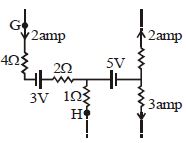
- 1In the part of a circuit shown in the figure, the potential difference $(V_G -V_H)$ between points $G$ and $H$ will be ............... $V$View Solution
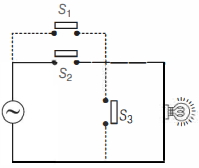
- 2View SolutionConsider the following circuit given below. The bulb will light up, if
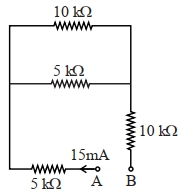
- 3A current of $15\,mA$ flows in the circuit as shown in figure. The value of potential difference between the points $A$ and $B$ will be $...\,V$View Solution
- 4In a potentiometer arrangement, a cell of emf $1.20\, V$ gives a balance point at $36\, cm$ length of wire. This cell is now replaced by another cell of emf $1.80\, V$. The difference in balancing length of potentiometer wire in above conditions will be $....cm$.View Solution
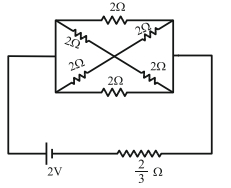
- 5In the following circuit, the battery has an emf of $2\mathrm{V}$ and an internal resistance of $\frac{2}{3}\ \Omega$. The power consumption in the entire circuit is$..... W.$View Solution
- 6If two bulbs of wattage $25$ and $30$, each rated at $220\, volts$, are connected in series with a $440$ $volt$ supply, which bulb will fuseView Solution
- 7If the balance point is obtained at the $35^{th} cm$ in a meter bridge the resistances in the left and right gaps are in the ratio ofView Solution
- 8$A$ constant voltage is applied between the two ends of a uniform metallic wire. Some heat is developed in it. The heat developed is doubled ifView Solution
- 9In an electrolyte $3.2 \times {10^{18}}$ bivalent positive ions drift to the right per second while $3.6 \times {10^{18}}$ monovalent negative ions drift to the left per second. Then the current isView Solution
- 10View SolutionResistance of one carbon filament and one tungsten lamp are measured individually when the lamp are lit and compared with their respective resistances when cold. Which one of the following statements will be true