MCQ
When two bodies collide elastically, then
  • A
    Kinetic energy of the system alone is conserved
  • B
    Only momentum is conserved
  • Both energy and momentum are conserved
  • D
    Neither energy nor momentum is conserved

Answer

Correct option: C.
Both energy and momentum are conserved
c
(c) In collisions in absence of any external force the momentum is conserved.

As the collision is elastic so there will not be any deformation in the shapes of the bodies so there will not be any

 loss in energy so the energy will remain constant.

Need a full question paper?

Generate a complete, print-ready paper with questions like this in minutes — across 16+ boards, with answer keys.
Start Generating Free

Similar questions

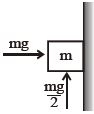
A block pressed against the vertical wall is in equilibrium. The minimum coefficient of  friction is:-
Two rings of radius $R$ and $nR$ having different masses and made up of same wire have the ratio of moment of inertia about an axis passing through centre as $1 : 8$. The value of $n$ is
A tuning fork of frequency $340\,Hz$ resonates in the fundamental mode with an air column of length $125\,cm$ in a cylindrical tube closed at one end. When water is slowly poured in it, the minimum height of water required for observing resonance once again is________ $cm$

(Velocity of sound in air is $340\,ms ^{-1}$ )

The pressure at the bottom of a tank containing a liquid does not depend on
A bomb is released from a horizontal flying aeroplane. The trajectory of bomb is
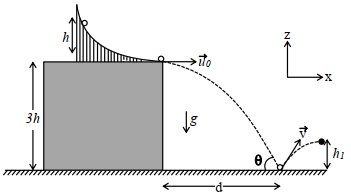
A slide with a frictionless curved surface, which becomes horizontal at its lower end,, is fixed on the terrace of a building of height $3 h$ from the ground, as shown in the figure. A spherical ball of mass $\mathrm{m}$ is released on the slide from rest at a height $h$ from the top of the terrace. The ball leaves the slide with a velocity $\vec{u}_0=u_0 \hat{x}$ and falls on the ground at a distance $d$ from the building making an angle $\theta$ with the horizontal. It bounces off with a velocity $\overrightarrow{\mathrm{v}}$ and reaches a maximum height $h_l$. The acceleration due to gravity is $g$ and the coefficient of restitution of the ground is $1 / \sqrt{3}$. Which of the following statement($s$) is(are) correct?

($AV$) $\vec{u}_0=\sqrt{2 g h} \hat{x}$ ($B$) $\vec{v}=\sqrt{2 g h}(\hat{x}-\hat{z})$  ($C$) $\theta=60^{\circ}$  ($D$) $d / h_1=2 \sqrt{3}$
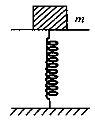
A mass of $2.0\, kg$ is put on a flat pan attached to a vertical spring fixed on the ground as shown in the figure. The mass of the spring and the pan is negligible.  When pressed slightly and released the mass executes a simple harmonic motion. The spring constant is $200\, N/m.$ What should be the minimum amplitude of the motion so that the mass gets detached from the pan (take $g = 10 m/s^2$). 
Water flows into a large tank with flat bottom at the rate of ${10^{ - 4}}\,{m^3}{s^{ - 1}}$. Water is also leaking out of a hole of area $1\, cm^2$ at its bottom. If the height of the water in the tank remains steady, then this height is........ $cm$
A car moves for half of its time at $80\, km/h$ and for rest half of time at $40\, km/h$. Total distance covered is $60 \,km$. What is the average speed of the car.........$km/h$
A communications Earth satellite