MCQ
When two bodies collide elastically, then
  • A
    Kinetic energy of the system alone is conserved
  • B
    Only momentum is conserved
  • Both energy and momentum are conserved
  • D
    Neither energy nor momentum is conserved

Answer

Correct option: C.
Both energy and momentum are conserved
(c)

Need a full question paper?

Generate a complete, print-ready paper with questions like this in minutes — across 16+ boards, with answer keys.
Start Generating Free

Similar questions

In a dc motor, induced e.m.f. will be maximum
The work done in which of the following processes is zero
A car, moving with a speed of $50 km / hr$, can be stopped by brakes after at least $6 m$. If the same car is moving at a speed of $100 km / hr$, the minimum stopping distance is
Radius of the first orbit of the electron in a hydrogen atom is $0.53 \mathring A$. So, the radius of the third orbit will be
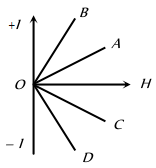
The variation of the intensity of magnetisation (I) with respect to the magnetising field $(H)$ in a diamagnetic substance is described by the graph
Image
Half part of ice block is covered with black cloth and rest half is covered with white cloth and then it is kept in sunlight. After some time clothes are removed to see the melted ice. Which of the following statements is correct
A black body radiates energy at the rate of $1 \times 10 \mathrm{~J} / \mathrm{s} \times \mathrm{m}$ at temperature of $227 C$. The temperature to which it must be heated so that it radiates energy at rate of $1 \times 10 \mathrm{~J} / \mathrm{sm}$, is
Work done by air when it expands from $50$ litres to $150$ litres at a constant pressure of $2$ atmosphere is
Material $A$ has critical angle $i_A$, and material $B$ has critical angle $i_B\left(i_B>i_A\right)$. Then which of the following is true
(i) Light can be totally internally reflected when it passes from $B$ to $A$
(ii) Light can be totally internally reflected when it passes from $A$ to $B$
(iii) Critical angle for total internal reflection is $i_B-i_A$
(iv) Critical angle between $A$ and $B$ is $\sin ^{-1}\left(\frac{\sin i_A}{\sin i_B}\right)$
If $N_P$ and $N_e$ be the numbers of holes and conduction electrons in an extrinsic semiconductor, then