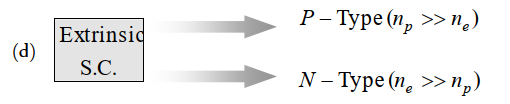
If $N_P$ and $N_e$ be the numbers of holes and conduction electrons in an extrinsic semiconductor, then
[MP PMT 1999; AMU 200I]


Download our appand get started for free
Experience the future of education. Simply download our apps or reach out to us for more information. Let's shape the future of learning together!No signup needed.*
Similar Questions
- 1In a triode, $g_m=2 \times 10^{-3} ohm ^{-1} ; \mu=42$, resistance load, $R=50$ kilo ohm. The voltage amplification obtained from this triode will beView Solution
- 2The current through an ideal $P N$-junction shown in the following circuit diagram will beView Solution
- 3In an experiment, the saturation in the plate current in a diode is observed at $240 V$. But a student still wants to increase the plate current. It can be done, ifView Solution
- 4View SolutionThe ripple factor in a half wave rectifier is
- 5View SolutionIf the forward voltage in a semiconductor diode is doubled, the width of the depletion layer will
- 6If $l_1, l_2, l_3$ are the lengths of the emitter, base and collector of a transistor thenView Solution
- 7In a $P N$ junction photo cell, the value of photo-electromotive force produced by monochromatic light is proportional to [CBSE PMT 2004]View Solution
- 8In case of $\text{NPN}-$transistors the collector current is always less than the emitter current becauseView Solution
- 9The depletion layer in silicon diode is $1 \mu m$ wide and the knee potential is $0.6 V$, then the electric field in the depletion layer will beView Solution
- 10A triode has a mutual conductance of $2 \times 10^{-3} mho$ and an amplification factor of $50.$ The anode is connected through a resistance of $25 \times 10^3$ ohms to a $250$ volts supply. The voltage gain of this amplifier isView Solution