When two displacements represented by $y_1 = asin\left( \omega t \right)$ and $y_2 = bcos\left(\omega t \right)$ are superimposed the motion is
AIPMT 2015, Medium
Download our app for free and get started
Here, $y_{1}=a \sin \omega t$
$y_{2}=b \cos \omega t=b \sin \left(\omega t+\frac{\pi}{2}\right)$
$y_{2}=b \cos \omega t=b \sin \left(\omega t+\frac{\pi}{2}\right)$
Hence, resultant motion is $SHM$ with amplitude
$\sqrt{a^{2}+b^{2}}$.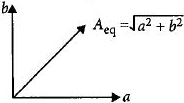

Download our appand get started for free
Experience the future of education. Simply download our apps or reach out to us for more information. Let's shape the future of learning together!No signup needed.*
Similar Questions
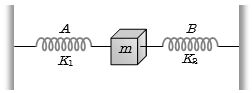
- 1View SolutionIn arrangement given in figure, if the block of mass m is displaced, the frequency is given by
- 2When a mass $m$ is attached to a spring it oscillates with period $4 \,s$. When an additional mass of $2 \,kg$ is attached to a spring, time period increases by $1 \,s$. The value of $m$ is ........... $kg$View Solution
- 3A pendulum is formed by pivoting a disc. What distance from center of mass, it should be pivoted for minimum time period while performing $SHM$ ?View Solution
- 4The total energy of the body executing $S.H.M.$ is $E$. Then the kinetic energy when the displacement is half of the amplitude, isView Solution
- 5There is a simple pendulum hanging from the ceiling of a lift. When the lift is stand still, the time period of the pendulum is $T$. If the resultant acceleration becomes $g/4,$ then the new time period of the pendulum isView Solution
- 6The displacement of a particle executing SHM is given by $x=10 \sin \left(\omega t+\frac{\pi}{3}\right) \mathrm{m}$. The time period of motion is $3.14 \mathrm{~s}$. The velocity of the particle at $\mathrm{t}=0$is_________. $\mathrm{m} / \mathrm{s}$.View Solution
- 7A $LCR$ circuit behaves like a damped harmonic oscillator. Comparing it with a physical springmass damped oscillator having damping constant $\mathrm{b}$, the correct equivalence would be:View Solution
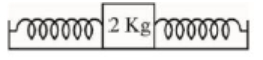
- 8A block of mass $2\,kg$ is attached with two identical springs of spring constant $20\,N / m$ each. The block is placed on a frictionless surface and the ends of the springs are attached to rigid supports (see figure). When the mass is displaced from its equilibrium position, it executes a simple harmonic motion. The time period of oscillation is $\frac{\pi}{\sqrt{x}}$ in SI unit. The value of $x$ is $..........$View Solution
- 9The function $sin^2\,(\omega t)$ representsView Solution
- 10View SolutionTwo mutually perpendicular simple harmonic vibrations have same amplitude, frequency and phase. When they superimpose, the resultant form of vibration will be