MCQ
When two magnetic moments are compared using equal distance method the deflections produced are $45^o$ and $30^o$. If the length of magnets are in the ratio  $1 : 2,$  the ratio of their pole strengths is
  • A
    $3:1$
  • B
    $3:2$
  • C
    $\sqrt 3 :1$
  • $2\sqrt 3 :1$

Answer

Correct option: D.
$2\sqrt 3 :1$
d
(d)$\frac{{{M_1}}}{{{M_2}}} = \frac{{\tan {\theta _1}}}{{\tan {\theta _2}}} \Rightarrow \frac{{{m_1}{L_1}}}{{{m_2}{L_2}}} = \frac{{\tan {\theta _1}}}{{\tan {\theta _2}}}$
$ \Rightarrow \frac{{{m_1}}}{{{m_2}}} = \frac{2}{1} \times \frac{{\tan 45^\circ }}{{\tan 30^\circ }} = \frac{{2\sqrt 3 }}{1}$

Need a full question paper?

Generate a complete, print-ready paper with questions like this in minutes — across 16+ boards, with answer keys.

Start Generating Free

Similar questions

The circular scale of a micrometer has $200$ divisions and pitch of $2\,mm$ . Find the measured value of thickness of a thin sheet .......... $mm$
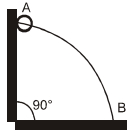
A wire, which passes through the hole is a small bead, is bent in the form of quarter of a circle. The wire is fixed vertically on ground as shown in the figure. The bead is released from near the top of the wire and it slides along the wire without friction. As the bead moves from $A$ to $B$, the force it applies on the wire is
The nuclear radius is given by $R=r_0 A^{1 / 3}$, where $r_0$ is constant and $A$ is the atomic mass number. Then, the nuclear mass density of $U^{238}$ is
A particle is moving in a circular path of radius a under the action of an attractive potential $U = - \frac{k}{{2{r^2}}}$ Its total energy is
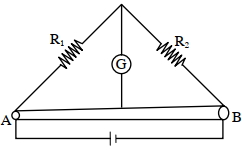
Two resistances $R_1=X \Omega$ and $R_2=1 \Omega$ are connected to a wire $A B$ of uniform resistivity, as shown in the figure. The radius of the wire varies linearly along its axis from $0.2 mm$ at $A$ to $1 mm$ at $B$. A galvanometer ($G$) connected to the center of the wire, $50 cm$ from each end along its axis, shows zero deflection when $A$ and $B$ are connected to a battery. The value of $X$ is. . . . .
A $60\,\mu F$ capacitor is charged to $100\,volts$ . This charged capacitor is connected across a $15\,mH$ coil, So that $LC$ oscillations occur. Maximum current in the coil is
A particle of mass $2\, kg$ is on a smooth horizontal table and moves in a circular path of radius $0.6\, m$. The height of the table from the ground is $0.8\, m$. If the angular speed of the particle is $12\, rad\, s^{-1}$, the magnitude of its angular momentum about a point on the ground right under the centre of the circle is $...... kg\, m^2\,s^{-1}$
Suppose that the angular velocity of rotation of earth is increased. Then, as a consequence.
A galvanometer gives full scale deflection with $0.006$ A current. By connecting it to a $4990 \ \Omega$ resistance, it can be converted into a voltmeter of range $0-30 \ V$. If connected to a $\frac{2 n }{249} \Omega$ resistance, it becomes an ammeter of range $0-1.5 \ A$. The value of $n$ is:
A current of $200\  \mu \mathrm{A}$ deflects the coil of a moving coil galvanometer through $60^{\circ}$. The current to cause deflection through $\frac{\pi}{10}$ radian is: