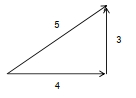
When two progressive waves $\mathrm{y}_1=4 \sin (2 \mathrm{x}-6 \mathrm{t})$ and $\mathrm{y}_2=3 \sin \left(2 \mathrm{x}-6 \mathrm{t}-\frac{\pi}{2}\right)$ are superimposed, the amplitude of the resultant wave is
IIT 2010, Diffcult


Download our appand get started for free
Experience the future of education. Simply download our apps or reach out to us for more information. Let's shape the future of learning together!No signup needed.*
Similar Questions
- 1View SolutionIt is desired to increase the fundamental resonance frequency in a tube which is closed at one end. This can be achieved by
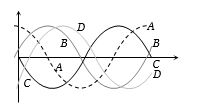
- 2Which of the following curves represents correctly the oscillation given by $y = {y_0}\sin (\omega \,t - \phi )$, where $0 < \phi < 90$View Solution
- 3If the wave equation $y = 0.08\sin \frac{{2\pi }}{\lambda }(200t - x)$ then the velocity of the wave will beView Solution
- 4Sound waves have the following frequencies that are audible to human beings .... $c/s$View Solution
- 5View SolutionA sound is produced by plucking a string in a musical instrument, then
- 6View SolutionThe intensity of a progressing plane wave in loss-free medium is
- 7Two waves represented by the following equations are travelling in the same medium ${y_1} = 5\sin 2\pi (75t - 0.25x)$, ${y_2} = 10\sin 2\pi (150t - 0.50x)$ The intensity ratio ${I_1}/{I_2}$ of the two waves isView Solution
- 8A closed organ pipe of radius $r_1$ and an open organ pipe of radius $r_2$ and having same length $'L'$ resonate when excited with a given tunning fork. Closed organ pipe resonates in its fundamental mode where as open organ pipe resonates in its first overtone, thenView Solution
- 9A tuning fork of frequency $340Hz$ is vibrated just above the tube of $120 cm$ height. Water is poured slowly in the tube. What is the minimum height of water necessary for the resonance .... $cm$ (speed of sound in the air $= 340 m/sec$)View Solution
- 10A person standing on an open ground hears the sound of a jet aeroplane, coming from north at an angle $60^o$ with ground level. But he finds the aeroplane right vertically above his position. If $\upsilon $ is the speed of sound, speed of the plane isView Solution