MCQ
When two sound waves are superimposed, beats are produced when they have
  • A
    Different amplitudes and phases
  • B
    Different velocities
  • C
    Different phases
  • Different frequencies

Answer

Correct option: D.
Different frequencies
d
(d) For producing beats, their must be small difference in frequency.

Need a full question paper?

Generate a complete, print-ready paper with questions like this in minutes — across 16+ boards, with answer keys.
Start Generating Free

Similar questions

A ball with an initial momentum $p$ collides normally with a rigid wall. If $p'$ is its linear momentum after the perfectly elastic collision, then:
A sound wave of frequency $\nu$ travels horizontally to the right. It is reflected from a large vertical plane surface moving to the left with a speed $v.$ The speed of sound in the medium is $c,$ then
A particle moves towards east with velocity $5\, m/s$. After $10$ seconds its direction changes towards north with same velocity. The average acceleration of the particle is
A ball thrown by one player reaches the other in $2$ sec. the maximum height attained by the ball above the point of projection will be about ....... $m$
A particle is moving in a circular path. The acceleration and momentum of the particle at a certain moment are $\vec a = (4\hat i + 3\hat j)\ m/s^2$ and $\vec p = (8\hat i - 6\hat j)\ kg-m/s$ . The motion of the particle is
A ball is dropped from a height $h$. If the coefficient of restitution be $e$, then to what height will it rise after jumping twice from the ground
The pressure of air in a soap bubble of $0.7\,cm$ diameter is $8\, mm$ of water above the pressure outside. The surface tension of the soap solution is ........ $dyne/cm$
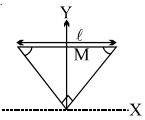
The figure shows an isosceles triangular plate of mass $M$ and base $L$. The angle at the apex is $90^o$. The apex lies at the origin and the base is parallel to $X$ -axis The moment of inertia of the plate about the $x$ -axis is
If $A$ and $B$ are two physical quantities having different dimensions then which of the following can't denote a physical quantity?
The motor of an engine is rotating about its axis with an angular velocity of $100 rev / m$. It comes to rest in 15 s , after being switched off. Assuming constant angular deceleration, what are the number of revolutions made by it before coming to rest?