MCQ
A sound wave of frequency $\nu$ travels horizontally to the right. It is reflected from a large vertical plane surface moving to the left with a speed $v.$ The speed of sound in the medium is $c,$ then
  • A
    The frequency of the reflected wave is $\frac{{\nu (c + v)}}{{c - v}}$
  • B
    The wavelength of the reflected wave is $\frac{{c(c - v)}}{{\nu (c + v)}}$
  • C
    The number of waves striking the surface per second is $\frac{{\nu (c + v)}}{c}$
  • All of the above.

Answer

Correct option: D.
All of the above.
d
(d) Number of waves striking the surface per second (or the frequency of the waves reaching surface of the moving target )

$n' = \frac{{(c + v)}}{\lambda }$$ = \frac{{\nu (c + v)}}{c}$

Now these waves are reflected by the moving target

(Which now act as a source). Therefore apparent frequency of reflected second $n'' = \left( {\frac{c}{{c - v}}} \right)n'$ $ = \nu \left( {\frac{{c + v}}{{c - v}}} \right)$

The wavelength of reflected wave  $n = \left( {\frac{c}{{c - v}}} \right)n'$

The number of beats heard by stationary listener  $ = n'' - \nu  = \nu \left( {\frac{{c + v}}{{c - v}}} \right) - \nu  = \frac{{2\nu v}}{{(c - v)}}$

Hence option $(a)\, (b)$ and $(c)$ are correct.

Need a full question paper?

Generate a complete, print-ready paper with questions like this in minutes — across 16+ boards, with answer keys.

Start Generating Free

Similar questions

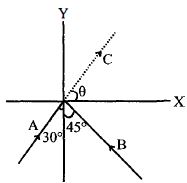
Two particles $A$ and $B$ of equal mass $M$ are moving with the same speed $v$ as shown in the figure . They collide completely inelastically and move as a single particle $C$. The angle $\theta $ that the path of $C$ makes with the $X-$ axis is given by 
A string of length $0.4\, m$ and mass ${10^{ - 2}}\,kg$ is tightly clamped at its ends. The tension in the string is $1.6\, N.$ Identical wave pulses are produced at one end at equal intervals of time $\Delta t$. The minimum value of $\Delta t$ which allows constructive interference between successive pulses is  .... $s$
Ultrasonic waves are those waves
The first ball of mass $m$ moving with the velocity $v$ collides head on with the second ball of mass $m$ at rest. If the coefficient of restitution is $e$, then the ratio of the velocities of the first and the second ball after the collision is:
A metal block of mass $m$ is suspended from a rigid support through a metal wire of diameter $14\,mm$. The tensile stress developed in the wire under equilibrium state is $7 \times 10^5\,Nm ^{-2}$. The value of mass $m$ is $......kg$.

(Take, $g =9.8\,ms ^{-2}$ and $\left.\pi=\frac{22}{7}\right)$

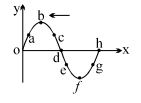
The figure represents the instantaneous picture of a transverse harmonic wave traveling along the negative $x$-axis. Choose the correct alternative $(s)$ related to the movement of the nine points shown in the figure.  The points moving with maximum velocity is/are
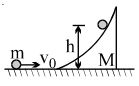
A particle of mass $m$ moving horizontally with $v_0$ strikes $a$ smooth wedge of mass $M$, as shown in figure. After collision, the ball starts moving up the inclined face of the wedge and rises to $a$ height $h$. When the particle has risen to $a$ height $h$ on the wedge, then choose the correct alternative $(s)$
The wavelength of maximum emitted energy of a body at $700 K$ is $4.08$  $\mu m$. If the temperature of the body is raised to $1400 K$ , the wavelength of maximum emitted energy will be ........ $\mu m$
The velocity of a particle depends upon as $v = a + bt + c{t^2}$; if the velocity is in $m/\sec $, the unit of $a$ will be
Speed of sound in mercury at a certain temperature is $1450 \,m/s$. Given the density of mercury as $13.6 × 10^3 kg / m^3$, the bulk modulus for mercury is