MCQ
When vector $\overrightarrow{ A }=2 \hat{ i }+3 \hat{ j }+2 \hat{ k }$ is subtracted from vector $\vec{B}$, it gives a vector equal to $2 \hat{j}$. Then the magnitude of vector $\vec{B}$ will be:
  • A
    $\sqrt{13}$
  • $\sqrt{33}$
  • C
    $\sqrt{6}$
  • D
    $\sqrt{5}$

Answer

Correct option: B.
$\sqrt{33}$
b
$\overrightarrow{ B }-\overrightarrow{ A }=2 j$

$\overrightarrow{ B }=2 \hat{ i }+5 \hat{ j }+2 \hat{ k }$

$|\overrightarrow{ B }|=\sqrt{33}$

Need a full question paper?

Generate a complete, print-ready paper with questions like this in minutes — across 16+ boards, with answer keys.

Start Generating Free

Similar questions

The mass of the earth is $6.00 \times {10^{24}}\,kg$ and that of the moon is $7.40 \times {10^{22}}\,kg$. The constant of gravitation $G = 6.67 \times {10^{ - 11}}\,N - {m^2}/k{g^2}$. The potential energy of the system is $ - 7.79 \times {10^{28}}\,joules$. The mean distance between the earth and moon is
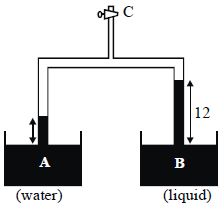
The limbs of a $U$ -tube glass are lowered into vessels $A$ and $B, A$ containing water. Some air is pumped out through the top of the tube $C$. The liquids in the left hand limb $A$ and the right hand limb $B$ rise to heights of $10\, cm$ and $12\, cm$ respectively. The density of liquid $B$ is ........ $g/cm^3$
How much force is required to produce an increase of $0.2\%$ in the length of a brass wire of diameter $0.6\, mm$ (Young’s modulus for brass = $0.9 \times {10^{11}}N/{m^2}$)
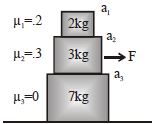
Find the acceleration of $a_1, a_2$ and $a_3$. If $10\,N$ force $F$ is applied on $3\,kg$ block :-
An object of mass $m _{1}$ collides with another object of mass $m _{2}$, which is at rest. After the collision the objects move with equal speeds in opposite direction. The ratio of the masses $m _{2}: m _{1}$ is
A particle of mass $m$ is projected at $45^o$ at $V_0$ speed from point $P$ at $t = 0$. The angular momnetum of particle about $P$ at $t = \frac{V_0}{g}$ is:-
If the water falls from a dam into a turbine wheel $19.6\, m$ below, then the velocity of water at the turbines, is ..................  $\mathrm{m} / \mathrm{s}$ (take $g = 9.8\, m/s^2$)
A man sets his watch by the sound of a siren placed at a distance $1 \,km$ away. If the velocity of sound is $330 \,m/s$
A uniform tube of length $60.5\,cm$ is held vertically with its lower end dipped in water. A sound source of frequency $500\,Hz$ sends sound waves into the tube. When the length of tube above water is $16\,cm$ and again when it is $50\,cm,$ the tube resonates with the source of sound. Two lowest frequencies (in $Hz$), to which tube will resonate when it is taken out of water, are (approximately).
Which of the following velocity-time graphs represent uniform motion