MCQ
A man sets his watch by the sound of a siren placed at a distance $1 \,km$ away. If the velocity of sound is $330 \,m/s$
  • A
    His watch is set $3 sec$. faster
  • His watch is set $3 sec$. slower
  • C
    His watch is set correctly
  • D
    None of the above

Answer

Correct option: B.
His watch is set $3 sec$. slower
b
(b) ${\rm{Time}} = \frac{{{\rm{Distance }}}}{{{\rm{Velocity}}}} = \frac{{1000}}{{330}} = 3.03\,\sec $.
Sound will be heard after $3.03 \,sec.$ So his watch is set $3sec$, slower.

Need a full question paper?

Generate a complete, print-ready paper with questions like this in minutes — across 16+ boards, with answer keys.
Start Generating Free

Similar questions

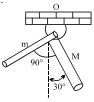
Two uniform rods of equal length but different masses are rigidly joined to form an $L$ -shaped body, which is then pivoted as shown. If in equilibrium the body is in the shown configuration, ratio $M/m$ will be:
Under steady state, the temperature of a body
$K.E.$ of molecular motion appears as:
Which of the following equations is dimensionally incorrect?

Where $t=$ time, $h=$ height, $s=$ surface tension, $\theta=$ angle, $\rho=$ density, $a, r=$ radius, $g=$ acceleration due to gravity, ${v}=$ volume, ${p}=$ pressure, ${W}=$ work done, $\Gamma=$ torque, $\varepsilon=$ permittivity, ${E}=$ electric field, ${J}=$ current density, ${L}=$ length.

Vapour is injected at a uniform rate in a closed vessel which was initially evacuated. The pressure in the vessel
Two particles of equal mass go round a circle of radius $R$ under the action of their mutual gravitational attraction. The speed of each particle is
A ball is thrown at different angles with the same speed $u$ and from the same point. It has the same range in both cases. If $y_1$ and $y_2$ be the heights attained in the two cases, then $y_1+y_2$ equals to
If acceleration due to gravity on the surface of a planet is two times that on surface of earth and its radius is double that of earth. Then escape velocity from the surface of that planet in comparison to earth will be
$10$ divisions on the main scale of a Vernier calliper coincide with $11$ divisions on the Vernier scale. If each division on the main scale is of $5$ units, the least count of the instrument is :
The equation of state of a gas is given by $\left( {P + \frac{{a{T^2}}}{V}} \right)\,{V^c} = (RT + b)$, where $a, b, c$ and $R$ are constants. The isotherms can be represented by $P = A{V^m} - B{V^n}$, where $A$ and $B$ depend only on temperature then