Question
When will the motion of a simple pendulum be simple harmonic?
Answer

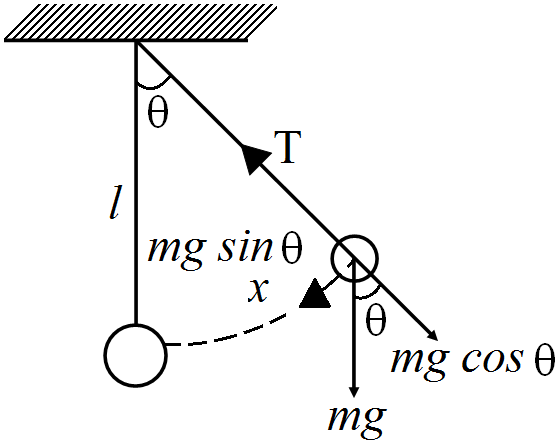
Consider a pendulum of length l and mass of bob m is displaced by angle $\theta$ as shown in fig.

The restoring force = F $=\text{mg}\sin\theta$

If $\theta$ is small then $\sin\theta=\theta=\frac{\text{arc}}{\text{radius}}=\frac{\text{x}}{\text{l}}$

$\therefore\text{F}=-\text{mg}\frac{\text{x}}{1}\ \text{or}\ \text{F}\propto(-\text{x})$

$(\because\text{m}_2\text{g},1\text{are constant})$

Hence, the motion of simple pendulam will be smile harmonic for small angle $\theta.$

Need a full question paper?

Generate a complete, print-ready paper with questions like this in minutes — across 16+ boards, with answer keys.

Start Generating Free

Similar questions

The specific heat capacities of hydrogen at constant volume and at constant pressure are 2.4cal-g-1 °C−1 and 3.4cal-g-1 °C-1 respectively. The molecular weight of hydrogen is 2g-mol-1 and the gas constant, R = 8.3 × 10⁷ erg°C-1 mol-1. Calculate the value of J.
Find the range of frequency of light that is visible to an average human being $(400\text{nm}<\lambda<700\text{nm}).$
A circular coil of one turn of radius 5.0cm is rotated about a diameter w!th a constant angular speed of 80 revolutions per minute. A uniform magnetic field B = 0.010T exists in a direction perpendicular to the axis of rotation. Find
  1. The maximum emf induced.
  2. The average emf induced in the coil over a long period.
  3. The average of the squares of emf induced over a lone period.
A point source emitting light uniformly in all directions is placed 60cm above a table-top. The illuminance at a point on the table-top, directly below the source, is 15 lux. Find the illuminance at a point on the table-top 80cm away from the first point.
At a depth of $\text{1000 m}$ in an ocean (a) what is the absolute pressure? (b) What is the gauge pressure? (c) Find the force acting on the window of area $\text{20 cm} \times \text{20 cm}$ of a submarine at this depth. the interior of which is maintained at sealevel atmospheric pressure. (The density of sea water is $1.03 \times 10^3 kg m ^{-3}$, $g=10 m s ^{-2}$.)
The momentum p of a particle changes with time t according to the relation $\frac{\text{dp}}{\text{dt}}=(10\text{N})+(2\text{N/s)t}.$ If the momentum is zero at t = 0, what will the momentum be at t = 10s?
The Sun is a hot plasma (ionized matter) with its inner core at a temperature exceeding 107K, and its outer surface at a temperature of about 6000K. At these high temperatures, no substance remains in a solid or liquid phase. In what range do you expect the mass density of the Sun to be, in the range of densities of solids and liquids or gases? Check if your guess is correct from the following data : mass of the Sun = 2.0 × 1030kg, radius of the Sun = 7.0 × 10⁸m.
A long, straight wire of radius r carries a current i and is placed horizontally in a uniform magnetic field B pointing vertically upward. The current is uniformly distributed over its cross-section.
  1. At what points will the resultant magnetic field have maximum magnitude? What will be the maximum magnitude?
  2. What will be the minimum magnitude of the resultant magnetic field?
The voltage across a lamp is $\text{V}=(6.0\pm0.1)$ Volt and the current passing through it $\text{I}=(4\pm0.2)$ ampere. Find the power consumed by the electric lamp. Given that power, P = VI
When an apple falls from a tree what happens to its gravitational potential energy just as it reaches the ground? After it strikes the ground?