Question
Where does fertilization occur?

Answer

In the Fallopian tube.

Need a full question paper?

Generate a complete, print-ready paper with questions like this in minutes — across 16+ boards, with answer keys.

Start Generating Free

Similar questions

State three ways in which roots are suited for absorbing water.
Give Reasons
Missing of menses is the first indication of pregnancy.
The diagram given below is that of a developing human fetus in the womb. Study the same and then answer the questions that follow:
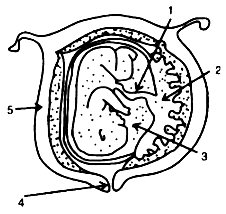
(i) Name the parts’l’ to ‘5’ indicated by guidelines.
(ii) What term is given to the period of development of the fetus in the womb?
(iii) How many days does the fetus take to be fully developed?
(iv) Mention two functions of the parts labeled ‘2’ other than its endocrine function.
(y) Name the hormone (anyone) produced by the part labeled ‘2’.
(vi) What is The function of the part marked ‘3’?
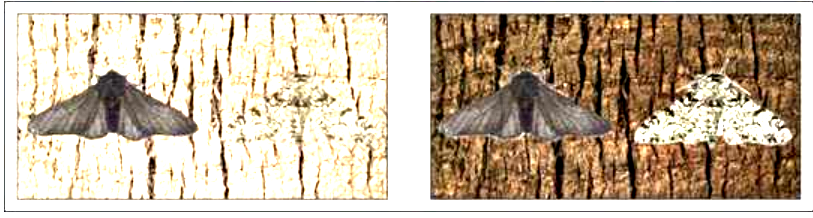
Given alongside are two figures (A and B) showing a phenomenon that was first observed in Manchester before and after the year 1850.

Briefly mention why the changes shown in the two figures appeared.
Suppose you are given two pairs of contrasting characters: Seed colour → yellow and green , seed coat → round and wrinkled.
Fill in the following table to show that $F_2$ generation according to the principle of independant assortment as given by Mendel.
Selfing among hybrids of $F_1​​​​​​​$​​​​​​​ RY Ry rY ry
RY        
Ry        
rY        
Ry        
$F_2​​​​​​​$​​​​​​​ generation        
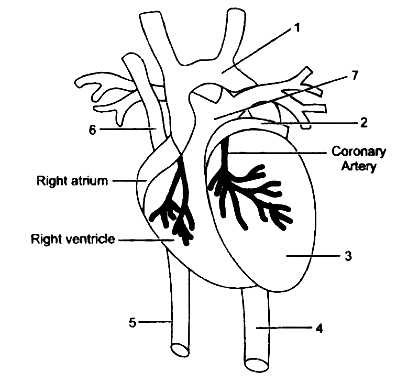
Given alongside is a diagram of the external features of the heart.
(i) Name the parts$ ‘1’$ to $‘7’.$
(ii) What happens if the coronary artery gets an internal clot?
(iii) Which type of blood does part$ ‘5’ $carry?
(iv) Mention one structural difference between part ‘5’ and$ ‘4’.$
What is the significance of mitosis?
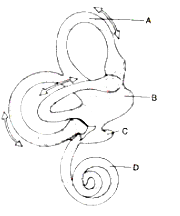
The diagram alongside represents the structure found in the inner ear. Study the same and then answer the questions that follow:
(i) Name the parts labelled A, B, C and D.
(ii) Name the parts of the ear responsible for transmitting impulses to the brain.
(iii) Name the part labelled above which is responsible for:
1. Static equilibrium. 2. Dynamic equilibrium. 3. Hearing
(iv) Name the audio receptor cells which pick up vibrations.
(v) Name the fluid present in the inner ear.
A candidate studied the importance of certain factors in photosynthesis. He took a potted plant and kept in the dark for over 24 hours. In the early hours of the next morning, he covered one of the leaves with black paper in the centre only. Then he placed the plant in sunlight for a few hours and tested the leaf which was covered with black paper for starch.
Describe step by step, how the candidate proceeded to test the leaf for the presence of starch?