Where would the image be formed by a convex mirror if the object is placed:
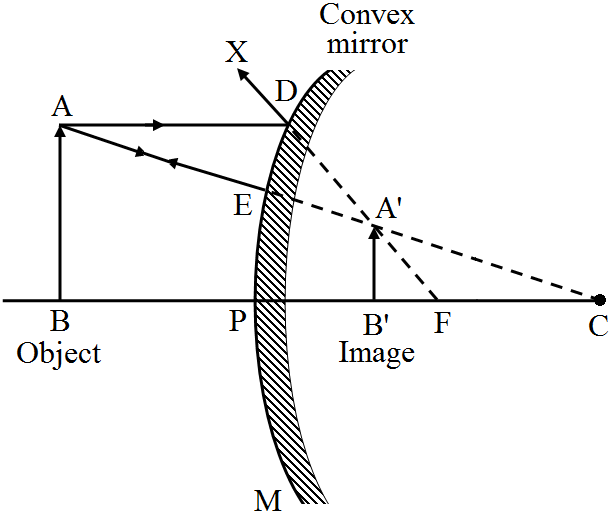
- Between infinity and pole of the mirror?
- At infinity?
Download our app for free and get started
- Image will form between pole and focus.
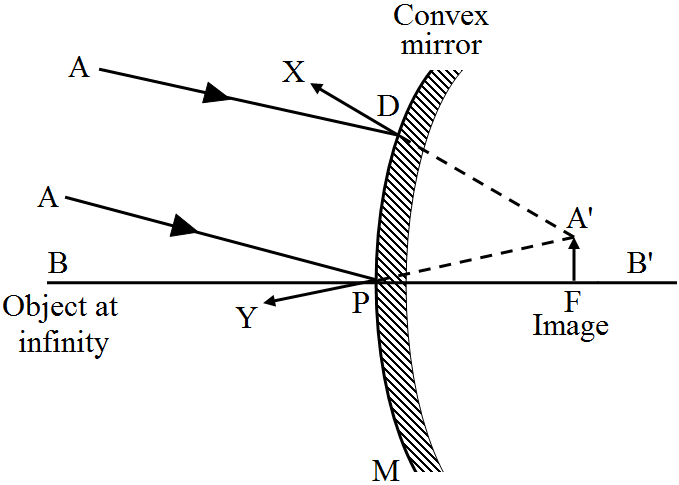
- At focus.

Download our appand get started for free
Experience the future of education. Simply download our apps or reach out to us for more information. Let's shape the future of learning together!No signup needed.*
Similar Questions
- 1View SolutionDiscuss the case when a convex lens forms a virtual and enlarged image.
- 2View SolutionWith the help of a labelled diagram explain how a convex lens converges a beam of parallel light rays.
- 3View SolutionWhat is observed when 2mL of dilute hydrochloric acid is added to 1g of sodium carbonate taken in a clean and dry test tube? Write chemical equation for the reaction involved.
- 4The speed of light in water is $2.25 \times 10^8 m / s$. If the speed of light in vacuum be $3 \times 10^8 m / s$, calculate the refractive index of water.View Solution
- 5View SolutionWhy does a ray of light passing through the centre of curvature of a concave mirror gets reflected along same path after reflection?
- 6View SolutionList four properties of the image formed by a plane mirror.
- 7View SolutionName the two types of spherical mirrors. What type of mirror is represented by the:
- Back side of a shining steel spoon?
- Front side of a shining steel spoon?
- 8View SolutionAn object is placed at a distance of 6cm from a convex mirror of focal length 12cm. Find the position and nature of the image.
- 9View SolutionList two possible ways in which a concave mirror can produce a magnified image of an object placed in front of it. State the difference, if any, between these two images.
- 10View SolutionA wall reflects light and a mirror also reflects light. What difference is there in the way they reflect light?