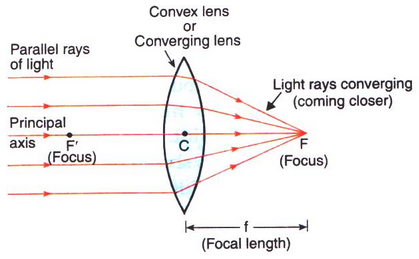
With the help of a labelled diagram explain how a convex lens converges a beam of parallel light rays.
Download our app for free and get started
When a beam of light rays parallel to one another and also to the principal axis of the convex lens fall on the lens, the incident rays pass through the lens and get refracted according to the laws of refraction. All the rays, after passing through the lens, converge at the same point F (focus) on the other side of the lens.

Download our appand get started for free
Experience the future of education. Simply download our apps or reach out to us for more information. Let's shape the future of learning together!No signup needed.*
Similar Questions
- 1View SolutionAn object is placed at a distance of 15 cm from a concave lens of focal length 30 cm. List four characteristics (nature, position, etc.) of the image formed by the lens.
- 2View SolutionDiscuss the case when a convex lens forms a virtual and enlarged image.
- 3View SolutionDescribe the nature of image formed when the object is placed at a distance of 20cm from a concave mirror of focal length 10cm.
- 4View SolutionDraw a ray diagram to show the formation of a real diminished image of an object by a convex lens. In your diagram, the position of object and image with respect to the principal focus should be shown clearly.
- 5View SolutionShow by drawing a ray-diagram that the image of an object formed by a concave lens is virtual, erect and diminished.
- 6View SolutionList some things that concave lens and convex mirror have in common.
- 7Light enters from air into diamond which has a refractive index of 2.42. Calculate the speed of light in diamond. The speed of light in air is $3.0 \times 10^8 ms^{-1}$.View Solution
- 8View SolutionState the uses of plane mirrors.
- 9View SolutionDraw ray diagrams showing the image formation by a convex lens when an object is placed:
Between optical centre and focus of the lens. - 10View Solution
Explain how to read the following message which was found on some blotting paper:
