Question
Whether there had been mock drill by fire fighters under the disaster management scheme in your school? Which techniques did you see during the drill?

Answer

We observe very interesting and informative things during the drills at our school. We learnt the following things from the fire fighters.
(i) How to rescue ourselves and others if there is any emergency in the classroom.
(ii) Switch off the mains if there is fire.
(iii) As we get any signal from smoke detectors, we must run out of closed places.
(iv) Classroom should have sand bags.
(v) If there is fire, contact fire brigade immediately. 
(vi) We came to know about what action should be taken if clothes catch fire.
(vii) We also came to know, how to rescue people or students stuck up at some height.

Need a full question paper?

Generate a complete, print-ready paper with questions like this in minutes — across 16+ boards, with answer keys.
Start Generating Free

Similar questions

Write Short note: Budding in hydra.
Complete the chart as per the objectives of first aid.
Remediation is the process of removing dangerous or poisonous substances from the environment, or limiting the effect that they have on it. When any biological organism is used for remediation, it is called bioremediation. When plant species are used for the purpose of remediation, it is called phytoremediation. When any microbes are used then it is named as microbial remediation. The methods of such remediation have helped to clean the environment from toxic effluents, especially sewage and crude oil. Dr. Anand Chakraborty, a scientist of Indian origin, has worked on Pseudomonas aeruginosa which have reduced the crude oil films into carbon dioxide and water.
1.What is the meaning of remediation?
2.What is the difference between phytoremediation and microbial remediation?
3.Which environmental pollutant is mainly removed through bioremediation processes?
4.What is the role of Pseudomonas aeruginosa?
5.Why Dr. Anand Chakraborty’s work phenomenal?
A camera fitted with a lens of focal length 50mm is being used to photograph a flower that is 5cm in diameter. The flower is placed 20cm in front of the camera lens.
  1. At what distance from the film should the lens be adjusted to obtain a sharp image of the flower?
  2. What would be the diameter of the image of the flower on the film?
  3. What is the nature of camera lens?
What are macromolecules? Explain Natural and manmade macromolecule.
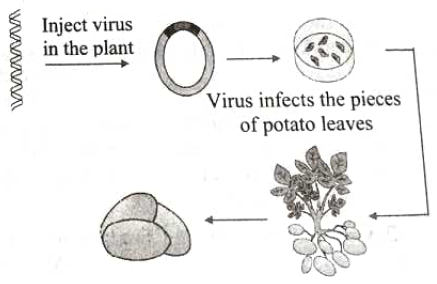
Observe the figure and answer the following questions:
Image
i. Identify the process given in the above figure.
ii. Write the importance of above process.
iii. Write any two benefits of Biotechnology.
Write short note: Cybercrimes.
Sketch, label and classify the following organisms: Liverfluke.
  1. Match the terms given in column I with the terms given in column II and column III having the same meaning:
  1.   Column I Column II Column III
    (i)
    Secondary consumer
    Herbivore
    $1^{st}$ trophic level
    (ii)
    Primary consumer
    Autotroph
    $3^{rd}$ trophic level
    (iii)
    Producer
    Carnivore
    $4^{th}$ trophic level
    (iv)
    Tertiary consumer
    Large carnivore
    $2^{nd}$ trophic level
  2. Give one example of a food chain having four organisms. Below each organism write the three appropriate terms from the part $(a)$ above which you think it represents.
What are the three R’s to save the environment? Explain with one example of each.