Question
Which among the following is an example of a semiconductor?

Answer

  1. Cuprous oxide
Explanation:
Iron, Copper, Aluminium are metals and are therefore conductors whereas Cuprous oxide is a semiconductor.

Need a full question paper?

Generate a complete, print-ready paper with questions like this in minutes — across 16+ boards, with answer keys.
Start Generating Free

Similar questions

A manufacturer uses a concave lens instead of a convex lens in a magnifying glass by mistake. What will be the effect on the working of the lens?
An energy source will supply a constant current into the load if its internal resistance is:
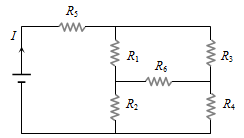
In the given circuit, it is observed that the current $I$ is independent of the value of the resistance $R_6.$ Then the resistance values must satisfy
When light is incident on a diffraction grating the zero order principal maximum will be (a) One of the component  colours(b) Absent(c) Spectrum of the colours(d) White
   
   
A conducting rod of length L is falling with velocity V in a uniform horizontal magnetic field B normal to the rod. The induced emf between the ends the rod will be:
A circular coil of $500$ turns of wire has an enclosed area of $0.1 \mathrm{~m}^2$ per turn. It is kept perpendicular to a magnetic field of induction $0.2 T$ and rotated by $180^\circ $ about a diameter perpendicular to the field in $0.1 \sec.$ How much charge will pass when the coil is connected to a galvanometer with a combined resistance of $50$ ohms
The $SI$ unit of surface charge density is:
An equiconvex lens of glass of focal length $0.1$ metre is cut along a plane perpendicular to principle axis into two equal parts. The ratio of focal length of new lenses formed is
Among the following properties describing diamagnetism identify  the property that is wrongly stated(a) Diamagnetic material do not have permanent magnetic moment(b) Diamagnetism is explained in terms of electromagnetic induction(c) Diamagnetic materials have a small positive susceptibility(d) The magnetic moment of individual electrons neutralize each other


Two equally charged, identical metal spheres A and B repel each other with a force 'F'. The spheres are kept fixed with a distance 'r' between them. A third identical, but uncharged sphere C is brought in contact with A and then placed at the mid-point of the line joining A and B. The magnitude of the net electric force on C is (a) F(b) 3F/4(c) F/2     (d) F/4