MCQ
Which force is dissipative force?
  • A
    Electrostatic force.
  • B
    Magnetic force.
  • C
    Gravitational force.
  • D
    Frictional force.

Answer

  1. Frictional force.

​​​​​​​​​​​​​​Explanation:

Frictional force is a non-conservative force because work done by it is dissipated (wasted) as heat energy. This is not the case with other forces.

Need a full question paper?

Generate a complete, print-ready paper with questions like this in minutes — across 16+ boards, with answer keys.
Start Generating Free

Similar questions

The pressure of a medium is changed from $1.01 × 10^5$ $Pa$ to $1.165 × 10^5$ $Pa$ and change in volume is $10\% $ keeping temperature constant. The Bulk modulus of the medium is
Consider two containers A and B containing identical gases at the same pressure, volume and temperature. The gas in container A is compressed to half of its original volume isothermally while the gas in container B is compressed to half of its original value adiabatically. The ratio of final pressure of gas in B to that of gas in A is
A given quantity of an ideal gas is at pressure P and absolute temperature T. The isothermal bulk modulus of the gas is:
The image formed by a concave mirror:
  1. Is always real.
  2. Is always virtual.
  3. Is certainly real if the object is virtual.
  4. Is certainly virtual if the object is real.
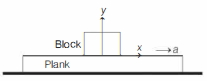
A plank is moving in a horizontal direction with a constant acceleration $\alpha \hat{ i }$. A uniform rough cubical block of side $l$ rests on the plank and is at rest relative to the plank. Let the centre of mass of the block be at $(0, l / 2)$ at a given instant. If $\alpha =g / 10$, then the normal reaction exerted by the plank on the block at that instant acts at
A body of mass $‘m’$ is dropped from a height of $‘h’$. Simultaneously another body of mass $2m$ is thrown up vertically with such a velocity $v$ that they collide at the height $h/2$. If the collision is perfectly inelastic, the velocity at the time of collision with the ground will be :
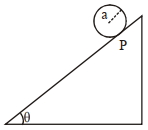
A solid disc of radius $'a'$ and mass $'m'$ rolls down without slipping on an inclined plane making an angle $\theta$ with the horizontal. The acceleration of the disc will be $\frac{2}{ b } g \sin \theta$ where $b$ is $........$. (Round off to the Nearest Integer)

$( g =$ acceleration due to gravity)

$(\theta=$ angle as shown in figure $)$
A glass flask of volume $200 \,cm ^3$ is just filled with mercury at $20^{\circ} C$. The amount of mercury that will overflow when the temperature of the system is raised to $100^{\circ} C$ is ........ $cm ^3$ $\left(\gamma_{\text {glase }}=1.2 \times 10^{-5} / C ^{\circ}, \gamma_{\text {mercury }}=1.8 \times 10^{-4} / C^{\circ}\right)$
Molar specific heat at constant volume, for a non-linear triatomic gas is (vibration mode neglected)
Which pair has the same dimensions