MCQ
Which gives difference between aldehyde and ketone
  • A
    Fehling's solution
  • B
    Tollen's reagent
  • C
    Schiff's reagent
  • All of these

Answer

Correct option: D.
All of these
d
(d) Fehling solution $⇒$ Alkaline $CuS{O_4} + Na - K$ tartarate

Tollen’s reagent $⇒$ $N{H_4}OH + AgN{O_3}$

Schiff’s reagent $⇒$ $P-$rosaniline hydrochloride or magneta

Benedict’s solution $⇒$ Alkaline $CuS{O_4} + $Citrate ions

All these reagents are used to distinguish between aldehydes and ketones.

Aldehydes reacts with all these reagents while ketones do not react.

Need a full question paper?

Generate a complete, print-ready paper with questions like this in minutes — across 16+ boards, with answer keys.

Start Generating Free

Similar questions

In a surface tension experiment with a capillary tube water rises upto $0.1\, m$. If the same experiment is repeated on an artificial satellite, which is revolving around the earth, water will rise in the capillary tube upto a height of
A man starts walking from a point on the surface of earth (assumed smooth) and reaches diagonally opposite point. What is the work done by him
A $5.0\, \mu F$ capacitor is charged to a potential difference $800\, V$ and discharged through a conductor. The energy(in $J$) given to a conductor during the discharge is
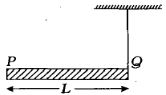
A rod $PQ$ of mass $M$ and length $L$ is hinged at end $P.$ The rod is kept horizontal by a massless string tied to point $Q$ as shown in figure. When string is cut, the initial angular acceleration of the rod is
The relation between the linear magnification $m,$ the object distance $u$ and the focal length $f$ is
A bar is subjected to axial forces as shown. If $E$ is the modulus of elasticity of the bar and $A$ is its crosssection area. Its elongation will be
A balloon of mass $m$ contains water of mass $M$ . If it is completely immersed in water, find the apparent mass of the balloon with water in it
Which of the following is not a correct statement
A large spherical mass $M$ is fixed at one position and two identical point masses $m$ are kept on a line passing through the centre of $M$ (see figure). The point masses are connected by a rigid massless rod of length $\ell$ and this assembly is free to move along the line connecting them. All three masses interact only through their mutual gravitational interaction. When the point mass nearer to $M$ is at a distance $r =3 \ell$ from $M$, the tension in the rod is zero for $m=k\left(\frac{M}{288}\right)$. The value of $k$ is
Assertion : The colour of the green flower seen through red glass appears to be dark.

Reason : Red glass transmits only red light.
