Question
Write comments on the following:
(a) Pauli's exclusion law
(b) n +$l$ rule

Answer

SELF

Need a full question paper?

Generate a complete, print-ready paper with questions like this in minutes — across 16+ boards, with answer keys.
Start Generating Free

Similar questions

0.2325g of an organic compound was analysed for nitrogen by Duma's method 0.0317L of moist nitrogen was collected at 25°C and 755.8mm pressure. Calculate the percentage of nitrogen. [Aq. tension of water at 25°C is 23.8mm Hg.)
The pH of milk, black coffee, tomato juice, lemon juice and egg white are 6.8, 5.0, 4.2, 2.2 and 7.8 respectively. Calculate corresponding hydrogen ion concentration in each.
1. a. Define the following terms:
i. Enantiomers
ii. Racemic mixture
b. Why is chlorobenzene resistant to nucleophilic substitution reaction?
2. What is the general molecular formula of saturated monohydric alcohols?
How the IUPAC nomenclature of derivatives of Benzene is done? Explain with example.
Ethyl acetate is formed by the reaction between ethanol and acetic acid and the equilibrium is represented as:
$\text{CH}_3\text{COOH (1) + C}_2\text{H}_5\text{OH (1)}\rightleftharpoons\text{CH}_3\text{COOC}_2\text{H}_5 \text{ (1) + H}_2\text{O (1)}$
At 293K, if one starts with 1.00mol of acetic acid and 0.18mol of ethanol, there is 0.171mol of ethyl acetate in the final equilibrium mixture. Calculate the equilibrium constant.
Explain the important aspects of resonance with reference to the $\text{CO}^{2-}_3$− ion.
What is the maximum concentration of equimolar solutions of ferrous sulphate and sodium sulphide so that when mixed in equal volumes, there is no precipitation of iron sulphide? (For iron sulphide, Ksp = 6.3 × 10⁻¹⁸).
Describe the hybridisation in case of $PCl _5$. Why are the axial bonds longer as compared to equatorial bond?
Explain different definitions of oxidation and reduction processess with example.
Attempt any five of the following:
1. Why are Alkenes called olefins?
2. Convert 1-bromopropane to 2-bromopropane.
3. If Qc < Kc, when we continuously remove the product, what would be the direction of the reaction?
4. Convert methane into ethane.
5. What are cycloalkanes?
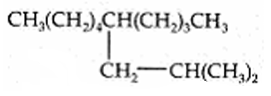
6. Write IUPAC name of following:
Image
7. How will you convert ethanoic acid into ethene?