MCQ
Which is the correct order of decreasing reactivity of metals?
  • $\ce{K > Na > Cu > Au}$
  • B
    $\ce{Na > Au > Cu > K}$
  • C
    $\ce{Cu > Na > K > Au}$
  • D
    $\ce{Au > Cu > Na > K}$

Answer

Correct option: A.
$\ce{K > Na > Cu > Au}$
Asbesto : was used for fireproof suits due to its high resistance to fire and heat.
Now a days, use of asbestos is banned in many countries because inhalation of asbestos fibres can cause a number of serious illness, including cancer.
Nomex : is a fire resistant nylon. Fire proof suits are made of nomex.
Kermel : is another fibre used as heat and flame protecting clothing.

Need a full question paper?

Generate a complete, print-ready paper with questions like this in minutes — across 16+ boards, with answer keys.
Start Generating Free

Similar questions

The nitrogen atom has $ 7$  protons and $7$  electrons, the nitride ion $({N^{3 - }})$ will have
The empirical formula of a compound is $CH$. Its molecular weight is $78$. The molecular formula of the compound will be
The number of ionic, covalent and coordinate bonds in $N{H_4}Cl$ are respectively
Two radiations having energies $E_1$ and $E_2$ as $15\,eV$ and $45\, eV$ respectively  then the relationship in between $\lambda_1$ and $\lambda_2$ will be
The correct set of oxidation numbers of $Br$ in $Br_3O_8$ is
Which of the following pairs show reverse properties on moving along a period from left to right and from top to bottom in a group?
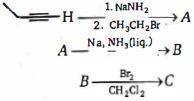
What is the final product, $C$ of the following reaction sequence ?
The compounds that will give an isomer of  $2; 2-$ dimethyl propane on catalytic hydrogenation are

$(1)$ $\begin{array}{*{20}{c}}
  {C{H_3}CH = C - C{H_3}} \\ 
  {\,\,\,\,\,\,\,\,\,\,|} \\ 
  {\,\,\,\,\,\,\,\,\,\,\,\,\,\,\,\,C{H_3}} 
\end{array}$

$(2)$ $C{H_3}CH = CHC{H_3}$

$(3)$ $\mathop {C{H_3}C}\limits^{\begin{subarray}{l} 
  \,\,\,\,\,\,\,\,{\begin{array}{*{20}{c}}
  {}&H 
\end{array}} \\ 
  \,\,\,\,\,\,\,\,\,\,\,\,\,\,| 
\end{subarray} }  = CHC{H_2}C{H_3}$

$(4)$ $\begin{array}{*{20}{c}}
  {C{H_3}C = C - C{H_3}} \\ 
  {\,\,\,\,\,\,\,|\,\,\,\,\,\,\,\,\,\,\,\,|\,\,\,\,\,\,\,\,\,\,\,\,\,} \\ 
  {\,\,\,\,\,\,\,\,\,\,\,\,\,C{H_{3\,\,}}\,\,C{H_3}\,\,\,\,\,\,\,\,\,\,\,\,\,\,\,\,} 
\end{array}$

Consider the following route of reactions ${R_2}SiC{l_2} + Warer \to \left( A \right)\xrightarrow{{Polymarisation}}\left( B \right)$ 

Compound $(B)$ in above reaction is

Pyrolysis of ethyl acetate gives :