Question
Which methodology is used while sequencing the total DNA from a cell? Explain it in detail.

Answer

Methodologies of HGP:

The methods involve two major approaches:

  1. Expressed sequence tags (ESTs): This method focusses on identifying all the genes that are expressed as RNA.

  2. Sequence annotation: It is an approach of simply sequencing the whole set of genome that contains all the coding and non-coding sequences, and later assigning different regions in the sequence with functions.

  • For sequencing, the total DNA from cell is first isolated and broken down in relatively small sizes as fragments.
  • These DNA fragments are cloned in suitable host using suitable vectors. When bacteria is used as vector, they are called bacterial artificial chromosomes (BAC) and when yeast is used as vector, they are called yeast artificial chromosomes (YAC).
  • Frederick Sanger developed a principle according to which the fragments of DNA are sequenced by automated DNA sequences.
  • On the basis of overlapping regions on DNA fragments, these sequences are arranged accordingly.
  • For alignment of these sequences, specialised computer-based programmes were developed.
  • Finally, the genetic and physical maps of the genome were constructed by collecting information about certain repetitive DNA sequences and DNA polymorphism, based on endonuclease recognition sites.

Need a full question paper?

Generate a complete, print-ready paper with questions like this in minutes — across 16+ boards, with answer keys.
Start Generating Free

Similar questions

(a) Draw the diagram of human sperm and label the cellular component. Also mention the functions of three components.
(b) Where does the head of sperm remain embedded in spermatogenesis.
Drugs and alcohol give short-term 'relief and long term 'damages'. Discuss.
You are given a red flower–bearing pea plant and a red flower–bearing snapdragon plant. How would you find the genotypes of these two plants with respect to the colour of the flower? Explain with the help of crosses. Comment upon the pattern of inheritance seen in these two plants.
Represent schematically the life cycle of a malarial parasite.
Explain briefly the ‘rivet popper hypothesis’ of Paul Ehrlich.
A pregnant human female was advised to undergo M.T.P. It was diagnosed by her doctor that the foetus she is carrying has developed from a zygote formed by an XX egg fertilised by Y–carrying sperms. Why was she advised to undergo M.T.P.?
What is mutualism? Describe any four examples.
What is Human genome project. Present its features and explain its mechanism.
Explain the events upto fertilisation that occur in a flower after the pollen grain has landed on its compatible stigma.
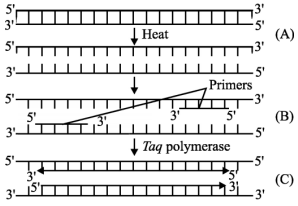
The melding of a technique for repeated rounds of DNA synthesis with the discovery of a thermostable DNA polymerase has given scientists the very powerful technique known as polymerase chain reaction (PCR). PCR is based on three simple steps required for any DNA synthesis reaction: (1) denaturation of the template into single strands; (2) annealing of primers to each original strand for new strand synthesis; and (3) extension of the new DNA strands from the primers.
In the given figure, one cycle of polymerase chain reaction (PCR) is shown:
Image
i. Name the steps A, B and C.
ii. Give the purpose of each of these steps.
iii. State the contribution of Thermus aquaticus in this process.