Question
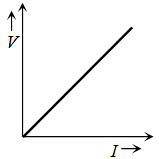
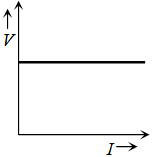
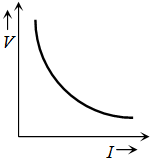
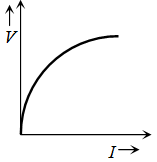
Which of the adjoining graphs represents ohmic resistance
(a)
|
(b)
|
(c)
|
(d)
|
Which of the adjoining graphs represents ohmic resistance
|
(a)
|
(b)
|
(c)
|
(d)
|
Generate a complete, print-ready paper with questions like this in minutes — across 16+ boards, with answer keys.
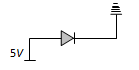
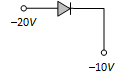
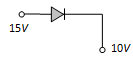
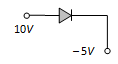
Which is reverse biased diode
|
(a)
|
(b)
|
(c)
|
(d)
|
The equivalent inductance of two inductances is 2.4 henry when connected in parallel and 10 henry when connected in series. The difference between the two inductances is
|
(a) 2 henry |
(b) 3 henry |
(c) 4 henry |
(d) 5 henry |
A straight conductor carries a current of 5A. An electron travelling with a speed of 5  parallel to the wire at a distance of 0.1m from the conductor, experiences a force of
|
(a) 8 |
(b) 3.2 |
(c) 8 |
(d) 1.6 |
Assertion : Only a change in magnetic flux will maintain an induced current the coil.
Reason : The presence of large magnetic flux through a coil maintains a current in the coil if the circuit is continuous.
|
(a) If both assertion and reason are true and the reason is the correct explanation of the assertion. |
|
(b) If both assertion and reason are true but reason is not the correct explanation of the assertion. |
|
(c) If assertion is true but reason is false. |
|
(d) If the assertion and reason both are false. |
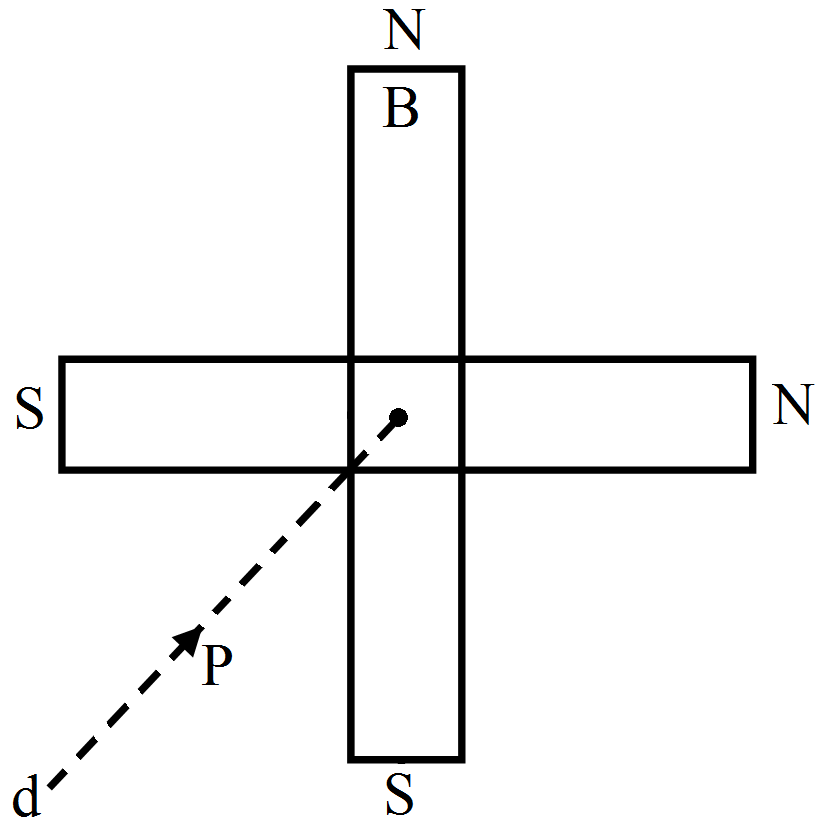
$\frac{\mu_0}{4\pi}\frac{2\text{M}}{\text{d}^3}$
Nuclear fission experiments show that the neutrons split the uranium nuclei into two fragments of about same size. This process is accompanied by the emission of several
|
(a) Protons and positrons |
(b) a - particles |
|
(c) Neutrons |
(d) Protons and a-particles |