Question
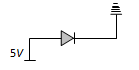
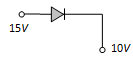
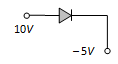
Which is reverse biased diode
|
(a)
|
(b)
|
(c)
|
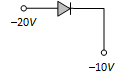
(d)
|
Which is reverse biased diode
|
(a)
|
(b)
|
(c)
|
(d)
|
(b)
Generate a complete, print-ready paper with questions like this in minutes — across 16+ boards, with answer keys.
A man cannot see clearly the objects beyond a distance of 20 cm from his eyes. To see distant objects clearly he must use which kind of lenses and of what focal length
|
(a) 100 cm convex |
(b) 100 cm concave |
(c) 20 cm convex |
(d) 20 cm concave |
The magnitude of i in ampere unit is

|
(a) 0.1 |
(b) 0.3 |
(c) 0.6 |
(d) None of these |
A double convex thin lens made of glass (refractive index μ = 1.5) has both radii of curvature of magnitude 20 cm. Incident light rays parallel to the axis of the lens will converge at a distance L such that
|
(a) L = 20 cm |
(b) L = 10 cm |
(c) L = 40 cm |
(d) L = 20 / 3 cm |
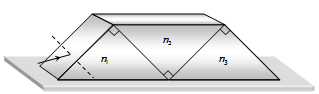
Three right angled prisms of refractive indices  and
and  are fixed together using an optical glue as shown in figure. If a ray passes through the prisms without suffering any deviation, then
|
(a) |
(b) |
|
(c) |
(d) 1 + |
A copper voltameter is connected in series with a heater coil of resistance 0.1 Ω. A steady current flows in the circuit for twenty minutes and mass of 0.99 g of copper is deposited at the cathode. If electrochemical equivalent of copper is 0.00033 gm/C, then heat generated in the coil is
|
(a) 750 J |
(b) 650 J |
(c) 350 J |
(d) 250 J |
If the energy released in the fission of one nucleus is 200 MeV. Then the number of nuclei required per second in a power plant of 16 kW will be
|
(a) 0.5 |
(b) 0.5 |
(c) 5 |
(d) 5 |