MCQ
Which of the following alkanes can be synthesized by the Wurtz reaction in good yield?
  • A
    $ \left(\mathrm{CH}_3\right)_2 \mathrm{CH}-\mathrm{CH}_2-\mathrm{CH}\left(\mathrm{CH}_3\right)_2 $
  • $ \left(\mathrm{CH}_3\right)_2 \mathrm{CH}-\mathrm{CH}_2-\mathrm{CH}_2-\mathrm{CH}\left(\mathrm{CH}_3\right)_2 $
  • C
    $ \mathrm{CH}_3-\mathrm{CH}_2-\mathrm{C}\left(\mathrm{CH}_3\right)_2 \mathrm{CH}_2-\mathrm{CH}_3 $
    ​​
  • D
    $ \left(\mathrm{CH}_3\right)_3 \mathrm{C}-\mathrm{CH}_2-\mathrm{CH}_2-\mathrm{CH}_3 $
Answer

Correct option: B.
$ \left(\mathrm{CH}_3\right)_2 \mathrm{CH}-\mathrm{CH}_2-\mathrm{CH}_2-\mathrm{CH}\left(\mathrm{CH}_3\right)_2 $
An even number of symmetrical alkyl halides can easily undergo Wurtz reaction as these form symmetrical alkanes which have uniform physical or chemical properties.
A general form of Wurtz reaction is
$\ce{2RX + 2Na \rightarrow R−R + 2NaX}$
Here, $R$ denotes any alkyl group, and $X$ is a halogen atom.
Asymmetric alkanes are not favorable to prepare by Wurtz reaction as the mixture of different products formed which are very difficult to seperate.
In the given options, $B$ is a symmetric alkane that can be easily prepared by the Wurtz reaction.

Need a full question paper?

Generate a complete, print-ready paper with questions like this in minutes — across 16+ boards, with answer keys.

Start Generating Free

Similar questions

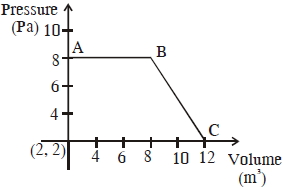
The magnitude of work done by a gas that undergoes a reversible expansion along the path $ABC$ shown in the figure is .............. $\mathrm{Joule}$
Gases possess characteristic critical temperature which depends upon the magnitude of intermolecular forces between the particles. Following are the critical temperatures of some gases.
Gases
$\ce{H_2}$
$\ce{He}$
$\ce{O_2}$
$\ce{n_2}$
Critical temperature in Kelvin
$33.2$ $5.3$ $154.3$ $126$
From the above data what would be the order of liquefaction of these gases? Start writing the order from the gas liquefying first.
$10\,\, mole$ of ideal gas expands isothermally and reversibly from a pressure of $10\,\, atm$ to $1\,\, atm$ at $300\,\, K$. What is the largest mass which can be lifted through a height of $100\,\, meter$  by energy obtained in this process
Assume each reaction is carried out in an open container. For which reaction will $\Delta H = \Delta E$ ?
The cooling in refrigerator is due to
Photon having wavelength $310\  nm$ is used to break the bond of  $A_2$  molecule having bond energy $288\   kJ \  mol^{-1}$ then $\%$ of energy of photon converted to the $K.E.$ is [$hc = 12400\  ev\mathop A\limits^o $ , $1\  eV/atom = 96 \ kJ/mol$]
The electronic configuration of four elements are

$(I)\,[Xe]\, 6s^1$                              $(II)\,[Xe]\,4f^{14}\,5d^1\,6s^2$

$(III)\,[Ar]\,4s^2\,4p^5$                    $(IV)\,[Ar]\,3d^7,\,4s^2$

Select the incorrect statement about these elements

For the reaction $FeC{O_{3(s)}} \to Fe{O_{(s)}} + C{O_{2(g)}}$ $\Delta H=82.8\,kJ$ at $25\,^oC$. What is $\Delta U$ at $25\,^oC$ ? .......$kJ$
The incorrect relation among the following is
The ratio of the mass percentages of $'C$ $\&$ $H'$ and $'C$ $\&$ $O'$ of a saturated acyclic organic compound$'X'$ are $4 : 1$ and $3 : 4$ respectively. Then, the moles of oxygen gas required for complete combustion of two moles of organic compound $'X$' is