Question
Which of the following cannot be polarized?

Answer

  1. Ultrasonic waves
Explanation:
All the longitudinal waves like sound etc cannot be polarized because the motion of the particles is already in one dimension that is the direction of propagation of wave.
Thus all the transverse waves like electromagnetic waves can be polarized.
Thus, (B) Ultrasonic waves being sound waves having frequency greater than 20kHz but being longitudinal in nature cannot be polarized

Need a full question paper?

Generate a complete, print-ready paper with questions like this in minutes — across 16+ boards, with answer keys.
Start Generating Free

Similar questions

Two identical charged spherical drops each of capacitance C merge to form a single drop. The resultant capacitance is(a) Equal to 2C (b) Greater than 2C (c) Less than 2C but greater than C(d) Less than C
   
   
The half life of a radioactive element which has only $\frac{1}{32}$  of its original mass left after a lapse of $60$ days is
Kirchoff’s I law and II law of current, proves the(a) Conservation of charge and energy(b) Conservation of current and energy(c) Conservation of mass and charge(d) None of these


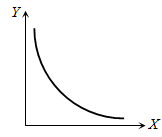
What physical quantities may $X$  and $Y$  represent ? $(Y$ represents the first mentioned quantity$)$
When light is refracted from air into glass(a) Its wavelength and frequency both increase(b) Its wavelength increases but frequency remains unchanged(c) Its wavelength decreases but frequency remains unchanged(d) Its wavelength and frequency both decrease


A source of e.m.f. E = 15 V and having negligible internal resistance is connected to a variable resistance so that the current in the circuit increases with time as i = 1.2 t + 3. Then, the total charge that will flow in first five second will be(a) 10 C(b) 20 C(c) 30 C(d) 40 C
       
When is the effective capacitance of a capacitor increased?
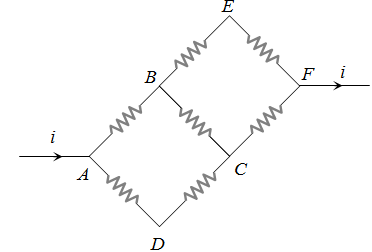
In the adjoining circuit diagram each resistance is of $10 W$. The current in the arm $AD$ will be
Three transparent media of refractive indices $\mu_1,\mu_2$ and $\mu_3.$ A point object $O$ is placed in the medium $\mu_2.$ If the entire medium on the right of the spherical surface has refractive index $\mu_1,$ the image forms at $O\ '$. If this entire medium has refractive index $\mu_3,$ the image forms at $O"$. In the situation shown:
Resistance in the two gaps of a meter bridge are 10 ohm and 30 ohm respectively. If the resistances are interchanged the balance point shifts by(a) 33.3 cm(b) 66.67cm(c) 25 cm(d) 50 cm