Question
Which of the following cannot travel in vacuum?

Answer

  1. Infrasonic waves
Explanation:
Radio waves, gamma waves, and infrared waves are electromagnetic waves and due to this they do not need any material medium to travel and hence, can travel in vacuum. Whereas, infrasonic waves are mechanical waves and so, they need a material medium to travel. Therefore, infrasonic waves cannot travel in vacuum.

Need a full question paper?

Generate a complete, print-ready paper with questions like this in minutes — across 16+ boards, with answer keys.
Start Generating Free

Similar questions

The working of dynamo is based on principle of(a) Electromagnetic induction(b) Conversion of energy into electricity(c) Magnetic effects of current(d) Heating effects of current
   
   
A galvanometer of $10$ ohm resistance gives full scale deflection with $0.01$ ampere of current. It is to be converted into an ammeter for measuring $10$ ampere current. The value of shunt resistance required will be
The diameter of each plate of an air capacitor is $4 \ cm$. To make the capacity of this plate capacitor equal to that of $20 \ cm$ diameter sphere, the distance between the plates will be
A man having height 6 m. He observes image of 2 m height erect, then mirror used is(a) Concave(b) Convex(c) Plane(d) None of these
       
If a high power heater is connected to electric mains, then the bulbs in the house become dim, because there is a(a) Current drop(b) Potential drop(c) No current drop(d) No potential drop
       
The impurity atoms which are mixed with pure silicon to make a P-type semiconductor are those of(a) Phosphorus(b) Boron(c) Antimony(d) Copper
       
The magnetic flux linked with a coil, in webers, is given by the equations $\emptyset=3 t^2+4 t+9$ Then the magnitude of induced $e.m.f.$ at $t=2$ second will be
The current is flowing in south direction along a power line. The direction of magnetic field above the power line (neglecting earth's field) is(a) South(b) East(c) North(d) West
       
How does retarding potential vary with the frequency of light causing photoelectric effect?
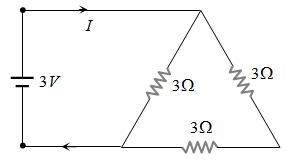
A $3$ volt battery with negligible internal resistance is connected in a circuit as shown in the figure.  The current $I,$ in the circuit will be