MCQ
Which of the following changes, when a particle is moving with uniform velocity?
  • A
    acceleration
  • B
    speed
  • C
    position vector
  • D
    velocity

Answer

C. position vector
Explanation:
position vector

Need a full question paper?

Generate a complete, print-ready paper with questions like this in minutes — across 16+ boards, with answer keys.

Start Generating Free

Similar questions

Energy is being emitted from the surface of a black body at ${127^o}C$ temperature at the rate of $1.0 \times {10^6}J/\sec - {m^2}$. Temperature of the black body at which the rate of energy emission is $16.0 \times {10^6}J/\sec - {m^2}$ will be......... $^oC$
At constant volume the specific heat of a gas is $\frac{{3R}}{2}$, then the value of $'\gamma '$ will be .... 
With the increase in principle quantum number, the energy difference between the two successive energy levels
At a moment in a progressive wave, the phase of a particle executing $S.H.M.$ is $\frac{\pi }{3}$. Then the phase of the particle $15 cm$ ahead and at the time $\frac{T}{2}$ will be, if the wavelength is $60 cm$
Given below in the left column are different modes of communication using the kinds of waves given in the right column

$A.$ Optical Fiber Communication $P.$ Ultrasound
$B.$ Radar $Q.$ Infrared Light
$C.$ Sonar $R.$ Microwaves
$D.$ Mobile Phones $S.$ Radio Waves

From the options given below, find the most appropriate match between entries in the left and the right column
A refrigerator is to maintain eatables kept inside at $9^{\circ} C .$ If room temperature is $36^{\circ} C$ calculate the coefficient of performance.
The average acceleration vector for a particle having a uniform circular motion is
The intensity of sound after passing through a slab decreases by $30\%$. On passing through two such slabs, the intensity will decrease by ..... $\%$
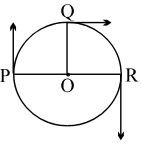
Three point particles $P, Q, R$ move in circle of radius $‘r’$ with different but constant speeds. They start moving at $t = 0$ from their initial positions as shown in the figure. The angular velocities (in rad/ sec) of $P, Q$ and $R$ are $5\pi , 2\pi$ & $3\pi$ respectively, in the same sense. The time interval after which they are at same angular position.
For a material, the refractive indices for red, violet and yellow colour light are respectively $1.52, 1.64$ and $1.60.$ The dispersive power of the material is