MCQ 14 Marks
You are given that mass of ${ }_3^7 L=7.0160 u$,
Mass of ${ }_2^4 He =4.0026 u$
and Mass of ${ }_1^1 H =1.0079 u$
When 20 g of ${ }_3^7 Li$ is converted into ${ }_2^4 He$ by proton capture, the energy liberated, (in kWh ), is:
[Mass of nucleon $=1 GeV / c ^2$ ]
- A
$4.5 \times 10^5$
- B
$8 \times 10^6$
- C
$1.33 \times 10^6$
- D
$6.82 \times 10^5$
AnswerC. $1.33 \times 10^6$
Explanation:
$\begin{array}{l}{ }_3^7 Li +{ }_1^1 H \longrightarrow 2\left({ }_2^4 He \right) \\ \Delta m \rightarrow\left[ m _{ Li }+ m _{ H }\right]-2\left[ M _{ He }\right] \\ \text { Energy released }=\Delta mc ^2 \\ \text { In use of } 1 g Li \text { energy released }=\frac{\Delta m c^2}{m_{ Li }} \\ \text { In use of } 20 g \text { energy released }=\frac{\Delta m c^2}{m Li} \times 20 g \\ =\frac{[(7.016+1.0079)-2 \times 4.0026] u \times c^2}{7.016 \times 1.6 \times 10^{-24}} \times 20 g \\ =\left(\frac{0.0187 \times 1.6 \times 10^{-19} \times 10^9}{7.016 \times 1.6 \times 10^{-24}} \times 20\right)=480 \times 10^{10} J \\ \because 1 J=2.778 \times 10^{-7} kWh \\ \therefore \text { Energy released }=480 \times 10^{10} \times 2.778 \times 10^{-7} \\ =1.33 \times 10^6 kWh \end{array}$
View full question & answer→MCQ 24 Marks
The energy of a hydrogen atom in the ground state is -13.6 eV . The energy of a $He ^{+}$ ion in the first excited state will be:
AnswerA. -13.6 Ev
Explanation:
Energy of a hydrogen atom-like $He ^{+}$in an nth orbit is given by
$E_{n}=-\frac{13.6 Z^2}{n^2} eV$
For hydrogen atom, $Z =1$
$\therefore E_1=-\frac{13.6}{1^2} eV=-13.6 eV$
For $He ^{+}$ion, $Z =2$
$E_{n}=-\frac{4(13.6)}{(n)^2} eV$
For first excited state, $n=2$
$\therefore E_2=-\frac{4(13.6)}{(2)^2} eV=-13.6 eV$
Hence, the energy in $He ^{+}$ion in first excited state is same that of energy of the hydrogen atom in ground state i.e., -13.6 eV .
View full question & answer→MCQ 34 Marks
Einstein's work on the photoelectric effect provided support for the equation:
AnswerB. $E = hv$
Explanation:
Einstein's photoelectric effect & compton effect establish the particle nature of light. These effects can be explained only, when we assume that the light has particle nature (To explain, Interference & diffraction the light must have wave nature. It means that light has both particle and have nature, so it is called dual nature of light).
$KE_{\max }=E_{\text {photon }}-W_0$
The above equation supports:
$E_{\text {photon }}=hv$
It proves that light is in the form of discrete packets of energy and not wave. Otherwise, the light with a lower frequency than the threshold could give enough energy(slowly accumulate) to the electrons to come out of the metal. Hence this theory supports the particle nature of light, as suggested by Einstein.
View full question & answer→MCQ 44 Marks
A metallic surface ejects electrons when exposed to green light of intensity I but no photoelectrons are emitted when exposed to the yellow light of intensity I. Is it possible to eject electrons from the same surface by:
- A
red light of any intensity
- B
yellow light of intensity which is less than I
- C
green light of any intensity
- D
yellow light of intensity which is more than I
AnswerC. green light of any intensity
Explanation:
The ejection of photoelectron does not depends on Intensity but on Frequency. The frequency of yellow and red light is less than that of green light so they can't eject photoelectrons.
View full question & answer→MCQ 54 Marks
- A
increase intensity of light
- B
reduce intensity of light
- C
- D
produce unpolarised light
AnswerC. produce polarised light
Explanation:
Polariser is used in producing polarised light.
View full question & answer→MCQ 64 Marks
A small telescope has an objective lens of focal length 140 cm and an eyepiece of focal length 5.0 cm . The magnifying power of the telescope for viewing distant objects when the final image is formed at the least distance of distinct vision $(=25 cm)$ is:
AnswerB. 33.6
Explanation:
When the final image is formed atleast distance of distinct vision d, magnifying power of the telescope is:
$\begin{array}{l}
m=\frac{f_0}{f_e}\left(1+\frac{f_e}{d}\right)=\frac{140}{5}\left(1+\frac{5}{25}\right) \\
=28[1+0.2]=28 \times 1.2=33.6
\end{array}$
View full question & answer→MCQ 74 Marks
A beam of light of intensity $20 W cm ^{-2}$ falls on a nonreflecting surface at normal incidence. If the area of the surface is $15 cm^2$, the average force exerted on the surface during 30 -minute time span is:
- A
$4 \times 10^{-6} N$
- B
$3 \times 10^{-6} N$
- C
$1 \times 10^{-6} N$
- D
$2 \times 10^{-6} N$
AnswerC. $1 \times 10^{-6} N$
Explanation:
Given that $I =20 W cm ^{-2}$
$\begin{array}{l}
=20 \times 10^4 W m^2 \\
A=15 cm^2=15 \times 10^{-4} m^2 \\
t=30 min,=30 \times 60 s=1800 s
\end{array}$
Total energy falling on the surface
$\begin{array}{l}
U=IAt \\
=\left(20 \times 10^4\right)\left(15 \times 10^{-4}\right)(1800) \\
=5.4 \times 10^5 J
\end{array}$
Total momentum delivered to the surface
$P=\frac{U}{c}=\frac{5.4 \times 10^5}{3 \times 10^8}=1.8 \times 10^{-3} kgms^{-1}$
$\therefore$ Average force,
$F=\frac{d p}{d t}=\frac{1.8 \times 10^{-3}}{1800}=1 \times 10^{-6} N$
View full question & answer→MCQ 84 Marks
If wattless current flows in the AC circuit, then the circuit is
AnswerB. Purely Inductive circuit
Explanation:
Wattless current flow in a circuit only when circuit is resistanceless i.e. circuit is purely capacitive or inductive.
View full question & answer→MCQ 94 Marks
In an inductor of self-inductance $L =2 mH$, current changes with time according to the relation: $I=t^2 e^{-t}$. At what time emf is zero?
AnswerC. 2 s
Explanation:
$\begin{array}{l}
I=t^2 e^{-t} \\
\therefore \quad \frac{d I}{d t}=2 te^{-t}-t^2 e^{-t}=te^{-t}(2-t)
\end{array}$
The induced emf is
$\varepsilon=-L \frac{d I}{d t}$
According to given problem, $\varepsilon=0$ or $\frac{d I}{d t}=0($ since, $L \neq 0)$
or $e^{-t} t(2-t)=0$
either $t=0$ or $t=2 s$
$t=2 s$
View full question & answer→MCQ 104 Marks
A uniform magnetic field $B$ exists in a direction perpendicular to the plane of a square loop made of a metal wire. The wire has a diameter of 4 mm and a total length of 30 cm . The magnetic field changes with time at a steady rate $\frac{d B}{d t}=0.032 Ts ^{-1}$. The induced current in the loop is close to (Resistivity of the metal wire is $1.23 \times 10^{-8} \Omega$ m)
AnswerB. 0.61 A
Explanation:
Given,
Length of wire, $l =30 cm$
Radius of wire, $r =2 mm=2 \times 10^{-3} m$
Resistivity of metal wire, $\rho=1.23 \times 10^{-8} \Omega m$
Emf generated, $|e|=\frac{d \phi}{d t}=\frac{d B}{d t}(A)(\because \phi= BA )$
Current, $i =\frac{e}{R}$
But, resistance of wire, $R =\rho \frac{l}{A}$
$\therefore i=\left|\frac{d B}{d t}\right| \frac{(A)^2}{\rho l}=\frac{0.032 \times\left\{\pi \times 2 \times 10^{-3}\right\}^2}{1.23 \times 10^{-8} \times 0.3}=0.61 A$
View full question & answer→MCQ 114 Marks
The force experienced by a pole of strength 100 Am at a distance of 0.2 m from a short magnet of length 5 cm and pole strength of 200 Am on its axial line will be:
- A
$2.5 \times 10^{-3} N$
- B
$2.5 \times 10^{-2} N$
- C
$5.0 \times 10^{-3} N$
- D
$5.0 \times 10^{-2} N$
AnswerB. $2.5 \times 10^{-2} N$
Explanation: We know that,
$\begin{array}{l}
F=mB \\
=\frac{\mu_0}{4 \pi} \frac{2 m^{\prime} l}{x^3} m \\
=\frac{10^{-7} \times 2 \times 200 \times 0.05 \times 100}{8 \times 10^{-3}} \\
=2.5 \times 10^{-2} N
\end{array}$
View full question & answer→MCQ 124 Marks
The susceptibility of a paramagnetic material at 300 K is $1.4 \times 10^{-5}$. The material is cooled and at a particular temperature, its susceptibility increased to $2.1 \times 10^{-5}$. What is the change in temperature of the material?
AnswerB. 100 K
Explanation: As per Curie law,
$\begin{array}{l}
\chi \propto \frac{1}{T} \\
\therefore \frac{\chi_2}{\chi_1}=\frac{T_1}{T_2} \\
\therefore \frac{2.1 \times 10^{-5}}{1.4 \times 10^{-5}}=\frac{300}{T_2} \\
\frac{3}{2}=\frac{300}{T_2} \\
\therefore T_2=\frac{600}{3} \\
=200 K
\end{array}$
$\therefore$ Change in temperature
$\begin{array}{l}
=T_1-T_2 \\
=300-200 \\
=100 K
\end{array}$
View full question & answer→MCQ 134 Marks
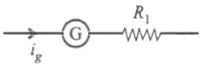
A galvanometer of resistance G is converted into a voltmeter of range $0-1 V$ by connecting a resistance $R_1$ in series with it. The additional resistance $R_1$ in series with it. The additional resistance that should be connected in series with $R _1$ to increase the range of the voltmeter to $0-2 V$ will be:
- A
$R _1- G$
- B
$R_1+G$
- C
- D
$R_1$
View full question & answer→MCQ 144 Marks
In metals the time of relaxation of electrons:
- A
decreases with increasing temperature.
- B
changes suddenly at 400 K .
- C
increases with increasing temperature.
- D
does not depend on temperature.
AnswerA. decreases with increasing temperature.
Explanation:decreases with increasing temperature.
View full question & answer→MCQ 154 Marks
A hollow metal sphere of radius 5 cm is charged such that the potential on its surface is 10 V . The potential at the centre of the sphere is
- A
same as at a point 25 cm away from the surface
- B
same as at a point 5 cm away from the surface
- C
- D
AnswerD. 10 V
Explanation: Electric potential at any point inside a hollow metallic sphere is constant. Therefore, if potential at surface is 10 V , potential at centre will also be 10 V .
View full question & answer→MCQ 164 Marks
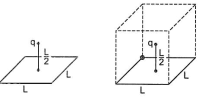
A charge + q is at a distance $\frac{L}{2}$ above a square of side L . Then, what is the flux linked with the surface?
- A
$\frac{2 q}{3 \varepsilon_0}$
- B
$\frac{6 q}{\varepsilon_0}$
- C
$\frac{q}{6 \varepsilon_0}$
- D
$\frac{q}{4 \varepsilon_0}$
View full question & answer→MCQ 174 Marks
The ratio of intensities between two coherent sound sources is $4: 1$. The difference of loudness (in decibels) between maximum and minimum intensities when they interfere in space is:
- A
$10 \log (3)$
- B
$20 \log (3)$
- C
$20 \log (2)$
- D
$10 \log (2)$
AnswerB. $20 \log (3)$
Explanation:
$\begin{array}{l}\frac{I_1}{I_2}=\frac{4}{1} \quad \text { or } \quad \sqrt{\frac{I_1}{I_2}}=\frac{2}{1} \\ \therefore \frac{I_{\max }}{I_{\min }}=\left[\frac{\sqrt{I_1 / I_2}+1}{\sqrt{I_1 / I_2}-1}\right]^2=\left[\frac{2+1}{2-1}\right]^2=9 \\ \therefore L_1- L _2=10 \log \frac{I_{\max }}{I_0}-10 \log \frac{I_{\min }}{I_0} \\ =10 \log \frac{I_{\max }}{I_{\min }}=10 \log (9)=20 \log (3)\end{array}$
View full question & answer→MCQ 184 Marks
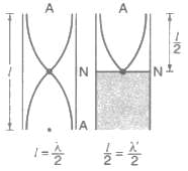
A glass tube is open at both the ends. A tuning fork of frequency $f$ resonates with the air column inside the tube. Now the tube is placed vertically inside water so that half the length of the tube is filled with water. Now the air column inside the tube is in unison with another fork of frequency $f$ '. Then:
- A
$f^{\prime}=4 f$
- B
$f^{\prime}=f / 2$
- C
$f^{\prime}=f$
- D
$f^{\prime}=2 f$
View full question & answer→MCQ 194 Marks
The displacement of a particle executing SHM is given by:
$y=5 \sin \left(4 t+\frac{\pi}{3}\right)$
If T is the time period and the mass of the particle is 2 g , the kinetic energy of the particle when $t=\frac{T}{4}$ is given by:
AnswerD. 0.3 J
Explanation:
The displacement of particle, executing SHM,
$y=5 \sin \left(4 t+\frac{\pi}{3}\right) \ldots(i)$
Velocity of particle,
$\begin{array}{l}
\left(\frac{d y}{d t}\right)=\frac{5 d}{d t} \sin \left(4 t+\frac{\pi}{3}\right)=5 \cos \left(4 t+\frac{\pi}{3}\right) \cdot 4 \\
=20 \cos \left(4 t+\frac{\pi}{3}\right)
\end{array}$
Velocity at $t=\left(\frac{T}{4}\right)$
$\left(\frac{d y}{d t}\right)_{t=\frac{T}{4}}=20 \cos \left(4 \times \frac{T}{4}+\frac{\pi}{3}\right)$
or $u=20 \cos \left(T+\frac{\pi}{3}\right)\ldots(ii)$
Comparing the given equation with standard equation of SHM
$y=a \sin (\omega t+\phi)$
We get; $\omega=4$
As, $\omega=\frac{2 \pi}{T}$ or $T=\frac{2 \pi}{\omega}$
$T=\frac{2 \pi}{4} \text { or } T=\left(\frac{\pi}{2}\right)$
Now, putting value of T in eqn. (ii), we get;
$\begin{array}{l}
u=20 \cos \left(\frac{\pi}{2}+\frac{\pi}{3}\right)=-20 \sin \frac{\pi}{3} \\
=-20 \times \frac{\sqrt{3}}{2}=-10 \times \sqrt{3}
\end{array}$
The kinetic energy of particle,
$KE=\frac{1}{2} m u^2=\frac{1}{2} \times 2 \times 10^{-3} \times(-10 \sqrt{3})^2=0.3 J$
View full question & answer→MCQ 204 Marks
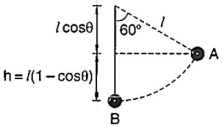
The pendulum bob has a speed of $3 ms^{-1}$ at its lowest position. The pendulum is 0.5 m long. The speed of the bob, when the length makes an angle of $60^{\circ}$ to the vertical, will be $\left( g =10 ms^{-2}\right)$ :
- A
$3 ms^{-1}$
- B
$\frac{1}{2} ms^{-1}$
- C
$2 ms^{-1}$
- D
$\frac{1}{3} ms^{-1}$
View full question & answer→MCQ 214 Marks
At which of the following temperatures would the molecules of a gas have twice the average kinetic energy they have at $27^{\circ} C$ ?
- A
$373^{\circ} C$
- B
$393^{\circ} C$
- C
$313^{\circ} C$
- D
$586^{\circ} C$
AnswerC. $313^{\circ} C$
Explanation:
$313^{\circ} C$
View full question & answer→MCQ 224 Marks
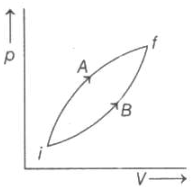
Following figure shows two processes A and B for a gas. If $\Delta Q _{ A }$ and $\Delta Q _{ B }$ are the amount of heat absorbed by the system in two cases, and $\Delta U _{ A }$ and $\Delta U _{ B }$ are changes in internal energies respectively, then
- A
$\Delta Q _{ A }=\Delta Q _{ B } ; \Delta U _{ A }=\Delta U _{ B }$
- B
$\Delta Q _{ A }>\Delta Q _{ B }, \Delta U _{ A }>\Delta U _{ B }$
- C
$\Delta Q _{ A }>\Delta Q _{ B }, \Delta U _{ A }=\Delta U _{ B }$
- D
$\Delta Q _{ A }<\Delta Q _{ B }, \Delta U _{ A }<\Delta U _{ B }$
AnswerC. $\Delta Q _{ A }>\Delta Q _{ B }, \Delta U _{ A }=\Delta U _{ B }$
Explanation: According to the first law of $t$ hermodynamics,
Heat supplied $(\Delta Q)=$ Work done $(W)+$ Change in internal energy of the system $(\Delta U)$
$\Delta Q_{A}=\Delta U_{A}+W_{A}$
Similarly, for process B ,
$\Delta Q_{B}=\Delta U_{B}+W_{B}$
Now, we know that, work done for a process $=$ area under it's $p - V$ curve
Here,
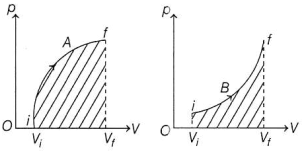
Thus, it is clear from the above graphs,
$W_{A}>W_{B} \ldots(i)$
Also, since the initial and final state are same in both process, so
$\Delta U_{A}=\Delta U_{B} \ldots \text { (ii) }$
So, from Eqs. (i) and (ii), we can conclude that
$\Delta Q_{A}>\Delta Q_{B}$
View full question & answer→MCQ 234 Marks
Heat is given to an ideal gas in an isothermal process.
A. Internal energy of the gas will decrease.
B. Internal energy of the gas will increase.
C. Internal energy of the gas will not change.
D. The gas will do positive work.
E. The gas will do negative work.
Choose the correct answer from the options given below:
AnswerA. C and D only
Explanation: From first law of thermodynamics
$dQ=dU+dW \Rightarrow dU=nC_{V} dT$
$dU =0$ (for isothermal, $dT =0$ )
$\therefore U =$ constant
Hence, internal energy of the gas will not change.
Also dQ $>0$ (Supplied)
Hence, $dW >0$
View full question & answer→MCQ 244 Marks
The temperatures inside and outside of a refrigerator are 273 K and 303 K respectively. Assuming that the refrigerator cycle is reversible, for every joule of work done, the heat delivered to the surroundings will be near:
AnswerB. 10 J
Explanation:
$\begin{array}{l}
\beta=\frac{Q_2}{W}=\frac{T_L}{T_H-T_L} \\
T_{L}=273 K, T_{H}=303 K \text { and } W=1 J \\
\therefore \quad Q_2=\frac{273}{303-273} \times 1=\frac{273}{30} \cong 9 J
\end{array}$
Hence, heat delivered to surroundings,
$Q_1=Q_2+W=9+1=10 J$
View full question & answer→MCQ 254 Marks
The quantities of heat required to raise the temperature of two solid copper spheres of radii $r_1$ and $r_2\left(r_1=1.5 r_2\right)$ through 1 K are in the ratio:
- A
$\frac{9}{4}$
- B
$\frac{27}{8}$
- C
$\frac{5}{3}$
- D
$\frac{3}{2}$
AnswerB. $\frac{27}{8}$
Explanation: Heat suppled $\Delta Q = M _{ S } \Delta T$
For same meterial 's' same
$\begin{array}{l}
\Delta Q \propto M \text { and } M=\frac{4}{3} \pi r^3 \rho \\
\Delta Q \propto r^3 \\
\frac{\Delta Q_1}{\Delta Q_2}=\left(\frac{r_1}{r_2}\right)^3=\left(\frac{1.5}{1}\right)^3=\frac{27}{8}
\end{array}$
View full question & answer→MCQ 264 Marks
Two rods of equal length and area of cross-section are kept parallel and lagged between temperatures $20^{\circ} C$ and $80^{\circ} C$. The ratio of the effective thermal conductivity to that of the first rod is: [the ratio $\left.\left( K _1 / K _2\right)=3: 4\right]$
- A
$7: 4$
- B
$7: 8$
- C
$7: 6$
- D
$4: 7$
AnswerC. $7: 6$
Explanation: For parallel combination of two rods of equal length and equal area of cross-section:
$K=\frac{K_1+K_2}{2}=\frac{K_1+\frac{4 K_1}{3}}{2}=\frac{7 K_1}{6}$
Hence, $\frac{K}{K_1}=\frac{7}{6}$
View full question & answer→MCQ 274 Marks
A copper wire of cross-sectional area $0.01 cm^2$ is under a tension of 22 N . Find the percentage change in the cross-sectional area. (Young's modulus of copper $=1.1 \times$ $10^{11} N / m ^2$ and Poisson ratio $=0.32$ )
- A
$12.8 \times 10^{-3}$
- B
$8.6 \times 10^{-3}$
- C
$6.4 \times 10^{-3}$
- D
$2.8 \times 10^{-3}$
AnswerA. $12.8 \times 10^{-3}$
Explanation:
$\begin{array}{l}
Y=\frac{F}{A} \times \frac{L}{l} \\
\therefore \frac{L}{l} \times \frac{F}{A Y}
\end{array}$
Poisson's ratio,
$\begin{array}{l}
\sigma=\frac{\frac{d r}{r}}{\frac{1}{L}}=\frac{\frac{d r}{r}}{F} \times AY \\
\therefore \frac{dr}{r}=\frac{\sigma F}{AY} \\
=\frac{0.32 \times 22}{0.01 \times 10^{-4} \times 1.1 \times 10^{11}} \\
=64 \times 10^{-6}
\end{array}$
Area of cross section of wire,
$\begin{array}{l}
A=\pi r^2 \\
\therefore \frac{d A}{A}=2 \frac{d r}{r} \\
\therefore \% \frac{d A}{A}=2 \times 64 \times 10^{-6} \times 100=12.8 \times 10^{-3}
\end{array}$
View full question & answer→MCQ 284 Marks
According to Kepler's law, the period of revolution of a planet $( T )$ and its mean distance from the sun $( R )$ are related by the equation:
- A
$T ^3 R ^3=$ constant
- B
$T ^2 R =$ constant
- C
$TR ^3=$ constant
- D
$T ^2 R ^{-3}=$ constant
AnswerD. $T ^2 R ^{-3}=$ constant
Explanation:
According to Kepler, $T ^2 \propto r ^3$
$\begin{array}{l}
\frac{T^2}{r^3}=\text { constant } \\
T^2 R^{-3}=\text { constant }
\end{array}$
View full question & answer→MCQ 294 Marks
Two point masses, each equal to 4 kg , attract one another with a force of $10^{-9} kg$-wt. The distance between the point masses is ( $G =6.6 \times 10^{-11}$ MKS units)
AnswerB. 32.8 cm
Explanation:
$\begin{array}{l}
F=10^{-9} kg wt=10^{-9} \times 9.8 N \\
F=\frac{GM_1 M_2}{R^2} \\
\therefore R^2=\frac{GM_1 M_2}{F}=\frac{6.6 \times 10^{-11} \times 4 \times 4}{10^{-9} \times 9.8}=0.108 m^2 \\
\therefore R \approx 0.328 m=32.8 cm
\end{array}$
View full question & answer→MCQ 304 Marks
The total energy and kinetic energy of an Earth's satellite are respectively:
AnswerC. negative and positive
Explanation: Total energy of Earth's satellite
$\begin{array}{l}
\text { T.E. }=K+U \\
=\left(\frac{G M m}{2 r}\right)+\left(-\frac{G M m}{r}\right) \\
=-\frac{G M m}{2 r}
\end{array}$
Hence, total energy is negative and kinetic energy is positive, i.e., correct answer.
View full question & answer→MCQ 314 Marks
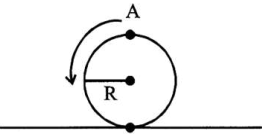
A disc is rolling without slipping on a surface. The radius of the disc is R. At $t=0$, the top most point on the disc is A as shown in figure. When the disc completes half of its rotation, the displacement of point A from its initial position is
- A
$R \sqrt{\left(\pi^2+1\right)}$
- B
$R \sqrt{\left(\pi^2+4\right)}$
- C
$2 R \sqrt{\left(1+4 \pi^2\right)}$
- D
$2 R$
AnswerB. $R \sqrt{\left(\pi^2+4\right)}$
Explanation: From figure,
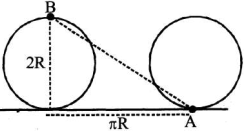
Displacement, $BA ==\sqrt{(2 R )^2+(\pi R )^2}= R \sqrt{4+\pi^2}$ View full question & answer→MCQ 324 Marks
The correct relation between moment of inertia I , radius of gyration K and mass M of the body is:
- A
$K =\sqrt{\frac{M}{I}}$
- B
$K =\sqrt{\frac{I}{M}}$
- C
$K = I ^2 M$
- D
$K = IM ^2$
AnswerB. $K =\sqrt{\frac{I}{M}}$
Explanation: The correct relation between moment of inertia I, radius of gyration $K$ and mass $M$ of the body is
$K=\sqrt{\frac{I}{M}}$
View full question & answer→MCQ 334 Marks
A big particle of mass $(3+ m ) kg$ blasts into 3 pieces, such that a particle of mass 1 kg moves along the x -axis, with velocity $2 m / s$ and a particle of mass 2 kg moves with velocity $1 m / s$ perpendicular to the direction of 1 kg particle. If the third particle moves with velocity $\sqrt{2} m / s$, then m is:
- A
$3 \sqrt{2} kg$
- B
- C
$2 \sqrt{2} kg$
- D
AnswerB. 2 kg
Explanation:
Resultant momentum $=\sqrt{(2)^2+(2)^2}=2 \sqrt{2}$
$\text { Mass }=\frac{\text { Momentum }}{\text { Velocity }}=\frac{2 \sqrt{2}}{\sqrt{2}}=2 kg$
View full question & answer→MCQ 344 Marks
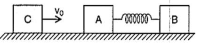
A block C of mass m is moving with velocity $v _0$ and collides elastically with block A of mass $m$ and connected to another block $B$ of mass $2 m$ through a spring of spring constant $k$. What is $k$ if $x_0$ is the compression of spring when velocity of $A$ and $B$ is same?
- A
$\frac{3}{2} \frac{m v_0^2}{x_0^2}$
- B
$\frac{m v_0^2}{2 x_0^2}$
- C
$\frac{2}{3} \frac{m v_0^2}{x_0^2}$
- D
$\frac{m v_0^2}{x_0^2}$
AnswerC. $\frac{2}{3} \frac{m v_0^2}{x_0^2}$
Explanation:
$\frac{2}{3} \frac{m v_0^2}{x_0^2}$
View full question & answer→MCQ 354 Marks
A particle moving along the circular path with a speed $v$ and its speed increases by $g$ in one second. If the radius of the circular path be $r$, then the net acceleration of the particle is:
AnswerA. $\left[\frac{v^4}{r^2}+g^2\right]^{\frac{1}{2}}$
Explanation: Centripetal acceleration $=\frac{v^2}{r}$. It is perpendicular to the rate of increase in speed, i.e., acceleration, which is equal to $g$ according to the question. It is tangential to the circular path.
Hence, the net acceleration of the particle $=\left[\left(\frac{v^2}{r}\right)^2+g^2\right]^{\frac{1}{2}}$.
View full question & answer→MCQ 364 Marks
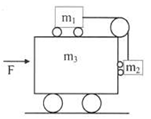
A frictionless cart carries two other frictionless carts as shown in the figure. Connected by a string over a pulley. The horizontal force F that must be applied so that $m _1$ and $m _2$ do not move relative to $m _3$ is:
- A
$\left( m _1+ m _2+ m _3\right) \frac{m_2 g}{m_1}$
- B
$\left( m _1+ m _2\right) \frac{m_2 g}{m_1}$
- C
$\left( m _1+ m _3\right) \frac{m_1 g}{m_2}$
- D
$\left( m _2+ m _3\right) \frac{m_1 g}{m_2}$
AnswerA. $\left( m _1+ m _2+ m _3\right) \frac{m_2 g}{m_1}$
Explanation:
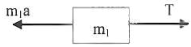
$\begin{array}{l} a =\frac{F}{m_1+m_2+m_3} \\ T= m _1 a ; T = m _2 g \\ \therefore m _1 a = m _2 a \text { or } a =\frac{m_2}{m_1} g \\ \therefore F =\frac{m_2}{m_1} g\left( m _1+ m _2+ m _3\right) \\ \therefore F =\left( m _1+ m _2+ m _3\right) \frac{m_2 g}{m_1}\end{array}$ View full question & answer→MCQ 374 Marks
Two blocks of masses 6 kg and 4 kg connected by a rope of mass 2 kg are resting on a frictionless floor as shown in the following figure.
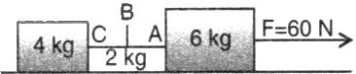
If a constant force of 60 N is applied to 6 kg block, tension in the rope at points $A , B$ and C are respectively given by: - A
$30 N, 25 N, 20 N$
- B
$60 N, 60 N, 60 N$
- C
$20 N, 25 N, 30 N$
- D
$20 N, 20 N, 20 N$
AnswerA. $30 N, 25 N, 20 N$
Explanation: At point A, because tension is pulling the rope and block of mass 4 kg , hence $T _{ A }=(2+4) \times$$5=30 N$
Similarly, at points B and C
$T_{B}=(1+4) \times 5=25 N$
and $T _{ C }=(0+4) \times 5=20 N$
View full question & answer→MCQ 384 Marks
The point from where a ball is projected is taken as the origin of the co-ordinate axes. The $x$ and $y$ components of its displacement are given by $x=6 t$ and $y=8 t-5 t^2$. What is the velocity of projection?
- A
$6 ms^{-1}$
- B
$10 ms^{-1}$
- C
$14 ms^{-1}$
- D
$8 ms^{-1}$
AnswerB. $10 ms^{-1}$
Explanation:
$\begin{array}{l}
v_x=\frac{d x}{d t}=6 \text { and } v_y=\frac{d y}{d t}=8-10 t=8-10 \times 0=8 \\
\therefore v=\sqrt{v_x^2+v_y^2}=\sqrt{6^2+8^2}=10 ms^{-1}
\end{array}$
View full question & answer→MCQ 394 Marks
A body is whirled in a horizontal circle of radius 20 cm . It has an angular velocity of $10 rad / s$. What is its linear velocity at any point on the circular path?
- A
$20 ms^{-1}$
- B
$\sqrt{2} ms^{-1}$
- C
$10 ms^{-1}$
- D
$2 ms^{-1}$
AnswerD. $2 ms^{-1}$
Explanation:
Radius of circle $r =20 cm=0.2 m$ and angular velocity $(\omega)=10 rad / s$
linear velocity $( v )= r \omega=0.2 \times 10=2 m / s$
View full question & answer→MCQ 404 Marks
Which of the following changes, when a particle is moving with uniform velocity?
AnswerC. position vector
Explanation:
position vector
View full question & answer→MCQ 414 Marks
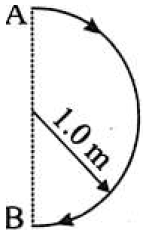
In 1.0 s , a particle goes from point A to B , moving in a semi-circle of radius 1.0 m (as shown in the figure). The magnitude of the average velocity of the particle is:
- A
- B
$2.0 m / s$
- C
$1.0 m / s$
- D
$3.14 m / s$
AnswerB. $2.0 m / s$
Explanation:
$\begin{array}{l}\mid \text { Avera } \geq \text { velocity } \left\lvert\,=\frac{\mid \text { displacement } \mid}{\text { time }}\right. \\
=\frac{2 r}{t}=2 \times \frac{1}{1}=2 m / s
\end{array}$
View full question & answer→MCQ 424 Marks
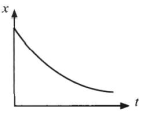
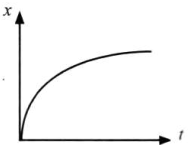
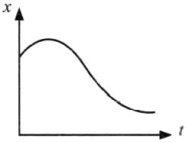
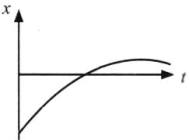
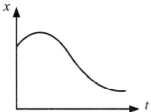
Among the four graphs, there is only one graph for which average velocity over the time interval $(0, T)$ can vanish for a suitably chosen T. Which one is it?
AnswerC.
 Explanation:
 In the graph, for one value of displacement, there are two timings. As a result of it, for one time, the average velocity is positive and for another time is equal but negative. Due to it, the average velocity for timings (equal to time-period) can vanish.
View full question & answer→MCQ 434 Marks
In the relation:
$y=a \cos (\omega t+K x)$, the dimensional formula for $K x$ is the same as that of:
- A
$\frac{y a}{\omega t}$
- B
$\frac{a}{\omega}$
- C
$\frac{w t}{a}$
- D
$\frac{a}{y}$
AnswerD. $\frac{a}{y}$
Explanation:Here, $[ a ]=[ y ]$. So, $\frac{a}{y}$ is dimensionless. Same is the case with Kx .
View full question & answer→MCQ 444 Marks
In the relation:
$y=a \sin (\omega t-K x)$,
the dimensional formula for K is:
- A
$\left[ M ^0 L^{-1} T^{-1}\right]$
- B
$\left[ M ^0 LT \right]$
- C
$\left[ M ^0 L^{-1} T^0\right]$
- D
$\left[ M ^0 LT ^{-1}\right]$
AnswerC.$\left[ M ^0 L^{-1} T^0\right]$
Explanation:Here, Kx is dimensionless. Hence,
$[K]=\left[\frac{1}{x}\right]=\left[M^0 L^{-1} T^0\right]$
View full question & answer→MCQ 454 Marks
The SI unit of gravitational potential is:
- A
- B
$J - kg ^{-2}$
- C
$J - kg ^{-1}$
- D
$J - kg$
AnswerC.$J - kg ^{-1}$
Explanation:The gravitational potential at a point is always negative, V is maximum at infinity. The SI unit of gravitational potential is $J / K g$.
View full question & answer→