Which of the following correctly represents the variation of electric potential $(V)$ of a charged spherical conductor of radius $(R)$ with radial distance $(r)$ from the centre?
- A
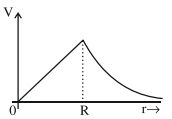
- B
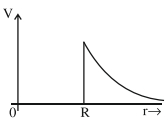
- C
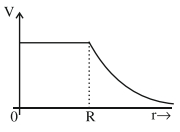
- D
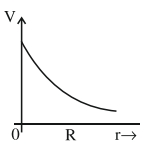
JEE MAIN 2023, Medium


Download our appand get started for free
Experience the future of education. Simply download our apps or reach out to us for more information. Let's shape the future of learning together!No signup needed.*
Similar Questions
- 1View SolutionAssertion : In a cavity within a conductor, the electric field is zero.
Reason : Charges in a conductor reside only at its surface
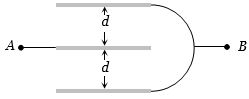
- 2Three plates of common surface area $A$ are connected as shown. The effective capacitance will beView Solution
- 3A uniform electric field having a magnitude ${E_0}$ and direction along the positive $X - $ axis exists. If the potential $V$ is zero at $x = 0$, then its value at $X = + x$ will beView Solution
- 4The work done in carrying a charge of $5\,\mu \,C$ from a point $A$ to a point $B$ in an electric field is $10\,mJ$. The potential difference $({V_B} - {V_A})$ is thenView Solution
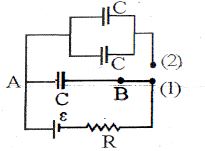
- 5If capacitor connected across $AB$ is charged to $Q$ and then switch is shifted to $2$ . The heat released after thatView Solution
- 6View SolutionIn a charged capacitor, the energy resides
- 7Two identical particles of mass m carry a charge $Q$ each. Initially one is at rest on a smooth horizontal plane and the other is projected along the plane directly towards first particle from a large distance with speed $v.$ The closest distance of approach beView Solution
- 8Two parallel plates have equal and opposite charge. When the space between them is evacuated, the electric field between the plates is $2 \times {10^5}\,V/m$. When the space is filled with dielectric, the electric field becomes $1 \times {10^5}\,V/m$. The dielectric constant of the dielectric materialView Solution
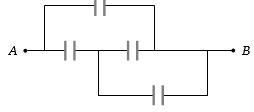
- 9In the circuit shown in figure, each capacitor has a capacity of $3\,\mu F$. The equivalent capacity between $A$ and $B$ is.......$\mu F$View Solution
- 10Assume that an electric field $\overrightarrow E = 30{x^2}\hat i$ exists in space. Then the potential difference $V_A -V_O$, where $V_O$ is the potential at the origin and $V_A$ the potential at $x = 2\, m$ isView Solution