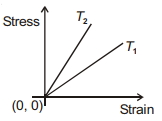
Figure shows graph between stress and strain for a uniform wire at two different femperatures. Then
A$T_2 > T_1$
B$T_1 > T_2$
C$T_1 = T_2$
D
None of these
Medium
Download our app for free and get started
B$T_1 > T_2$
b (a)
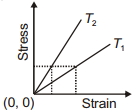
From the graph we can see young's modulus is less for $T_1$ as compared to $T_2$ ( $Y=$ slope of stress-strain curve)
As $T$ increases $Y$ decreases
So $T_1 > T_2$
Download our app
and get started for free
Experience the future of education. Simply download our apps or reach out to us for more information. Let's shape the future of learning together!No signup needed.*
The ratio of Young's modulus of the material of two wires is $2 : 3.$ If the same stress is applied on both, then the ratio of elastic energy per unit volume will be
A thin $1 \,m$ long rod has a radius of $5\, mm$. A force of $50\,\pi kN$ is applied at one end to determine its Young's modulus. Assume that the force is exactly known. If the least count in the measurement of all lengths is $0.01\, mm$, which of the following statements is false ?
Two similar wires under the same load yield elongation of $0.1$ $mm$ and $0.05$ $mm$ respectively. If the area of cross- section of the first wire is $4m{m^2},$ then the area of cross section of the second wire is..... $mm^2$
A wire of cross-sectional area $3\,m{m^2}$ is first stretched between two fixed points at a temperature of $20°C$. Determine the tension when the temperature falls to $10°C$. Coefficient of linear expansion $\alpha = {10^{ - 5}} { ^\circ}{C^{ - 1}}$ and $Y = 2 \times {10^{11}}\,N/{m^2}$ ........ $N$
The stress-strain curves are drawn for two different materials $X$ and $Y$. It is observed that the ultimate strength point and the fracture point are close to each other for material $X$ but are far apart for material $Y$. We can say that materials $X$ and $Y$ are likely to be (respectively)